
by Hotel Development Guide – Darren Blanchard
Last Updated: November 2026
Robotics in hotels can extend amenity delivery to quieter shifts, move supplies between departments and keep large public areas ready for use. A delivery robot can take towels to a guestroom while the night receptionist stays at the desk. A restaurant robot can carry dishes from the kitchen to a service station, giving servers more time at the tables. A floor-cleaning robot can prepare a conference foyer overnight while the housekeeping team attends to other areas.
For a hotel developer, these uses affect the layout of the building as well as the organisation of the operation. The position of stores and floor pantries determines where supplies are loaded and received, while the location and configuration of the lifts determine which parts of the building a robot can serve. Equipment also needs space to wait, charge and be serviced. These requirements are easier to accommodate when the design team understands what the robots are expected to achieve.
Robotics in Hotels
What Is a Hotel Robot and What Can It Do?
A hotel robot is a programmable machine that uses sensors and controlled movement to perform a physical task in the hotel. It may move through the building, operate a cleaning mechanism or use an arm to handle an object. The degree of autonomy varies, and many hotel robots still depend on staff to load them, set priorities or handle exceptions. A machine can qualify as a robot even if it stays in one place, as in the case of a robotic arm used to store and retrieve luggage.
Communication devices and software can support a robotic service by receiving a request, sending instructions or contacting the guest. A chatbot can take an order for towels, a staff application can dispatch the robot, and a telephone can notify the guest when the towels arrive. The robot performs the physical delivery. A lift or controlled door may enable the journey, and those building systems remain part of the infrastructure that supports the service.
| Hotel function | What a robot can physically do | Supporting technology and staff responsibilities |
|---|---|---|
| Guestroom delivery | Carry amenities, towels, snacks or other suitable items to the guest’s door. | A request system can dispatch the task and notify the guest. Staff prepare the order and handle exceptions. |
| Food and beverage service | Move dishes to a service station, return trays or carry selected in-room dining orders. | A point-of-sale or dispatch system may initiate the task. Staff prepare, present and serve the food as required. |
| Internal logistics | Move linen, packaged supplies or equipment between stores, pantries and departments. | A scheduling system can assign trips. Staff load, unload and check the goods. |
| Housekeeping | Vacuum carpeted routes or scrub suitable hard floors. | Cleaning software can schedule and record runs. Staff prepare the area, inspect the result and complete detailed work. |
| Concierge and wayfinding | Move with a guest to guide them to a destination or use physical gestures to assist with wayfinding. | A screen, voice assistant or chatbot can provide directions and answer questions. Staff handle requests requiring judgement. |
| Luggage handling | Use a mobile platform or robotic arm to move, store or retrieve bags. | A kiosk or baggage system can issue a receipt and trigger retrieval. Staff assist with oversized, fragile or unclaimed items. |
| Security patrol | Travel along designated routes and carry cameras or other sensors through the areas it patrols. | A monitoring system receives footage or alerts. Security staff review events and respond. |
A Brief History of Robotics in Hotels
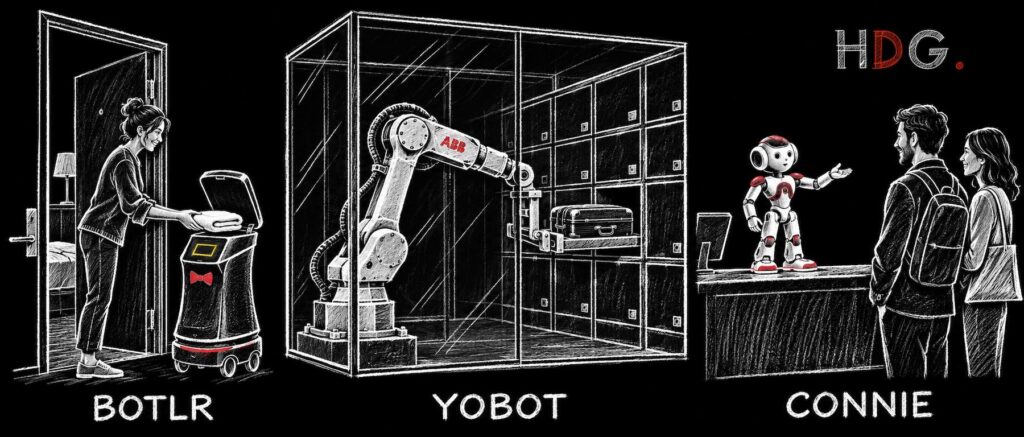
Some of the earliest hotel robots were designed around a single physical task. At YOTEL New York in 2011, a fixed robotic arm stored and retrieved guests’ luggage. At Aloft Cupertino in 2014, a mobile robot carried amenities from a dispatch point to guestrooms. These projects illustrate two different approaches that still shape hotel robotics today: bringing items to a machine in a dedicated space, or sending a machine through the building to where it is needed.
Hotel automation provided some of the infrastructure for these developments. From the 1960s to the 2000s, computerised reservations, property management systems, electronic locks and self-service kiosks changed how hotels processed bookings, registered guests and controlled access. These systems handled information and transactions, while robots could take on physical work such as moving baggage or delivering an order. As the technologies came together, hotels could connect a robot’s movements to an existing service request, a lift call or a guest notification.
| Period | Hotel robotics milestone | What it brought to hotel operations |
|---|---|---|
| 2011 | YOTEL New York introduced Yobot, an articulated robotic arm in the lobby. | The arm moved luggage into storage and retrieved it when requested, showing how an industrial robot could be adapted to a guest service. |
| 2014 | Aloft Cupertino introduced Botlr, a mobile delivery robot. | The machine carried amenities along hotel corridors and used the lift to reach guestrooms. |
| 2015 | Crowne Plaza San Jose–Silicon Valley trialled Dash. | The trial brought robotic delivery to another major hotel brand, with a focus on routine requests for snacks, toiletries and other amenities. |
| 2015 | Henn na Hotel opened in Japan with robots in several guest-facing roles. | The hotel explored how robotics could form part of the guest experience across several points in the stay, including reception. |
| 2016 | Hilton and IBM piloted Connie, a robot concierge. | The pilot explored how a robot at the front desk could answer common questions about the hotel and nearby attractions. |
| By 2019 | Alibaba’s FlyZoo Hotel in Hangzhou used mobile delivery robots and a robotic bartender. | The property brought together two forms of robotics in one hotel: mobile machines that transported items and a fixed arm that prepared drinks. |
| 2020s | Hotels deployed specialist cleaning machines and connected service fleets. | Applications expanded to scheduled floor care and coordinated deliveries. In 2026, an 11-robot fleet at the Novotel and Mercure complex in Singapore was reported to use the hotels’ lifts and internal telephone system. |
How Hotel Automation Made Connected Robotics Possible
Earlier hotel automation has made it possible for one system to act on information held by another. A room assignment could be used to issue a key, while a guest request could be recorded, sent to the appropriate department and tracked until it was completed. Robotics extends that process to the physical work involved in fulfilling a request. For example, when a guest asks for extra towels, the request system records the room number, an employee loads the towels, the robot transports them, and the hotel’s communications system tells the guest when they arrive.
For developers, this has changed what it meant to provide for robotics in a new hotel. A clear corridor and a suitable lift make the journey physically possible, but the lift must also be able to accept a call from the robot, and the hotel needs a way to confirm whether the delivery succeeded. Those functions can sit in separate packages specified by the lift contractor, the technology team and the operator. The design brief therefore needs to describe the whole service, including how staff are alerted when a delivery cannot be completed, so each supplier understands the part its equipment has to perform.
Types of Robots Used in Hotels
Hotel service robots can be grouped by the work they perform. Guestroom delivery, food and beverage service, internal transport, housekeeping and concierge support are five useful categories for a development brief. Some machines can serve more than one department, particularly where the loads and routes are similar. Others need specialist equipment, such as a scrubber for hard floors or a secured compartment for unaccompanied guest deliveries.
The categories also help distinguish the service the guest receives from the way the hotel fulfils it. A guest may request the same bottle of water whether it is carried by a member of staff or delivered by a robot. The physical requirements change when the hotel chooses robotic delivery, because the machine needs a suitable loading point, a clear route and a way to confirm collection. That distinction matters when the operator and design team decide which functions to provide from opening.
Guestroom Delivery Robots
Guestroom delivery robots carry towels, toiletries, bottled water and other small orders from a staffed loading point to a guest’s door. An employee prepares the order and puts it into the compartment, then assigns the destination. The machine follows a mapped route, calls a compatible lift where required and triggers a notification on arrival. Depending on the model and the service, the guest can open the compartment directly or use a code to release the order.
The clearest opportunity is in hotels where repeated journeys take staff away from a fixed service point. In a high-rise select-service hotel, a trip to an upper floor can leave reception unattended just as another guest arrives. A delivery robot can keep the amenity service available overnight and help cover overlapping requests during busy periods. The hotel should make human assistance easy to request, particularly for guests who cannot reach the compartment or need an item brought into the room.
Food and Beverage Service Robots
Food and beverage robots can carry dishes between a kitchen and a service station, return used trays from a buffet or support selected in-room dining deliveries. Their role is particularly relevant in a large restaurant where the kitchen is some distance from the dining area. Transferring some of those journeys to a machine gives servers more time to take orders, explain dishes and attend to tables. The restaurant still needs a suitable handover point and a route that works when the room is busy.
In-room dining brings additional requirements because temperature, presentation and timing affect the guest’s experience. A packaged snack or breakfast order may suit a secured robot compartment, while a meal served on a tray may need an employee to set it up and explain the order. The developer should consider the distance from the production kitchen, the location of the dispatch point and whether guestroom deliveries use the same lift as other service movements. In a banqueting hotel, the same principles apply to repeated trips between kitchens, staging areas and function rooms.
Internal Transport Robots
Internal transport robots carry linen, packaged supplies and equipment between hotel departments. Their value can be considerable in a large property where receiving, stores, laundry, guest floors and event spaces are spread across several levels or wings. A machine might replenish floor pantries before room attendants start or deliver standard supplies to function rooms before an event. These routine movements can often be scheduled around the hotel’s daily operating programme.
The payload and the handover are as important as the journey itself. A small cargo robot may suit frequent movements of light goods, while the laundry may still rely on larger trolleys for bulk linen. A department receiving supplies also needs someone available to unload the machine, or a designated point where the load can be left securely. The architect can support these movements by planning suitable space at stores and pantries and by avoiding routes that send service traffic through busy guest areas.
Housekeeping Robots
Autonomous vacuums and scrubber-dryers are suited to defined areas such as guest corridors, lobbies, conference foyers and other public spaces. They can carry out routine floor care during quieter hours, helping housekeeping prepare an area for opening or an event. At InterContinental Wien, the manufacturer reported that different robots were used for guest floors, public areas and a mezzanine. The application illustrates how machine selection can follow the floor finish, dimensions and cleaning needs of each area.
A housekeeping robot performs part of a wider cleaning operation. Staff still move or work around furniture, inspect the result and deal with spills, edges or areas the machine cannot reach. Guestroom housekeeping involves a broader set of tasks, including making beds, cleaning bathrooms, replenishing amenities and identifying defects. The most immediate contribution of robotics is therefore in repeatable floor care and the transport of housekeeping supplies.
Concierge and Wayfinding Robots
A concierge robot can have a physical role when it moves with guests through the hotel, for example by guiding them from the lobby to a meeting area. It can also serve as a recognisable point of assistance in a large arrival space. These applications are easiest to define where destinations are fixed and the routes are suitable for both the machine and the guest. The team should decide how the robot will hand the guest over when a route involves controlled access or an area it cannot enter.
A screen or voice assistant can provide directions and answer routine questions without performing any physical action. Mobile check-in, digital keys and guest messaging similarly belong to hotel software and access systems, although they may operate alongside a robot. A hotel can draw the boundary by asking whether physical movement or handling is part of the service being provided. At reception, guests should also have a straightforward way to reach an employee for a complex enquiry, a service problem or personal assistance.
Security and Patrol Robots
Security patrol robots can travel along designated routes through hotel grounds, parking areas or selected parts of the building. Depending on the model, they can carry cameras and other sensors, transmit footage and alert staff to events that need review. Their physical mobility allows them to collect information from different locations during a patrol, which distinguishes them from fixed CCTV cameras and other stationary monitoring equipment. The hotel’s security team remains responsible for assessing alerts and responding to incidents.
This application is particularly relevant to resorts and large hotel developments with extensive grounds, detached buildings or several parking areas. The design team should consider which surfaces and routes the robot can cover, where it can recharge and how its video and alerts reach the security control room. The operator should also set boundaries for where it can patrol and how footage is handled, especially in guest areas. A hotel may assign patrols to a dedicated security robot or, as M Hotel Singapore reported, add a patrol function to an existing delivery robot.
How Hotel Delivery Robots Work
A hotel delivery robot combines a mobile platform with equipment for carrying a load and communicating with the hotel. To complete a delivery, it has to determine its position, reach the correct destination and make the item available to the intended recipient. It also needs to report what happened, including a delay, an uncollected order or a journey that could not be completed. These requirements explain why two machines of similar size can offer quite different levels of service.
Consider a request for towels on the seventh floor. The guest’s message creates a task, and a staff member loads the towels and confirms the destination. The robot travels from its loading point to the lift, goes to the guest floor and sends a notification when it reaches the door. If the guest does not collect the order, the service can alert staff and direct the machine to wait or return, according to the operating procedure.
Navigation and Physical Handling
A mobile robot uses a digital map and sensors to determine where it is and find a usable path. Some models use laser scanning, known as LiDAR (Light Detection and Ranging), while others rely on cameras or a combination of sensors. Simultaneous localisation and mapping, commonly called SLAM, allows a machine to build or update a map while keeping track of its position. In a hotel, the practical result is that a robot can follow a planned route and respond when luggage, guests or housekeeping trolleys occupy part of it.
Handling mechanisms vary according to what the robot carries or manipulates. Open trays can be suitable for staff-to-staff movements, while an enclosed compartment can protect a delivery travelling through public areas. Automatic doors, tray detection or load restraints can support handling and collection, depending on the equipment. Machines with arms add the ability to pick up or reposition objects, although most routine hotel deliveries can be performed with a compartment and a staff member at the loading point.
Communication Interfaces and Security Features
A robot’s communication interfaces allow it to receive tasks, report its status and request access to parts of the building. A staff application may assign deliveries and display their progress, while a lift interface allows the robot to call the lift and select an approved floor. On arrival, the system can notify the guest by telephone or messaging. The hotel’s property management system may supply room information where required, although a task platform can often manage the workflow using only the destination and the details needed to complete it.
Security covers access to the cargo, the controls and the information involved. A compartment may stay locked until the intended recipient is ready to collect the order, and a record of the handover can help staff resolve a missing delivery. The operator should also determine who can dispatch the robot, change its routes and view its logs. If cameras are used, the hotel should understand whether images are retained and what access the supplier has when providing remote support.
Advantages and Limitations of Hotel Robotics
Service Capacity, Consistency and Staff Availability
Robotics allows a hotel to carry out several routine activities at the same time. A receptionist in a limited service hotel can continue checking in guests while a robot delivers amenities, and a housekeeper can prepare meeting areas while an autonomous scrubber cleans a foyer. Employees can remain where they are most useful during periods of overlapping demand. This can be especially valuable in a hotel with long service routes, several guestroom towers or a busy programme of events.
A second benefit is consistency across the operating day. A robot can follow a scheduled route at a time when the area is quieter, and a dispatch system can give staff visibility over requests still awaiting completion. Overnight delivery can become more practical where a team has limited capacity to leave reception. In public-area cleaning, a dependable finish before opening can be an operational benefit in its own right.
Operating Constraints and Guest Expectations
A robot’s performance depends on conditions along the route and on the work required at either end. A busy lift can delay deliveries, a blocked corridor can interrupt a cleaning run, and a misplaced order still requires someone to put it right. Staff time is needed for loading, charging, cleaning, maintaining and occasionally recovering the equipment. The business case should reflect the work the robot takes over and the work the operation will continue to perform around it.
Guest expectations also shape where robotics adds value. A discreet delivery may suit someone who wants extra towels late at night, while an in-room dining guest may expect presentation and personal attention. A guest with limited mobility may need help reaching the compartment or taking an item into the room. The service design should give staff enough visibility to intervene promptly and give guests a clear way to ask for help.
Current Developments in Hotel Robotics
Connected Fleets
The ability to coordinate several robots across one property extends the range of services a hotel can automate. Fleet software can distribute jobs, show which machines are available and direct units to charge when needed. This can support deliveries in one part of the building and scheduled transport in another without every department having to manage equipment independently. It also gives supervisors a common view of delayed tasks and machines requiring attention.
In October 2026, 11 autonomous service robots were reported deployed at Novotel Singapore on Stevens and Mercure Singapore on Stevens under a commercial agreement. The two hotels share a multi-tower complex, and the fleet was connected to the lift system for travel between floors and to internal telephones for guest notifications. The project demonstrates how robotics can operate across a larger hotel development when vertical circulation and communications support the service. It also illustrates the importance of coordinating equipment and interfaces supplied by different contractors.
Humanoid Robots and Mobile Robots with Arms
Mobile robots fitted with arms are being developed to pick up, reposition and handle objects as well as move around the building. Humanoid designs extend that idea by trying to operate in spaces and use equipment made for people. Potential applications in hotels include handling selected items during a banquet setup or carrying out parts of a housekeeping task. These are harder assignments than point-to-point transport because the machine must respond to variations in objects, layouts and how people use the space.
The Singapore partnership described humanoid development as a separate research phase informed by housekeeping and banquet workflows. Its commercial service fleet and its research programme therefore illustrate two different stages of hotel robotics. Developers can use established delivery and cleaning applications to guide infrastructure decisions today. A more adaptable building can also accommodate future equipment as manufacturers demonstrate that it can perform a wider range of work in live hotel conditions.
Designing Robotics into a Hotel Development
Space Planning and Building Services
The concept design should describe the service the hotel intends to provide and where that service begins and ends. A new hotel planning guestroom deliveries can position a loading point near a suitable lift and provide room for the machine to wait without blocking staff or guests. A property that expects to use robots for linen transport should consider the relationship between the laundry, stores, guestroom towers and floor pantries. Drawing these movements on the plans clarifies whether the service can work across the entire building or is better suited to particular zones.
The design brief should also cover turning space, thresholds, floor finishes, connectivity, power and places to charge and service the equipment. A housekeeping machine needs a convenient place to be emptied, cleaned and replenished, while a delivery robot needs a secure place to wait between jobs. Lift controls and controlled doors should accommodate the intended route and respect the building’s access and emergency arrangements. Providing these interfaces during construction can give the operator more flexibility over when and how it introduces the equipment.
Procurement and Pre-opening
The developer and operator should agree which elements belong to the building contract and which form part of the robotics package. The lift contractor may provide an interface, the IT team may establish network access, and the operator may supply the platform that receives guest requests. Responsibility for maintenance should follow those interfaces after opening, especially when a robot fault can originate elsewhere in the building. Clear scope boundaries are particularly important in a branded hotel, where several systems may have to meet operator requirements.
Pre-opening is when the team confirms that the pieces work together as a hotel service. A test delivery should cover the guest request, loading, lift journey, arrival notification and collection, including what happens when a door is unavailable or a guest needs assistance. Staff should know who takes over the request and how to return the machine to service. This makes the technology part of the operating procedures from the first day the hotel uses it.
Existing Hotels and Conversions
An existing hotel can introduce many of the same applications, with the layout and infrastructure determining their reach. A single-floor cleaning robot may require relatively little alteration, while a multi-floor delivery service may depend on adapting lift controls or improving connectivity. Internal transport can also be introduced on a suitable back-of-house route even where guest-floor access is constrained. These applications allow a hotel to gain part of the operational benefit without undertaking a building-wide retrofit.
A refurbishment or conversion provides more scope to improve the underlying infrastructure. A lift replacement can allow for a future robot interface, while a network upgrade can extend coverage along service routes and into lift lobbies. A reorganisation of stores and pantries can create loading and charging space at the same time. Combining these elements with planned works can expand the range of robotics applications the property can support over its remaining operating life.
Investment and the Operating Model
Robots can be purchased outright or supplied through a recurring service agreement, often called robotics as a service. An outright purchase usually places the equipment and installation in the development budget, with ongoing support and eventual replacement in the operating or capital plan. A service agreement may include software, maintenance and replacement equipment, depending on the contract. In both cases, the owner and operator should understand who pays for lift and building interfaces, local technical support, subscriptions and the work involved in keeping the service available.
The return can take different forms according to the hotel’s service model. A select-service hotel may gain through better availability at reception, a convention hotel through reliable overnight floor care, and a luxury resort through fewer staff journeys behind the scenes. Some of those improvements can reduce overtime or contracted work, while others increase capacity or consistency within the existing staffing model. For a development project, the opportunity is to provide the space and infrastructure for those gains early, so the operator can introduce the right equipment as the hotel’s needs and the technology evolve.
Further Resources:
See HDG – IoT in Hospitality: How Connected Technology Is Transforming Hotels
See HDG – Hotel Distribution Platforms: Controlling Guest Demand
See HDG – AI-Mediated Hotel Discovery
See HDG – Opaque Hotel Booking
See HDG – The Hotelisation of Real Estate
See HDG – Co-Working Spaces and Hotels: A Converging Hospitality Model
YYForce (October 2026) – “YYForce Brings Humanoid Robots to Hospitality in Landmark Partnership with Novotel & Mercure Singapore on Stevens“
HospitalityNet.org (August 2014) – “Aloft Hotels Recruits Robot to Join Team in Cupertino“