
Hotel construction costs are among the most critical determinants of feasibility, investment returns, and ultimately residual land value in hotel development. Unlike other commercial real estate asset classes, hotel build costs are not driven by a single dominant factor, but by a layered interaction between site conditions, regulatory frameworks, structural systems, MEP complexity, and interior fit-out requirements. As a result, early-stage cost assumptions that rely on simple €/m² benchmarks are frequently misleading.
From a development perspective, hotel costs must be assessed through multiple lenses simultaneously: cost per key, cost per m², and capital intensity relative to positioning and revenue potential. A luxury hotel and a select-service hotel may sit on the same site, yet differ materially in cost structure due to public space requirements, back-of-house ratios, and brand-driven specifications. This complexity is further amplified in emerging markets, where seismic design, import dependencies, and financing conditions can significantly distort cost assumptions.
- Hotel Construction Cost Framework in Development Planning
- Site & Location Factors Affecting Hotel Construction Costs
- Planning, Zoning & Regulatory Cost Drivers
- Site Conditions and Substructure Complexity
- Structural System and Building Envelope
- Mechanical, Electrical and Plumbing (MEP) Systems
- Internal Construction and Fit-Out
- External Works and Infrastructure
- FF&E (Furniture, Fixtures and Equipment)
- Soft Costs and Professional Fees
- Contingency and Risk Allowances
- Brand Standards and Operator Requirements
- Building Efficiency and Net-to-Gross Ratio
- FF&E Benchmarks and Cost per Key
- Construction Methodology, Programme and Market Conditions
- Professional Fees and Project Cost Structure
- Industry Benchmarks and External Resources on Hotel Development Costs
- Interpreting Hotel Construction Cost in the Development Context
- Land Cost and Residual Land Value in Hotel Development
- How Investors Assess Hotel Construction Costs and Feasibility
This guide provides a structured breakdown of hotel construction cost drivers, allowing developers, investors, and advisors to evaluate cost risk at feasibility stage, before detailed design or contractor pricing is available.
Hotel Construction Cost Framework in Development Planning
At the feasibility stage, hotel construction cost is not a single number but a composite of interacting cost layers, each influenced by different stakeholders, planners, engineers, operators, and contractors. Understanding how these layers interact is more important than attempting to benchmark costs in isolation.
From an investor perspective, the relevance of construction cost lies not in absolute value, but in its relationship to yield on cost and exit valuation. A technically efficient building that is misaligned with its market positioning can destroy value just as quickly as an over-engineered luxury product in a midscale market. Cost must therefore always be evaluated in context.
Understanding Hotel Construction Cost Metrics
Hotel construction costs are often presented using a range of different metrics, which can create confusion when comparing projects, benchmarks, or feasibility studies. This is not due to inconsistency, but rather because different stakeholders, developers, quantity surveyors, contractors, lenders, and operators each analyse costs from their own perspective, using definitions relevant to their role in the development process.
For example, a contractor will typically focus on hard construction costs, expressed in €/m² or as the total contract value, while a designer or cost consultant may separate construction from professional fees and contingency. Investors, by contrast, assess the total project cost relative to yield, financing, and exit value, often incorporating or excluding land depending on the analysis. At the same time, industry publications and benchmarks frequently isolate specific components such as FF&E or MEP systems, meaning that percentages are often quoted against different cost bases.
As a result, hotel development costs cannot be understood with a single metric. Instead, they must be interpreted through a structured framework of cost layers, each reflecting a different aspect of the development process and carrying distinct implications for feasibility and risk.
Hotel Development Cost Layers
| Cost Layer | Definition | Includes | Excludes | Typical Use |
|---|---|---|---|---|
| Hard Construction Cost | Direct physical construction cost of the building | Structure, façade, MEP systems, internal fit-out, contractor preliminaries | Land, professional fees, FF&E (loose), financing | Contractor pricing, cost planning, €/m² benchmarking |
| FF&E (Furniture, Fixtures & Equipment) | Movable and operational equipment required to complete the hotel | Guestroom furniture, lighting, equipment, loose items, OS&E (depending on definition) | Structural works, fixed joinery (sometimes split), core MEP | Brand standards, operator requirements, per-key benchmarking |
| Soft Costs | Non-construction project costs required to deliver the project | Design consultants, engineers, project management, permits, brand technical services | Physical construction, FF&E | Development budgeting, lender review |
| Contingency & Risk Allowances | Financial buffers for design development and construction uncertainty | Design contingency, construction contingency | Base construction cost | Risk management, stage-based budgeting |
| Total Project Cost (TPC) | Full development cost excluding or including land depending on methodology | Hard cost + FF&E + soft costs + contingency | Land (often excluded for yield-on-cost analysis) | Investor underwriting, feasibility studies |
| Total Development Cost (incl. Land) | Full capital exposure of the project | Total Project Cost + land acquisition + financing costs (sometimes) | — | Equity analysis, full capital structuring |
Clarification on Cost Interpretation
Similarly, allowances such as FF&E per key are often presented independently, not because they sit outside the total capital expenditure, but because they are driven by brand standards, operator requirements, and procurement strategies, which are evaluated separately from core construction. This separation allows developers and operators to benchmark specification levels and adjust positioning without distorting the underlying building cost.
Conversely, items such as professional fees and contingencies are generally expressed as a percentage of total project cost, reflecting their relationship to overall project complexity, design development, and risk exposure rather than to any single physical component of the building. These costs scale with the entire development process, not just construction. The use of different cost bases is therefore not arbitrary but reflects how different parts of the project are designed, procured, and managed by different stakeholders. Contractors, consultants, operators, and investors each use the cost metrics most relevant to their decisions.
Understanding which cost base is being used in each case is critical. Misinterpreting these percentages, for example, applying a hard cost ratio to total project cost, is a common source of error in early-stage feasibility analysis and can materially distort investment assumptions. In practice, experienced developers will often rebase all cost components to a common denominator when testing feasibility, while still tracking individual components using their native metrics.
Cost Amplifiers in Hotel Development
Hotel construction costs are not determined solely by the direct components captured within hard construction costs or total project costs. A number of underlying factors act as cost amplifiers, shaping the overall capital requirement without appearing as standalone line items within the cost structure.
These amplifiers are critical at feasibility stage, as they can materially influence project viability while remaining partially obscured within aggregated cost metrics. Understanding their role allows developers and investors to interpret cost benchmarks more accurately and to identify potential risks before detailed design or pricing is undertaken.
Land and Market Context
Land cost sits outside the construction cost structure but remains one of the most important determinants of overall development feasibility. Unlike construction costs, which can be benchmarked and engineered, land values are driven by location, planning potential, and demand for alternative uses and may not align with hotel-supported economics.
For this reason, total project cost is often analysed both excluding and including land, depending on whether the focus is on development efficiency or total capital exposure. In many urban markets, a misalignment between land pricing and achievable hotel performance is a primary reason why projects do not proceed, regardless of how efficient the construction cost structure may be.
Site & Ground Conditions
Site-specific conditions represent one of the most variable and potentially high-impact cost amplifiers. Ground conditions, topography, water table levels, and previous land use can significantly affect foundation design, structural systems, and construction methodology.
In challenging conditions, additional works such as piling, soil stabilisation, waterproofing, or remediation may be required. In seismic regions, structural systems must also comply with local code requirements, which can increase reinforcement and construction complexity. These factors do not appear independently in cost breakdowns but are reflected in the hard construction cost, where they can shift the total build cost by approximately 5–20%, depending on site conditions.
Regulatory & Compliance Requirements
Regulatory and compliance requirements are among the most significant cost amplifiers in hotel development. Fire safety systems, accessibility standards, energy performance regulations, and seismic design requirements all impose additional technical and design obligations on the project.
Rather than existing as a separate cost category, these requirements are embedded across multiple components of the development. Fire safety and life-safety systems are reflected in MEP costs, structural requirements are influenced by seismic codes, and energy regulations affect façade design and building services. At the same time, compliance-related design input and approvals contribute to soft costs through consultants and engineering disciplines. As a result, regulatory frameworks can materially increase total project cost, often by 8–12%, but are not treated as a single line item in feasibility-level cost structures.
Hard Construction Cost Components
Having established the primary cost amplifiers that influence hotel development, the next step is to understand how costs are structured within the building itself. Hard construction cost represents the direct cost of delivering the physical asset and is typically the largest component of total project cost, forming the core of contractor pricing and detailed cost planning.
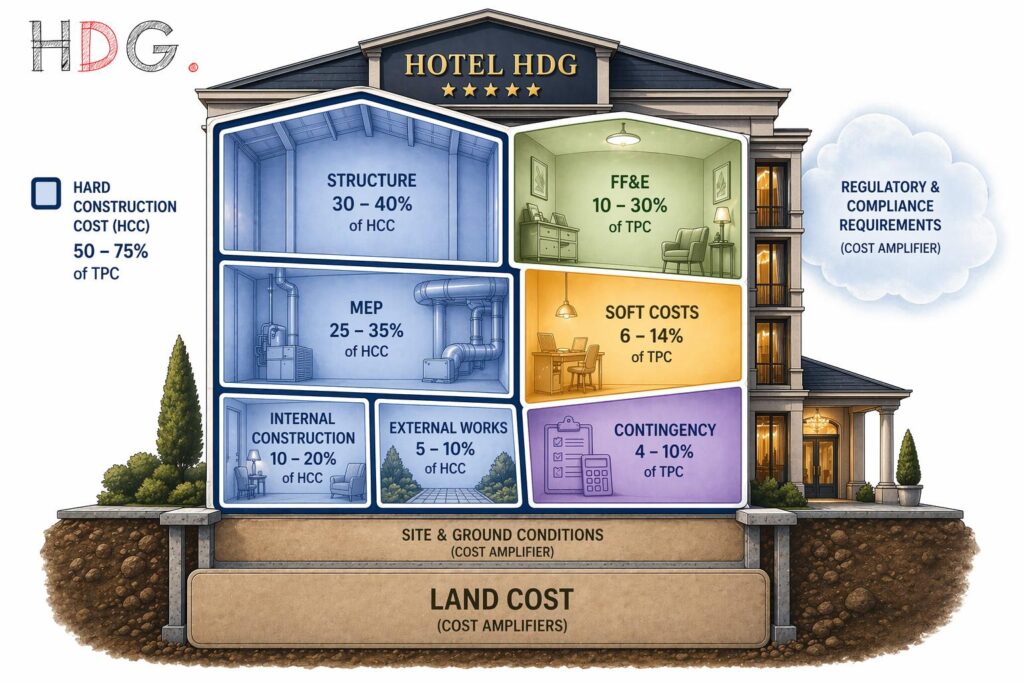
Within this category, costs are distributed across several interrelated building systems and construction elements, including structure, façade, building services, and internal works. While these components are often benchmarked individually, in practice, they are closely interdependent, with design decisions in one area influencing cost outcomes in others. The table below outlines the principal components of hard construction cost and their typical proportional ranges, providing a framework for understanding how the total build cost is assembled at the feasibility stage.
| Cost Component | Primary Influence | Share of Cost (Defined Basis) | Variability & Risk |
|---|---|---|---|
| Structure & Façade | Structural frame, spans, envelope systems | 30–40% of Hard Construction Cost | High (design-driven) |
| MEP Systems | HVAC, electrical, plumbing | 25–35% of Hard Construction Cost | High (often underestimated) |
| Internal Construction & Contractor Scope | Partitions, finishes, joinery, preliminaries, OHP | 10–20% of Hard Construction Cost | Medium–High (fragmented scope) |
| External & Infrastructure | Access, utilities, landscaping | 5–10% of Hard Construction Cost | Medium (site-specific) |
Total Project Cost (TPC) Composition in Hotel Development
The ranges presented below illustrate how total project cost is typically distributed across the principal components of hotel development, with variations primarily driven by positioning, design complexity, and brand requirements. As hotel specifications increase, a greater proportion of capital is allocated to FF&E, interior design, and specialist consultancy input, while the relative share of base building construction tends to reduce.
| Cost Component | Main Drivers | Midscale – Select Service | Upscale – Luxury – Lifestyle |
|---|---|---|---|
| Hard Construction Cost | Structure, façade, MEP systems, internal construction, external works | 65–75% | 50–60% |
| FF&E | Brand standards, room specification, public areas, operator requirements | 10–15% | 20–30% |
| Soft Costs | Design consultants, engineers, project management, permits, technical services | 6–9% | 10–14% |
| Contingency | Design development stage, construction risk, procurement timing | 4–7% | 6–10% |
The percentages presented above are indicative ranges based on typical hotel development structures and are intended for feasibility-level reference only. Individual cost components are interdependent and may vary depending on project-specific factors, including site conditions, design complexity, brand requirements, and procurement strategy. When considered together, these components generally amount to approximately 100% of the total project cost (excluding land), although variations may occur depending on the development context and the level of project definition.
These ranges should be interpreted as indicative rather than prescriptive. In practice, individual cost components are interdependent, and the final distribution will reflect site conditions, procurement strategy, regulatory requirements, and the level of definition achieved at each stage of the project. For feasibility purposes, developers will often adjust individual components to test different design and positioning scenarios, rather than applying fixed percentage assumptions across the entire cost structure.
Site & Location Factors Affecting Hotel Construction Costs
Site-specific conditions are one of the earliest and most decisive cost drivers in hotel development. Before any architectural or brand decisions are made, the site’s physical characteristics can materially influence structural design, construction methodology, and programme duration. In many cases, these factors are only partially understood at the feasibility stage, which makes them a major source of cost uncertainty.
Urban hotel developments, particularly in constrained city environments, frequently encounter irregular plot geometries, limited access for construction logistics, and adjacent structures that restrict excavation or crane operations. These constraints tend to increase both direct and indirect construction costs through longer programme durations and more complex sequencing.
Site Conditions and Ground Risk
Ground conditions are among the most significant hidden risks in hotel construction. Poor soil bearing capacity may require deep piling or raft foundations, while high groundwater levels may require additional waterproofing and dewatering. In seismic regions, including parts of Eastern Europe, structural systems must also be designed to comply with stringent earthquake regulations, which often require increased reinforcement, higher concrete grades, and greater overall structural complexity.
The financial impact of these factors can be substantial, often altering project viability before construction has even begun.
Site Risk and Cost Impact Overview
| Site Condition | Design Implication | Cost Impact | Development Consideration |
|---|---|---|---|
| Poor soil / weak bearing | Piling, deep foundations | High (+10–20%) | Requires early geotechnical study |
| High water table | Waterproofing, drainage systems | Medium–High | Impacts basement feasibility |
| Brownfield / contamination | Remediation works | High (case-specific) | Programme risk + approvals |
| Seismic requirements | Reinforced structure, shear walls | Medium–High | Critical in countries such as Türkiye and Romania |
| Tight urban plot | Complex logistics, crane limits | Medium | Increases preliminaries |
In practice, developers who invest early in geotechnical surveys and site investigations can significantly reduce cost uncertainty, even if this adds a modest upfront expense. The absence of this information at the feasibility stage is one of the most common reasons for cost overruns later in the development cycle.
Planning, Zoning & Regulatory Cost Drivers
Planning and regulatory frameworks play a central role in shaping hotel construction costs, not only through direct compliance requirements but also by influencing building efficiency and design flexibility. Constraints imposed at the planning stage often cascade into structural, MEP, and operational inefficiencies, increasing the cost per key.
Height restrictions, setback requirements, and heritage preservation rules can all reduce the efficiency of floor plates, leading to lower net-to-gross ratios and higher capital intensity. In hotel development, where profitability is closely linked to the number and efficiency of keys, even small losses in usable area can have a disproportionate financial impact.
Planning Constraints & Design Efficiency
Planning constraints frequently force compromises in building geometry and layout. For example, excessive setbacks or irregular massing may result in inefficient corridors or unusable residual spaces. Similarly, height limitations may require additional floors to achieve the same key count, thereby increasing vertical circulation costs and structural complexity. These inefficiencies are rarely visible in headline cost-per-m² figures but become highly apparent when analysed on a per-key basis.
Building Codes, Fire Safety & Compliance Costs
Building code and compliance requirements are a fundamental driver of hotel construction cost, although they are rarely presented as a single, isolated line item. Instead, these costs are embedded across multiple components of the project, influencing structural design, MEP systems, façade performance, and operational layouts.
Fire safety requirements alone can materially alter both design and cost. Hotels typically require enhanced life-safety systems compared to many other asset classes, including sprinkler systems, smoke extraction, pressurised escape routes, fire compartmentation, and fire-rated materials. These systems must be integrated into both architectural and engineering design from an early stage, often increasing both capital cost and spatial requirements (e.g. plant rooms, risers, escape stairs).
Accessibility and energy compliance further compound this effect. Requirements for accessible rooms, circulation widths, lift provisions, and energy performance standards (including façade insulation, glazing specifications, and HVAC efficiency) all contribute to incremental cost layers. In many jurisdictions, sustainability frameworks or certifications (such as LEED or BREEAM) add further cost, either directly through systems or indirectly through design and coordination complexity.
The challenge from a development perspective is that these requirements are jurisdiction-specific and evolve over time. As a result, early-stage benchmarking must always be adjusted for local regulatory context, as applying generic cost assumptions without this adjustment can lead to significant underestimation.
Typical Compliance Cost Influence by Area
| Compliance Area | Typical Cost Impact Mechanism | Cost Influence (Indicative) | Embedded In |
|---|---|---|---|
| Fire & Life Safety | Sprinklers, smoke control, fire-rated materials | 3–8% of HCC | MEP, structure, interiors |
| Accessibility | Room layouts, lifts, circulation | 1–3% of TPC | Design, interiors |
| Energy & Sustainability | Façade, HVAC efficiency, controls | 3–7% of HCC | Façade, MEP |
| Local Codes & Permits | Design changes, approvals, delays | Variable | Soft costs, contingency |
Site Conditions and Substructure Complexity
Site and ground conditions are among the most unpredictable elements in hotel development and can materially affect both cost and programme. Unlike above-ground construction, which can be benchmarked with reasonable accuracy, substructure works are highly dependent on site-specific factors that are often only fully understood after detailed investigation. Ground conditions such as poor soil bearing capacity, high water tables, contamination, or previous site use can necessitate significant additional work. These may include piling, soil stabilisation, dewatering systems, or remediation, all of which can substantially increase construction costs.
Topography and site constraints also influence design efficiency. Sloped sites may require retaining structures or split-level construction, while constrained urban plots can complicate logistics, access, and sequencing. In seismic regions, additional structural reinforcement further increases complexity and cost. From a feasibility perspective, these risks are typically managed through contingency allowances and conservative assumptions, but they remain a key source of cost variability, particularly in early-stage development.
Site Condition Cost Sensitivity
| Site Factor | Potential Impact on Cost | Typical Cost Effect |
|---|---|---|
| Poor soil conditions | Piling, deeper foundations | +5–15% of HCC |
| High water table | Waterproofing, dewatering | +3–10% of HCC |
| Contamination | Remediation works | Highly variable |
| Seismic requirements | Structural reinforcement | +5–12% of structure cost |
| Urban constraints | Logistics inefficiency | +2–8% of HCC |
Structural System and Building Envelope
The structural system and building envelope typically account for the largest share of hard construction costs and are heavily influenced by the hotel’s positioning, scale, and design intent. Structural decisions are driven by span requirements, building height, grid efficiency, and local construction practices, while façade systems respond to both aesthetic and performance requirements.
For hotels, structural efficiency is closely tied to room layout and module repetition. Efficient structural grids aligned with room dimensions can significantly reduce cost, while irregular layouts or complex geometries increase both material use and construction complexity. The façade plays a dual role in both aesthetics and performance. High-end hotels often require premium façade systems, including curtain walling, stone cladding, or bespoke detailing, which can significantly increase cost. At the same time, façade performance requirements related to energy efficiency and acoustic control further influence specification and cost.
The interaction between structure and façade is critical, as decisions in one area directly impact the other. Early coordination between design disciplines is therefore essential to optimise both cost and performance.
Structural and Façade Cost Drivers
| Element | Primary Drivers | Cost Sensitivity |
|---|---|---|
| Structural frame | Spans, height, seismic design | High |
| Floor systems | Grid efficiency, repetition | Medium–High |
| Façade system | Materials, glazing, performance | High |
| Envelope detailing | Thermal, acoustic, durability | Medium–High |
Mechanical, Electrical and Plumbing (MEP) Systems
MEP systems represent one of the most complex and frequently underestimated components of hotel construction cost. Hotels require significantly more intensive building services than many other asset classes due to their operational nature, guest expectations, and 24/7 usage patterns.
HVAC systems are typically the largest single component within MEP, driven by requirements for individual room control, ventilation standards, and energy efficiency. Electrical systems must support not only lighting and power but also IT infrastructure, guest systems, and back-of-house operations. Plumbing systems are similarly extensive, reflecting the high density of wet areas in guest rooms, kitchens, and public spaces. The complexity of MEP systems increases with hotel category. Luxury and full-service hotels require more sophisticated systems, higher redundancy, and greater integration, all of which increase both capital cost and coordination requirements.
A major challenge is that MEP costs are often underestimated in the early stages due to their technical complexity and the difficulty of benchmarking without detailed design. This makes them a critical focus area for cost control and value engineering.
Typical MEP Cost Distribution
| System | Relative Share of MEP Cost | Key Drivers |
|---|---|---|
| HVAC | 40–50% | Climate, efficiency, system type |
| Electrical | 25–35% | Load requirements, technology |
| Plumbing | 15–25% | Room density, water systems |
| ELV / IT Systems | 5–15% | Brand standards, connectivity |
Within the MEP cost structure, ELV (Extra Low Voltage) systems represent a distinct and increasingly important category of building services. These systems typically operate at low voltage levels and support the hotel’s digital, operational, and guest-facing infrastructure. This includes IT and data networks, in-room entertainment, access control, CCTV, fire detection interfaces, building management systems (BMS), and guest room management systems (GRMS). While ELV typically accounts for a smaller share of overall MEP costs, its importance has grown significantly with the increasing reliance on connectivity, automation, and integrated guest experiences, particularly in upscale, luxury, and lifestyle hotel segments.
Internal Construction and Fit-Out
Internal construction encompasses all building elements within the structure, excluding FF&E. This includes partitions, ceilings, finishes, doors, and built-in elements that define the guest experience and the hotel’s operational functionality.
The cost of internal construction is highly sensitive to hotel positioning and brand standards. Higher-end hotels require more complex detailing, premium materials, and greater coordination between design disciplines, all of which increase cost. At the same time, operational requirements such as back-of-house layouts, service circulation, and durability of finishes must be carefully considered.
Efficiency in internal planning can significantly impact costs. Standardisation of room layouts, repetition of details, and alignment with structural grids can reduce both material and labour costs, while bespoke design or frequent variation increases complexity.
External Works and Infrastructure
External works include all elements outside the building footprint that are required to make the hotel operational. This typically includes access roads, parking, landscaping, utility connections, drainage systems, and external lighting. The extent of external works varies significantly depending on the site context. Urban hotels may have a limited external scope but higher complexity due to integration with existing infrastructure, while resort or standalone developments may require extensive infrastructure provision, including utilities and access roads.
Although external works typically account for a smaller share of hard construction costs, they are highly site-specific and can become a major cost driver under certain conditions, particularly where infrastructure is not already in place.
FF&E (Furniture, Fixtures and Equipment)
FF&E represents a distinct and highly variable component of hotel development cost, directly linked to positioning, brand standards, and guest expectations. Unlike core construction elements, FF&E is closely tied to the guest experience and is therefore one of the most visible aspects of the investment.
Costs vary significantly by segment, with luxury and lifestyle hotels requiring higher levels of specification, bespoke design, and premium materials. Brand requirements can further influence FF&E scope, particularly in branded environments where standards dictate minimum specifications.
FF&E is typically budgeted on a per-key basis, allowing for benchmarking across markets and hotel types. However, the total FF&E cost must be considered in the context of the overall project cost, as it can represent a substantial proportion of the total capital expenditure.
Soft Costs and Professional Fees
Soft costs include all non-construction costs associated with delivering the project, including design fees, consultants, permits, legal costs, and project management. These costs are typically expressed as a percentage of total project cost and reflect the complexity and scale of the development. The level of soft costs varies depending on project complexity, location, and procurement strategy. More complex projects with multiple stakeholders, higher design requirements, or challenging regulatory environments will typically incur higher soft costs.
Contingency and Risk Allowances
Contingency is a critical component of hotel development cost planning, reflecting the inherent uncertainty in construction projects. It provides a buffer against unforeseen conditions, design changes, and market fluctuations. Contingency levels vary by project stage, with higher allowances at early feasibility stages and lower levels as design and cost certainty improve. It is essential that contingency not be treated as optional but as an integral part of responsible financial planning.
Brand Standards and Operator Requirements
Hotel brand standards and operator requirements are a fundamental driver of construction cost, influencing not only the level of specification but also spatial planning, technical systems, and operational layouts. Unlike purely architectural decisions, these requirements are externally imposed and are often non-negotiable once a brand is selected.
Brand standards typically define minimum room sizes, bathroom configurations, corridor widths, ceiling heights, acoustic performance, and back-of-house provisions. They also dictate requirements for public areas, including lobby scale, food-and-beverage facilities, and guest amenities. In addition, operators impose technical standards for MEP systems, IT infrastructure, and life-safety integration that must align with their operational platforms and brand positioning.
From a development perspective, these requirements introduce both cost uplift and reduced design flexibility. While they may increase capital expenditure, they also provide benefits for operational performance, brand recognition, and financing support. The challenge lies in aligning brand standards with market positioning, ensuring that the specification level is appropriate for the achievable ADR and demand profile.
Typical Brand Impact on Construction Cost
| Area of Influence | Typical Requirement | Cost Impact Mechanism |
|---|---|---|
| Guestrooms | Minimum size, bathroom standards | Increased area, higher fit-out cost |
| Public Areas | Lobby, F&B, amenities | High-cost, non-revenue space |
| Back-of-House | Staff areas, circulation | Increased gross area |
| Technical Systems | IT, BMS, standards | Higher MEP complexity |
| Acoustic & Quality Standards | Noise control, materials | Higher specification |
Building Efficiency and Net-to-Gross Ratio
Building efficiency is one of the most important drivers of hotel development cost. It reflects the relationship between revenue-generating space (primarily guestrooms) and the total built area required to support the operation. The net-to-gross ratio measures this efficiency:
- Net Area → guestroom and revenue-generating spaces
- Gross Area (GIA) → total built area including circulation, structure, and back-of-house
A higher ratio indicates a more efficient building, where a greater proportion of the construction cost is allocated to revenue-generating space. Conversely, lower efficiency results in a higher cost per key, as more capital is required to deliver each room.
Efficiency is influenced by multiple factors, including hotel segment, architectural design quality, site constraints, and brand requirements. Full-service and luxury hotels typically have lower efficiency due to extensive public areas and back-of-house requirements, while select-service hotels are designed to maximise efficiency.
From a development perspective, building efficiency is also an early indicator of project feasibility. Projects with structurally low efficiency, whether due to design decisions, site constraints, or over-programming of non-revenue areas, often struggle to support viable cost-per-key levels relative to achievable revenues. In this sense, inefficiency identified at the concept stage is frequently a warning signal that the scheme may be commercially unbalanced.
This impact does not remain limited to development. Inefficient buildings typically carry through into operations, where excess circulation, oversized public areas, or poorly utilised back-of-house spaces increase operating complexity without generating corresponding revenue. At exit, these inefficiencies become even more visible, as valuation metrics tied to income and area, such as value per square metre or per key, fail to reflect the capital invested. In extreme cases, this results in built space that carries cost but delivers little or no incremental value.
Typical Net-to-Gross Efficiency Ranges
| Hotel Type | Net-to-Gross Ratio | Cost Implication |
|---|---|---|
| Select-Service / Midscale | 65–72% | High efficiency, lower cost per key |
| Full-Service | 60–68% | Moderate efficiency |
| Upscale / Lifestyle | 55–65% | Lower efficiency, higher cost per key |
| Luxury | 50–60% | Low efficiency, high capital intensity |
FF&E Benchmarks and Cost per Key
FF&E represents a major component of hotel development cost and is typically benchmarked on a per-key basis to allow comparison across projects and markets. Unlike core construction costs, FF&E is closely linked to guest experience and brand positioning, making it one of the most visible and variable elements of capital expenditure.
FF&E includes guestroom furniture, lighting, casegoods, soft furnishings, and equipment, as well as a proportionate share of public area and back-of-house FF&E. It is typically procured separately from the main construction contract and is heavily influenced by brand standards and design intent. From a feasibility perspective, FF&E is often underestimated, particularly in higher-end projects where bespoke design and premium materials can significantly increase cost. It is therefore essential to align FF&E budgets with positioning and brand expectations from an early stage.
Typical FF&E Cost per Key
| Hotel Segment | FF&E Cost per Key (€) |
|---|---|
| Midscale / Select-Service | 12,000 – 25,000 |
| Upper Midscale / Upscale | 25,000 – 45,000 |
| Luxury / Lifestyle | 45,000 – 90,000+ |
Higher-end projects, particularly luxury and lifestyle hotels, may materially exceed these ranges where bespoke design, signature public spaces, or brand positioning require above-standard specifications.
Construction Methodology, Programme and Market Conditions
Construction methodology, programme duration, and market conditions directly impact both cost and risk, influencing contractor pricing, financing exposure, and project delivery timelines.
New Build vs Conversion
The difference between new build, conversion, or extension has significant implications for both the cost structure and the risk profile. New build developments offer the advantage of full design control, allowing the building to be optimised for operational efficiency, structural grid alignment, and brand requirements from the outset. This typically results in more predictable construction costs and better alignment between gross area and revenue-generating space. In addition, new builds enable more efficient integration of MEP systems and compliance requirements, reducing the need for compromise or rework in later stages of the project.
By contrast, conversion projects introduce a different set of challenges. Existing structures often impose constraints on layout, floor-to-ceiling heights, structural grids, and vertical circulation, all of which can limit efficiency and increase cost per key. Compliance upgrades, particularly relating to fire safety, accessibility, and seismic standards, can require significant intervention, sometimes approaching the cost of new construction in certain areas. Furthermore, unknown conditions within the existing building can lead to cost uncertainty and programme delays. While conversions may benefit from reduced structural scope and, in some cases, shorter programme durations, these advantages must be carefully weighed against the risk of inefficiency and unforeseen capital expenditure.
Programme Duration and Cost Risk
The construction programme duration is a critical driver of the total project cost. Longer construction periods increase contractor preliminaries, site overheads, and management costs, all of which are embedded within the hard construction cost. More importantly, extended programmes increase exposure to financing costs, as interest accrues over a longer period before the asset becomes operational and begins generating revenue. In markets with a high cost of capital, this effect can be significant and may materially impact overall project feasibility.
Programme duration also introduces exposure to external risks, including inflation, currency fluctuations, and changes in labour or material availability. Delays arising from permitting, design revisions, coordination issues, or contractor performance can compound these risks, leading to cost escalation beyond initial assumptions. From a development perspective, programme control is therefore not only a scheduling issue but a financial one, requiring careful planning, realistic assumptions, and proactive risk management. In many cases, the difference between a viable and non-viable project can be traced back to programme-related cost overruns rather than initial construction pricing.
Labour, Materials and Market Volatility
Construction costs are highly sensitive to prevailing market conditions, particularly labour availability, contractor capacity, and material pricing. In periods of high construction activity, limited contractor availability can lead to pricing premiums, while shortages of skilled labour can drive wage inflation and reduce productivity. Conversely, in weaker markets, increased competition among contractors may lead to more competitive pricing, though this can sometimes be offset by reduced contractor stability or performance risk.
Material costs represent another significant source of volatility. Core inputs such as steel, cement, glass, and mechanical equipment are subject to global supply chains and can experience rapid price fluctuations due to geopolitical factors, energy costs, or supply disruptions. In emerging markets, these effects can be amplified by reliance on imported materials and exposure to foreign exchange movements. As a result, cost planning at the feasibility stage must account not only for current pricing but also for potential volatility over the project timeline, often through contingency allowances and sensitivity analysis. Understanding these dynamics is essential for realistic budgeting and risk management in hotel development.
Programme and Market Risk Overview
The table below summarises the principal programme- and market-related cost drivers in hotel development, along with an indication of their relative risk levels. In this context, risk level reflects both the potential impact of each factor on project cost and programme, and the degree to which it can be controlled or mitigated by the developer. Factors classified as “high” risk are those that can materially affect project viability and are often influenced by external conditions such as market dynamics, regulatory processes, or supply constraints. Lower-risk factors are typically more predictable or within the developer’s direct control, even if they still require active management.
| Factor | Cost Impact Mechanism | Risk Level |
|---|---|---|
| Construction duration | Preliminaries, financing | High |
| Labour availability | Wage inflation, delays | Medium–High |
| Material costs | Price volatility | High |
| Contractor capacity | Pricing premiums | Medium |
Professional Fees and Project Cost Structure
Professional fees form a significant component of total project cost and reflect the level of expertise required to design, coordinate, and deliver the project. These costs are typically expressed as a percentage of total project cost and vary depending on project complexity and procurement strategy.
Key consultants include architects, interior designers, engineers (structural and MEP), project managers, quantity surveyors, and specialist designers (e.g., kitchen, spa, sustainability). In branded projects, operator technical services also form part of this cost structure.
Typical Professional Fee Distribution
| Consultant Type | Typical Share of Fee Budget | Role |
|---|---|---|
| Architect | 25–35% | Design, coordination |
| Interior Designer | 15–25% | Guest experience, FF&E |
| Engineers (MEP + Structural) | 20–30% | Technical systems |
| Project Management | 10–20% | Delivery, coordination |
| QS / Cost Consultant | 5–10% | Cost control |
| Specialist Consultants | Variable | Kitchens, spa, ESG |
Industry Benchmarks and External Resources on Hotel Development Costs
Independent industry benchmarks and research reports provide valuable reference points for validating hotel construction costs against prevailing market conditions, investor expectations, and lender assumptions. While project-specific cost plans remain essential, these external sources offer a broader perspective on cost trends across regions, segments, and development cycles, helping to contextualise feasibility assumptions and identify potential outliers.
Such benchmarks are particularly useful at early-stage planning, where detailed design information may not yet be available. They allow developers to test cost-per-key assumptions, understand segment positioning, and assess whether projected capital expenditure aligns with comparable developments in similar markets. However, these sources should be used as reference tools rather than definitive pricing, as methodologies, inclusions, and regional variations can differ significantly.
HVS U.S. Hotel Development Cost Survey
The annual HVS Development Cost Survey is one of the most widely referenced industry benchmarks for hotel construction costs. Based on actual project data, it provides detailed insights into development costs per key across a range of hotel categories, including limited-service, select-service, full-service, and luxury segments. The survey typically includes:
- Median and range-based cost per key benchmarks
- Cost breakdowns by major development components
- Comparisons across hotel types and positioning levels
Although focused on the U.S. market, the report is frequently used internationally as a directional benchmark, particularly for understanding relative cost positioning between segments and for calibrating early-stage feasibility assumptions.
→ Explore: HVS U.S. Hotel Development Cost Survey (2025 edition)
EMEA Hotels Monitor (RLB, Whitebridge Hospitality & HotStats)
The EMEA Hotels Monitor is a collaborative quarterly publication that provides insight into hotel development activity, construction costs, and operating performance across Europe, the Middle East, and Africa. Produced by Rider Levett Bucknall in partnership with Whitebridge Hospitality and HotStats, it combines cost consultancy data with operational performance metrics. The report typically covers:
- Construction cost trends across prime EMEA markets
- Development pipeline activity and investment sentiment
- Operating performance benchmarks and profitability trends
- Commentary on sustainability, refurbishment, and market dynamics
Its regional focus makes it particularly relevant for developers working in Europe and emerging markets, offering a more locally grounded perspective than global datasets.
→ Explore: EMEA Hotels Monitor (issue No. 37 – February 2026)
Land Cost and Residual Land Value in Hotel Development
In major urban markets and gateway cities, land cost is often one of the most critical determinants of the viability of hotel development. Unlike construction costs, which can be benchmarked, optimised, and value-engineered with a reasonable degree of certainty, land pricing is driven by a wider set of market forces, including location, zoning, permitted gross internal area (GIA), alternative-use potential, and investor expectations. In many cases, land values reflect residential or mixed-use pricing rather than hotel-specific fundamentals, creating a structural mismatch between land cost and hotel-supported returns.
As a result, even well-designed and technically efficient hotel projects can become financially unviable if the underlying land cost exceeds what the asset can support through its operating performance. This is particularly evident in competitive urban markets, where residential or office uses can justify higher land values than hotels do. In such cases, hotel development is effectively priced out unless specific advantages, such as branding, mixed-use integration, or strategic positioning, can justify the allocation.
For this reason, hotel feasibility is typically assessed using a residual land value approach, where the land value is derived from the project rather than assumed as an input. This approach starts with projected stabilised operating performance, applies investor return requirements and exit yield assumptions, and deducts total development cost to determine the maximum supportable land value. Where market land prices exceed this residual value, the project is unlikely to proceed as a hotel in its current form. This disconnect between land pricing and hotel-supported economics remains one of the most common barriers to hotel development in urban markets.
Interpreting Hotel Construction Cost in the Development Context
Hotel construction cost is not a fixed or standardised figure but a dynamic outcome shaped by design decisions, regulatory environments, site conditions, and market context. While benchmarks and percentage ranges provide a useful framework, their application must always be adjusted to reflect the specific characteristics of each project.
A clear understanding of both cost structure and cost drivers allows developers to move beyond headline figures and engage with the underlying mechanics of hotel development. This, in turn, supports more informed decision-making, better risk management, and ultimately more viable and successful projects.
How Investors Assess Hotel Construction Costs and Feasibility
From an investor’s perspective, hotel construction costs are not assessed in isolation but in terms of their relationship to income generation, yield on cost, and exit value. While development costs are typically expressed in metrics such as €/m² (GIA) and € per key, these are only reference points. The central question is whether the total capital invested can be supported by the asset’s stabilised operating performance and market yield expectations.
In this context, construction cost must be evaluated against projected revenue, operating margins, and exit yield assumptions to determine whether the development achieves an acceptable return profile. A higher cost base requires either stronger operating performance (through higher ADR, occupancy, or ancillary revenue) or a more favourable exit yield to justify the investment. Where this alignment is lacking, the project may fail to meet investor return thresholds, regardless of its technical quality.
Ultimately, the question is not simply:
“What does it cost to build?”
but rather:
“Does this level of investment translate into a viable and competitive asset?”
A technically well-designed hotel that is over-specified or over-engineered for its market can result in a cost structure that cannot be supported by achievable revenues. In such cases, the development may underperform, face challenges at exit, or require repositioning. Conversely, projects that are appropriately aligned with their market, balancing cost, specification, and positioning, are more likely to achieve sustainable returns and liquidity.
See HDG – Hotel Development Strategy
See HDG – Hotel Valuation vs Land Value: Why Hotel Sellers and Buyers Disagree
See HDG – Architectural Planning
See HDG – Hotel Asset Management
See LEED – “Building Design and Construction: Hospitality“