
Online travel agencies (Hotel OTAs) have become one of the most influential structural forces in the hotel sector, fundamentally altering how demand is accessed, priced, and monetised. What was once a supplementary distribution channel has evolved into a system of global demand aggregation, in which a small number of platforms now influence booking visibility, customer acquisition costs, and, ultimately, the financial performance of hotel assets.
For hotel developers and investors, this shift has direct implications. Distribution is no longer simply an operational consideration managed post-opening, but a core element of feasibility, brand strategy, and long-term asset positioning. The degree to which a hotel relies on OTA-driven demand affects its net operating income, its resilience across market cycles, and its attractiveness at exit.
- From Distribution Channel to Strategic Gatekeeper
- The Evolution of OTAs in the Hotel Ecosystem
- Who Are the Major OTAs in the Global Hotel Market?
- OTA Economics and Their Impact on Hotel Performance
- Hotel OTAs in the Context of Development Feasibility
- Brand, Operator, and Hotel OTAs Dynamics
- Data Ownership and the Customer Relationship
- Operational Implications of OTA-Driven Demand
- Strategic Responses: Managing OTA Dependency
- Future Outlook: Platform Power and Hotel Control
From Distribution Channel to Strategic Gatekeeper
The role of OTAs has expanded significantly beyond that of an intermediary connecting hotels with guests. Today, these platforms shape consumer behaviour through search rankings, review systems, and pricing transparency, effectively determining which hotels are visible and competitive within a given market. This influence places OTAs in a position of control over demand access rather than simple participation in distribution.
From a development perspective, this transformation means that hotels are increasingly evaluated not only on their physical and locational attributes, but also on their ability to perform within OTA ecosystems. Visibility on these platforms, the ability to compete within ranking algorithms, and the cost of participation are all embedded in the commercial logic of a project. As a result, the OTA strategy must be considered early, rather than treated as a downstream operational issue.
The Evolution of OTAs in the Hotel Ecosystem
The emergence of OTAs initially provided hotels, particularly independent properties, with access to global demand that would otherwise have been difficult to capture. In this early phase, OTAs acted primarily as distribution support, enabling hotels to fill excess inventory and improve occupancy without fundamentally altering the balance of control within the relationship.
As online booking became the dominant mode of travel planning, OTAs invested heavily in marketing, technology, and user experience, consolidating their position as the primary interface between hotels and consumers. This shift coincided with a change in booking behaviour, where travellers increasingly began their search within OTA platforms rather than through brand websites. Over time, the aggregation of reviews, pricing comparisons, and availability transformed these platforms into the central marketplace for accommodation.
In the current phase, OTAs operate as demand controllers with significant influence over pricing visibility and booking conversion. Their algorithms determine ranking, their commercial programmes influence exposure, and their scale allows them to shape consumer expectations around pricing and availability. For many hotels, particularly those without strong brand distribution, participation is not optional but essential.
| Phase | OTA Role | Hotel Dependency | Value Exchange |
|---|---|---|---|
| Early | Distribution support | Low to moderate | Incremental bookings in exchange for commission |
| Growth | Demand generator | Increasing | Volume growth balanced against margin pressure |
| Current | Demand controller | High | Access to demand in exchange for structural dependency |
Who Are the Major OTAs in the Global Hotel Market?
The OTA landscape, while appearing fragmented at a regional level, is in practice highly concentrated. A small number of global platforms dominate digital hotel bookings, supported by significant marketing expenditure, advanced technology, and strong brand recognition. These players operate across multiple geographies and often control access to specific source markets, making them critical components of any hotel’s distribution strategy.
From an ownership and structural perspective, the market is largely shaped by two major Western groups, Booking Holdings and Expedia Group, alongside a separate but equally significant ecosystem centred on China through Trip.com Group. In parallel, Airbnb operates as a structurally different platform, but one that increasingly overlaps with traditional hotel demand.
Booking.com (Part of Booking Holdings)
Booking.com is widely recognised as the dominant global OTA for accommodation bookings, with particular strength in Europe and a strong presence across most international markets. Its agency-based model aligns revenue with completed stays, and its extensive inventory, particularly of independent hotels, makes it a primary distribution channel for a large proportion of the global hotel stock.
From a development and investment perspective, Booking.com often represents the single most important third-party demand source. Its scale, conversion rates, and consumer trust create a high level of dependence, particularly in the urban and independent hotel segments, where brand-driven demand is less pronounced.
Get your stay ridiculously right │ Booking.com Big Game Ad – January 2025 – 30 Seconds
Booking.com operates as the core accommodation platform within the broader Booking Holdings ecosystem, which includes complementary businesses such as Priceline, Agoda, Rentalcars.com, and OpenTable. Rather than functioning as a standalone OTA, Booking.com sits at the centre of a multi-layered travel platform designed to capture and monetise demand across the entire journey, from initial search and booking through to in-destination services.
This ecosystem structure allows Booking Holdings to cross-sell and package different components of travel in a way that strengthens customer retention and increases overall transaction value. A user entering via an accommodation search on Booking.com can be channelled into flights, car rental, or restaurant reservations within the same ecosystem, often without leaving the platform. From a hotel perspective, this integration enhances demand generation but also deepens platform dependency, as Booking Holdings increasingly positions itself not just as a distributor of rooms, but as an end-to-end travel marketplace controlling multiple touchpoints of the customer journey.
Expedia Group
Expedia Group European website
Expedia Group is one of the two dominant global OTA platforms and a publicly listed US-based travel technology company headquartered in Seattle. Originally launched in the late 1990s, it has expanded through acquisitions into a multi-brand ecosystem that includes Expedia, Hotels.com, Vrbo, and supporting platforms such as Trivago and Egencia. This structure allows Expedia to operate across multiple travel segments, from traditional hotel bookings to vacation rentals and corporate travel, positioning it as a broad-based travel marketplace rather than a single-channel distributor.
A defining feature of Expedia’s model is its combination of merchant and agency approaches, enabling it to package travel components such as flights, accommodation, and ancillary services into bundled offerings. This is particularly effective in North America, where consumers are accustomed to purchasing integrated travel products. Through its ecosystem, Expedia captures demand at different entry points, whether through hotel search, flight booking, or vacation rental, and retains users on its platform through cross-selling and brand segmentation, with Hotels.com focusing on accommodation simplicity and Vrbo targeting leisure and longer-stay demand.
For hotels, Expedia’s ecosystem provides access to incremental demand, particularly from US-origin and long-haul travellers, while also introducing a different commercial dynamic compared to purely agency-based platforms. The merchant model can influence rate presentation and reduce pricing transparency, placing Expedia in a more active intermediary role within the transaction. As a result, it remains a critical component of global distribution strategy, not only as a booking channel but as a platform shaping how travel products are packaged, positioned, and consumed.
Airbnb
Airbnb was founded in 2008 in San Francisco and has grown into one of the most significant digital platforms in the accommodation sector, operating alongside traditional OTAs but with a structurally different model. Unlike classic OTAs, which primarily distribute hotel inventory, Airbnb was built as a marketplace connecting supply and demand directly, without owning or leasing assets. Its scale, global reach, and strong consumer brand position it as a parallel distribution ecosystem, increasingly competing for the same demand that flows through traditional OTA channels.
Over time, Airbnb has expanded beyond peer-to-peer rentals into a broader accommodation platform that now includes boutique hotels, serviced apartments, and professionally managed portfolios. This evolution has brought it closer to the traditional OTA space, as it increasingly distributes accommodation types that overlap with the hotel product. At the same time, its platform design, focused on user-generated content, reviews, and experiential positioning, mirrors many of the behavioural drivers seen in OTAs, reinforcing its role as a demand aggregator. In effect, Airbnb functions as both a competitor to OTAs and an alternative OTA-like channel, capturing demand at the same discovery and booking stages of the customer journey.
From a hotel development perspective, Airbnb’s relevance lies in how it reshapes the distribution landscape rather than simply adding supply. It diverts demand that might otherwise flow through OTA channels, while also influencing pricing transparency, guest expectations, and length-of-stay patterns. In markets with significant Airbnb penetration, hotels may face both direct competition and indirect pressure on OTA performance, as the platform competes for visibility within the same digital ecosystem. As a result, Airbnb should be considered not only as an alternative accommodation provider, but as part of the broader OTA-driven demand structure that influences feasibility, channel mix, and long-term asset positioning.
Agoda (Part of Booking Holdings)
Agoda was founded in the mid-2000s and quickly established itself as a leading OTA platform in the Asia-Pacific region before being acquired by Booking Holdings as part of its global expansion strategy. While it sits within the same group as Booking.com, Agoda has retained a distinct identity, with a strong regional focus and a technology-driven approach tailored to Asian markets. Its early emphasis on mobile booking, localised pricing, and deep relationships with regional hotel supply allowed it to scale rapidly in Southeast Asia and surrounding markets.
The coexistence of Agoda and Booking.com within the same group reflects a deliberate strategic positioning rather than duplication. Booking.com operates as a globally standardised platform with broad geographic coverage, while Agoda is optimised for price-sensitive, mobile-first consumers in Asia, often with more aggressive pricing strategies, different rate structures, and a stronger focus on merchant-style transactions. Agoda has also developed expertise in handling fragmented supply and local market dynamics, which can differ significantly from European or North American booking behaviour. This dual-platform approach allows Booking Holdings to capture demand across different customer segments and regional booking patterns without relying on a single global interface.
From a hotel perspective, Agoda plays a critical role in accessing Asian source markets, particularly where domestic and intra-regional travel demand is dominant. Its strength in Southeast Asia, combined with its pricing competitiveness and mobile penetration, means that it is often a primary rather than secondary channel in these markets. For developments targeting Asian travellers, Agoda should be considered a core component of distribution strategy, not simply an extension of Booking.com, as its performance, booking patterns, and commercial dynamics can differ materially from other global OTAs.
Trip.com Group
Trip.com Group is the dominant online travel platform in China and one of the largest travel service providers globally. Originally founded as Ctrip in 1999, the company evolved alongside the rapid expansion of China’s domestic and outbound travel markets and later rebranded internationally as Trip.com Group. Through a combination of organic growth and acquisitions, including platforms such as Skyscanner, it has developed into a comprehensive travel ecosystem spanning accommodation, flights, rail, and packaged travel, with a strong technological backbone and deep integration into Chinese consumer behaviour.
Unlike Western OTAs, Trip.com operates within a highly localised digital environment shaped by China’s unique internet ecosystem, including payment systems, super-app integration, and mobile-first usage patterns. Its platform is closely aligned with Chinese consumer habits, offering seamless booking across multiple travel components, supported by customer service, local language interfaces, and payment methods tailored to domestic users. This creates a level of accessibility and trust that international OTAs often struggle to replicate within the Chinese market, giving Trip.com a structural advantage in capturing both domestic and outbound demand.
For hotels, Trip.com functions not simply as another OTA channel but as a critical gateway to Chinese travellers, particularly in the outbound segment. Its ability to package travel components, combined with its control over distribution in China, means participation is often essential to access this demand segment. In markets where Chinese tourism is significant, Trip.com can play a defining role in occupancy and revenue performance, making it a strategic rather than optional component of distribution. Its focus on integrated travel services, strong domestic positioning, and expanding global reach ensures that it remains a key player in shaping demand flows between China and international destinations.
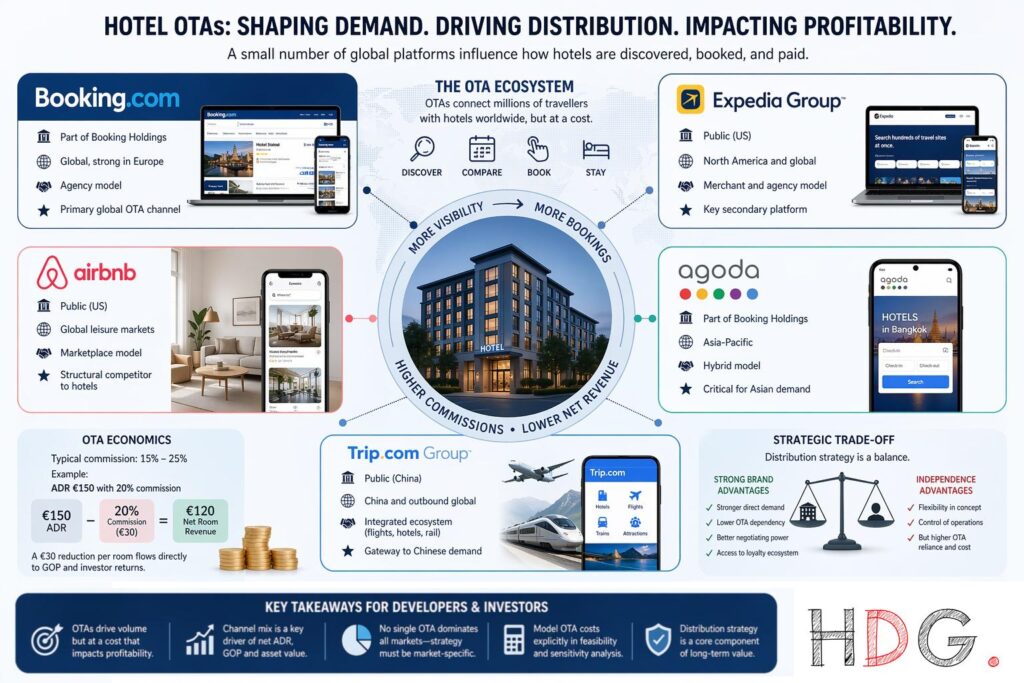
Comparative Positioning of Major OTA Platforms
While each of the major OTA platforms operates within the same broad distribution landscape, their ownership structures, geographic focus, and commercial models differ in ways that are highly relevant to hotel development and asset positioning. These differences influence not only where demand originates, but also how it is priced, packaged, and converted into bookings. As a result, OTAs should not be viewed as interchangeable channels, but as distinct demand ecosystems with specific strategic roles.
From a development perspective, understanding these distinctions is critical when assessing channel mix, forecasting demand sources, and aligning with target markets. A hotel targeting European city demand, for example, will typically rely heavily on Booking.com, whereas a resort targeting Asian or Chinese outbound travellers may depend more on Agoda or Trip.com. Similarly, platforms such as Airbnb introduce a different form of competition that sits alongside, rather than directly within, the traditional OTA structure.
| OTA Platform | Ownership | Core Markets | Business Model | Strategic Relevance |
|---|---|---|---|---|
| Booking.com | Booking Holdings | Global, strong in Europe | Agency | Primary global OTA channel |
| Expedia Group | Public (US) | North America and global | Merchant and agency | Key secondary platform |
| Airbnb | Public (US) | Global leisure markets | Marketplace | Structural competitor to hotels |
| Agoda | Booking Holdings | Asia-Pacific | Hybrid | Critical for Asian demand |
| Trip.com Group | Public (China) | China and outbound global | Integrated ecosystem | Gateway to Chinese demand |
The comparative framework above highlights the concentration of power within a relatively small number of global platforms, but also underlines the importance of market-specific strategy. No single OTA dominates all regions or segments equally, and effective distribution planning requires aligning the platform mix with the hotel’s target demand profile. For developers and investors, this reinforces the need to move beyond generic assumptions about “OTA demand” and instead adopt a more nuanced view of how different platforms contribute to performance across markets.
OTA Economics and Their Impact on Hotel Performance
OTA participation introduces a structural cost to hotel operations that is often understated at the development stage, yet has a direct and recurring impact on financial performance. Commission levels, typically in the mid-teens to mid-twenties, are applied to gross room revenue, reducing the amount retained by the hotel before operating costs are considered. In practical terms, if a hotel achieves an ADR of €150 and pays a 20% OTA commission, the net room revenue retained is €120. That €30 difference per room flows directly through to GOP and investor returns, making distribution cost one of the most significant variable expenses within the operating model.
For investors, this highlights a critical distinction between headline revenue and revenue quality. A hotel achieving €150 ADR through OTA channels is not economically equivalent to one achieving the same ADR through direct bookings, as the cost of acquisition materially reduces profitability. As OTA dependency increases, effective net ADR declines, and strong top-line performance can mask weaker underlying returns. This is particularly relevant in competitive markets where pricing power is limited and commission costs cannot be offset through higher rates.
Reducing reliance on OTAs is therefore a strategic objective, but it requires deliberate action rather than simple intent. Hotels typically shift channel mix over time through stronger direct booking platforms, digital marketing, repeat business, and loyalty-driven demand. Brand positioning plays an important role: globally branded hotels are generally better placed to drive direct bookings and reduce dependency, while independent properties often rely more heavily on OTAs for visibility. However, even branded hotels continue to use OTAs strategically, meaning the objective is not elimination, but control of dependency and cost.
From a development perspective, OTA economics should be explicitly integrated into feasibility and investment analysis. Assumptions around ADR and occupancy must be considered alongside channel mix and cost of acquisition, recognising that not all revenue delivers the same financial outcome. Sensitivity testing around OTA reliance can materially change projected returns, reinforcing that distribution is not an operational detail, but a core driver of asset performance and investment viability.
| Channel | Cost of Acquisition | Control | Data Ownership | Margin Impact |
|---|---|---|---|---|
| Direct | Low to moderate | High | Full | Strong |
| OTA | High | Limited | Restricted | Dilutive |
| Corporate / Wholesale | Moderate | Medium | Partial | Stable |
Hotel OTAs in the Context of Development Feasibility
From a feasibility perspective, reliance on OTA is frequently underestimated in early-stage financial modelling. Projections may assume an optimistic share of direct bookings or brand-driven demand that does not fully reflect market realities, particularly in emerging or highly competitive urban markets.
The consequence of this misalignment is that projected revenues may not translate into expected profitability once distribution costs are applied. A higher-than-anticipated OTA mix can reduce net operating income, directly affecting yield on cost and investor returns. Over time, this also influences exit value, as buyers assess not only headline performance but the sustainability and cost structure of revenue.
In markets where brand penetration is limited or demand is fragmented, OTA dependency may be structurally higher. Conversely, in mature markets with strong brand ecosystems, hotels may achieve a more balanced channel mix. Understanding this distinction is critical when assessing development opportunities across different geographies.
Brand, Operator, and Hotel OTAs Dynamics
The relationship between brand strength and OTA dependency is one of the defining dynamics within hotel distribution. Strong global brands, supported by loyalty programmes, direct booking infrastructure, and global marketing platforms, are generally better positioned to reduce reliance on OTAs by capturing a higher proportion of bookings through direct channels. This ability to generate demand internally is one of the primary economic advantages of brand affiliation, particularly in mature markets with established loyalty ecosystems.
In addition, large hotel brands and operators may benefit from more favourable commercial terms with OTAs, including slightly lower commission rates, preferred visibility arrangements, or participation in strategic partnership programmes. This reflects their scale, consistent inventory, and ability to deliver high booking volumes. However, while these negotiated advantages do exist, they are typically incremental rather than transformative. A branded hotel may achieve a modest reduction in commission compared to an independent property, but the overall cost of OTA distribution remains significant and continues to impact net revenue.
In contrast, independent hotels or those operating under weaker distribution platforms are often more exposed to OTA-driven demand. Without strong direct booking channels or loyalty-driven repeat business, they rely more heavily on OTAs for visibility and occupancy. This can result in higher effective distribution costs, not only through standard commissions but also through participation in visibility programmes that further increase the cost of acquisition. White-label operators, while offering flexibility in concept and management, typically lack the distribution strength required to materially shift this balance.
This dynamic creates a strategic trade-off within development. Alignment with a strong brand can improve distribution efficiency, reduce dependency, and in some cases marginally improve OTA economics, but it comes with its own fee structures and operational constraints. Independence offers flexibility and potential cost savings on brand fees, but often increases reliance on third-party platforms and exposes the asset to higher and less controllable distribution costs. For developers and investors, the decision is therefore not simply about brand versus independent positioning, but about how distribution costs, demand access, and long-term asset value are balanced within the overall commercial strategy.
Data Ownership and the Customer Relationship
One of the less visible yet highly significant implications of OTA dominance is the shift in ownership of customer relationships. When bookings are made through OTAs, the platform retains control over core elements of the guest journey, including communication, data capture, and post-stay engagement.
For hotels, this creates limitations in building direct relationships with guests. Access to customer data may be restricted, reducing the ability to drive repeat business, personalise offers, or develop loyalty programmes. Over time, this weakens the hotel’s ability to convert OTA customers into direct customers, reinforcing the cycle of dependency.
From an asset perspective, this has long-term implications for value. Hotels that lack direct access to their customer base may be perceived as less resilient and more dependent on external platforms, affecting both operational performance and investor perception.
Operational Implications of OTA-Driven Demand
The operational impact of OTAs extends beyond distribution cost into pricing strategy, inventory management, and reputation dynamics. Rate parity requirements can constrain pricing flexibility, while participation in visibility programmes may influence how inventory is allocated across channels.
Review systems add another layer of operational complexity. Guest feedback, aggregated and displayed on OTA platforms, directly affects ranking and conversion. This creates a continuous feedback loop where operational performance influences digital visibility, which in turn affects revenue.
Managing this environment requires a high level of coordination between revenue management, marketing, and operations. OTA performance is no longer isolated within a single department but is integrated across the hotel’s entire operating model.
Strategic Responses: Managing OTA Dependency
Hotels and developers are increasingly adopting strategies to manage and reduce OTA dependency without eliminating the benefits these platforms provide. Strengthening direct booking channels through website optimisation, customer relationship management, and targeted marketing is a common approach, although it requires sustained investment.
Diversification of distribution channels also plays a role, reducing reliance on any single platform. At the same time, commercial negotiation with OTAs, particularly around commission structures and visibility programmes, can provide incremental improvements in economics, although the scope for negotiation is often limited by platform dominance.
| Strategy | Time Horizon | Investment Level | Impact on OTA Dependency |
|---|---|---|---|
| Direct channel development | Medium to long | Moderate to high | Reduces dependency over time |
| Loyalty and CRM systems | Long | High | Structural reduction |
| OTA commercial optimisation | Short | Low to moderate | Incremental improvement |
| Brand alignment | Long | High | Transformational impact |
Future Outlook: Platform Power and Hotel Control
The balance between platform-driven demand and hotel-controlled distribution remains one of the industry’s defining strategic questions. As OTAs continue to invest in technology, data, and user experience, their role as demand aggregators is likely to strengthen, particularly in markets with limited brand penetration.
At the same time, hotels and brands are investing in direct channels, loyalty ecosystems, and digital capabilities to reclaim control over customer relationships. The outcome of this dynamic will shape not only operational performance but also the way value is created and captured in the hotel sector.
Ultimately, the relationship between hotels and OTAs is not one of simple competition or dependence, but of structural interdependence. The challenge for developers and investors is not to eliminate OTAs, but to understand and manage their role within a balanced and sustainable distribution strategy.
Further Resources: