Hotel social media has fundamentally reshaped how demand is created, evaluated, and ultimately converted into bookings. Where traditional distribution channels relied on search-led behaviour, brand recognition, and intermediary platforms, today’s travel journey increasingly begins in a visually driven, content-rich environment where destinations and hotels are discovered passively rather than actively sought. Platforms such as Instagram and TikTok have shifted the starting point of demand generation upstream, influencing not only where guests choose to travel, but also which specific properties enter their consideration set. This transformation extends far beyond marketing, affecting how hotels are positioned, designed, and operated.
From a development and investment perspective, social media now acts as both a filter and an amplifier of value. It filters demand through layers of peer validation, reviews, and perceived authenticity, while simultaneously amplifying exposure for properties that align with contemporary expectations of experience, design, and shareability. Hotels that perform well within this ecosystem benefit from stronger pricing power, more resilient occupancy patterns, and enhanced brand positioning. Conversely, those that fail to engage effectively face immediate visibility challenges, reputational risk, and increased reliance on discount-driven distribution channels. As a result, social media is no longer a post-opening consideration; it is a factor that must be understood and integrated from the earliest stages of hotel development.
- The Social Media Ecosystem: Platforms That Shape Hotel Demand
- Social Media as a Demand Driver (Pre-Booking Behaviour)
- Reputation Layer: Reviews, Ratings and Trust Signals
- Social Media vs OTAs: Demand Creation vs Demand Capture
- Hotel Social Media Strategy (Integrated Within Development and Operations)
- Social Media and Hotel Design: Designing for Visibility and Shareability
- Operational Integration: Social Media as a Live System
- Metrics That Matter: Linking Social Media Performance to Financial Outcomes
- Risk, Volatility and Crisis Amplification
- Impact on Valuation and Exit
- Forward View: Social Media as Core Infrastructure in Hotel Development
For developers and investors, the relevance of social media extends through the entire asset lifecycle, from concept creation and design through to operations, asset management, and eventual exit. Digital perception increasingly shapes financial performance, influencing metrics such as ADR, RevPAR, and ultimately asset valuation. A hotel is no longer judged solely on its physical attributes or operational efficiency, but on how it is perceived, discussed, and validated within a global digital ecosystem. Understanding this dynamic is essential for aligning development strategy with market realities and ensuring that hotel assets remain competitive in an environment where visibility and reputation are as important as location and product quality.
The Social Media Ecosystem: Platforms That Shape Hotel Demand
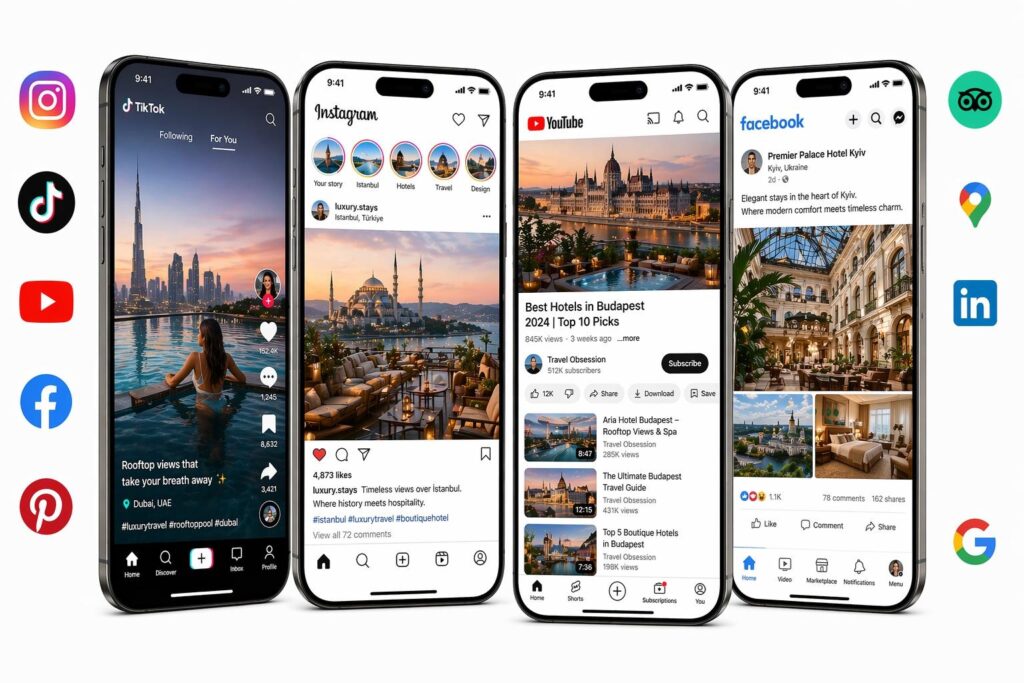
The social media landscape influencing hotel performance can be broadly understood through three interconnected layers: inspiration, validation, and conversion. Each layer is dominated by different platforms, each playing a distinct role in shaping how potential guests move from initial awareness to confirmed booking. Understanding these layers allows developers and investors to interpret social media not as a single channel but as an ecosystem that directly influences distribution, pricing, and demand stability.
At the inspiration stage, visually driven platforms such as Instagram, TikTok, and YouTube dominate the travel discovery process. These platforms do not rely on active search behaviour; instead, they introduce destinations and properties through curated content, influencer exposure, and algorithm-driven recommendations. Hotels that feature prominently in this layer benefit from organic visibility and aspirational positioning, often reaching audiences before formal travel planning begins. This has shifted competitive dynamics, particularly for lifestyle, resort, and design-led properties where visual storytelling can directly influence demand.
The validation layer is anchored by structured review platforms such as Tripadvisor and Google Maps. Here, potential guests move from inspiration to evaluation, assessing a property’s credibility through ratings, written reviews, and aggregated sentiment. This layer plays a decisive role in conversion, as even highly visible hotels may fail to secure bookings if review performance is weak or inconsistent. Importantly, this validation process is continuous rather than static, meaning that reputation must be actively managed over time to maintain pricing power and occupancy stability.
Social Media Platforms Within the Hotel Demand Ecosystem
| Platform | Primary Layer | Secondary Role | How It Influences Hotel Demand |
|---|---|---|---|
| Inspiration | Validation | Broad reach and legacy platform; supports discovery through content and reinforces trust via reviews and community engagement | |
| Inspiration | Validation (light) | Core visual platform for hotel discovery; drives aspirational demand through design, lifestyle, and location-led content | |
| Inspiration (B2B) | Validation (indirect) | Relevant for corporate positioning, investor perception, and brand credibility rather than direct guest demand | |
| Inspiration | — | Niche but effective for travel planning and design-led inspiration, particularly for resorts and lifestyle properties | |
| TikTok | Inspiration | Conversion (indirect) | Rapid awareness and viral reach; can trigger immediate travel intent and short-term booking spikes |
| YouTube | Inspiration | Validation | Long-form video builds deeper trust and destination understanding; supports higher-consideration travel decisions |
| Google Maps (Google Reviews) | Validation | Conversion | Integrated into search behaviour; often the final credibility check before booking |
| Tripadvisor | Validation | Conversion | Structured reviews and rankings; heavily influences final hotel selection and pricing confidence |
These layers ultimately connect to the conversion stage, where demand is captured either through direct booking channels or intermediaries such as online travel agencies. Social media does not operate in isolation; it feeds directly into broader distribution systems, influencing where and how bookings are made. For hotel developers and investors, the main insight is that social media shapes demand before it becomes visible in traditional metrics, making it an early indicator of market positioning and future performance.
Social Media as a Demand Driver (Pre-Booking Behaviour)
The shift from search-driven to inspiration-driven travel behaviour represents one of the most significant structural changes in the hospitality sector over the past decade. Traditionally, hotel demand was generated through a combination of brand awareness, destination appeal, and search-based discovery, with guests actively seeking accommodation options once travel intent had already been formed. Social media has fundamentally altered this sequence, introducing a model in which travel intent itself is often triggered by exposure to content rather than pre-existing plans.
Platforms such as Instagram and TikTok have created an environment where destinations and hotels are encountered organically through feeds, recommendations, and shared content. A rooftop pool, a distinctive lobby, or a unique guest experience can generate widespread visibility, placing a property directly into the consideration set of potential guests who may not have previously intended to visit that location. This has expanded the competitive landscape, allowing properties in secondary or emerging markets to compete with established destinations by leveraging visual appeal and shareable experiences. At the same time, it has heightened the importance of differentiation, as only properties that resonate in this content-driven environment achieve meaningful visibility.
For hotel development, this shift has direct implications for concept positioning and project feasibility. Developers must now consider not only traditional demand drivers such as location, accessibility, and market segmentation, but also the inherent “shareability” of the product. A hotel that generates organic visibility on social media can benefit from lower customer acquisition costs, stronger direct demand, and a faster ramp-up period following opening. Conversely, a property that lacks visual or experiential appeal may struggle to gain traction, relying more heavily on paid distribution channels and promotional pricing to drive occupancy. In this context, social media becomes an integral component of demand forecasting, influencing both revenue projections and long-term asset performance.
Reputation Layer: Reviews, Ratings and Trust Signals
While social media platforms drive discovery and initial interest, the booking decision itself is typically filtered through a layer of structured validation, where reputation becomes the decisive factor. Platforms such as Tripadvisor and Google Maps play a central role in this process, providing aggregated ratings, detailed guest feedback, and comparative positioning within a competitive set. Even where demand has been successfully generated through visually driven platforms, conversion is unlikely to occur unless a hotel performs strongly within this validation layer. As a result, reputation has evolved from a qualitative consideration into a quantifiable driver of revenue performance.
From an operational perspective, review platforms serve as a continuous, real-time audit of service delivery, capturing both strengths and weaknesses in ways that are publicly visible and difficult to control. Unlike traditional brand standards or internal quality assessments, reputation is shaped directly by guest perception, often reflecting aspects of the experience that may not be fully captured in formal operating frameworks. This creates both opportunity and risk: strong guest satisfaction can reinforce positioning and support pricing power, while inconsistencies or negative experiences can rapidly undermine demand, particularly in highly competitive urban markets where alternatives are readily available.
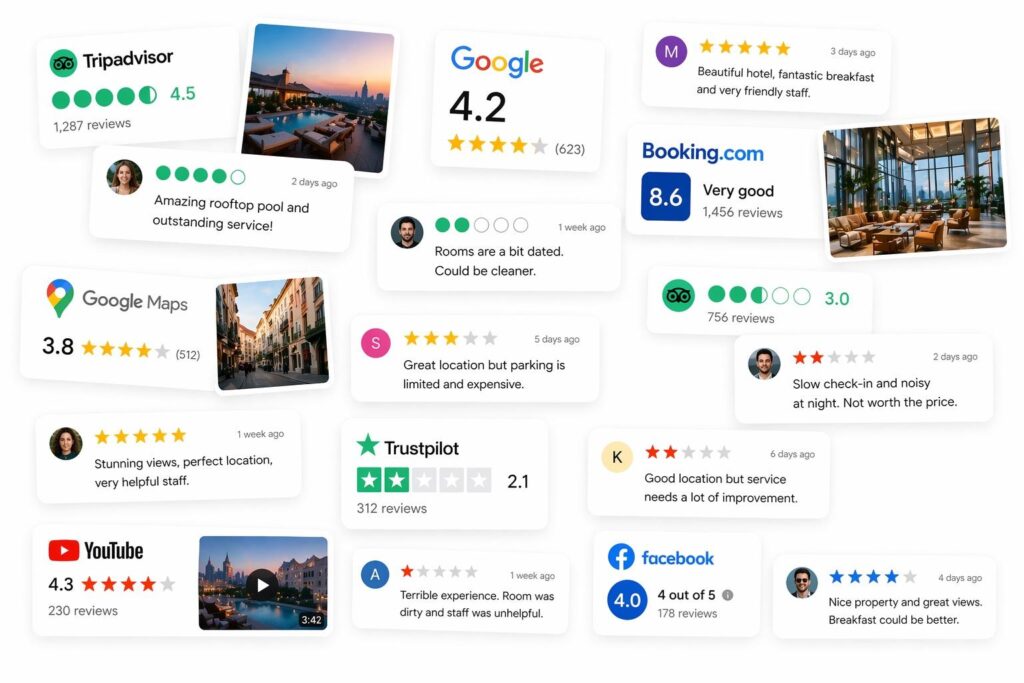
For investors, the stability and trajectory of review scores have direct financial implications. Consistently high ratings are typically associated with stronger ADR performance, higher occupancy resilience, and improved market positioning, all of which contribute to enhanced asset value. Conversely, declining or volatile reputation indicators can signal operational weaknesses, increased pricing pressure, and potential long-term performance risk. Importantly, reputation trends are often visible before their full impact is reflected in financial results, making them an early indicator of asset performance. In this context, social media and review platforms together form a critical component of the asset monitoring framework, linking guest perception directly to financial outcomes.
Social Media vs OTAs: Demand Creation vs Demand Capture
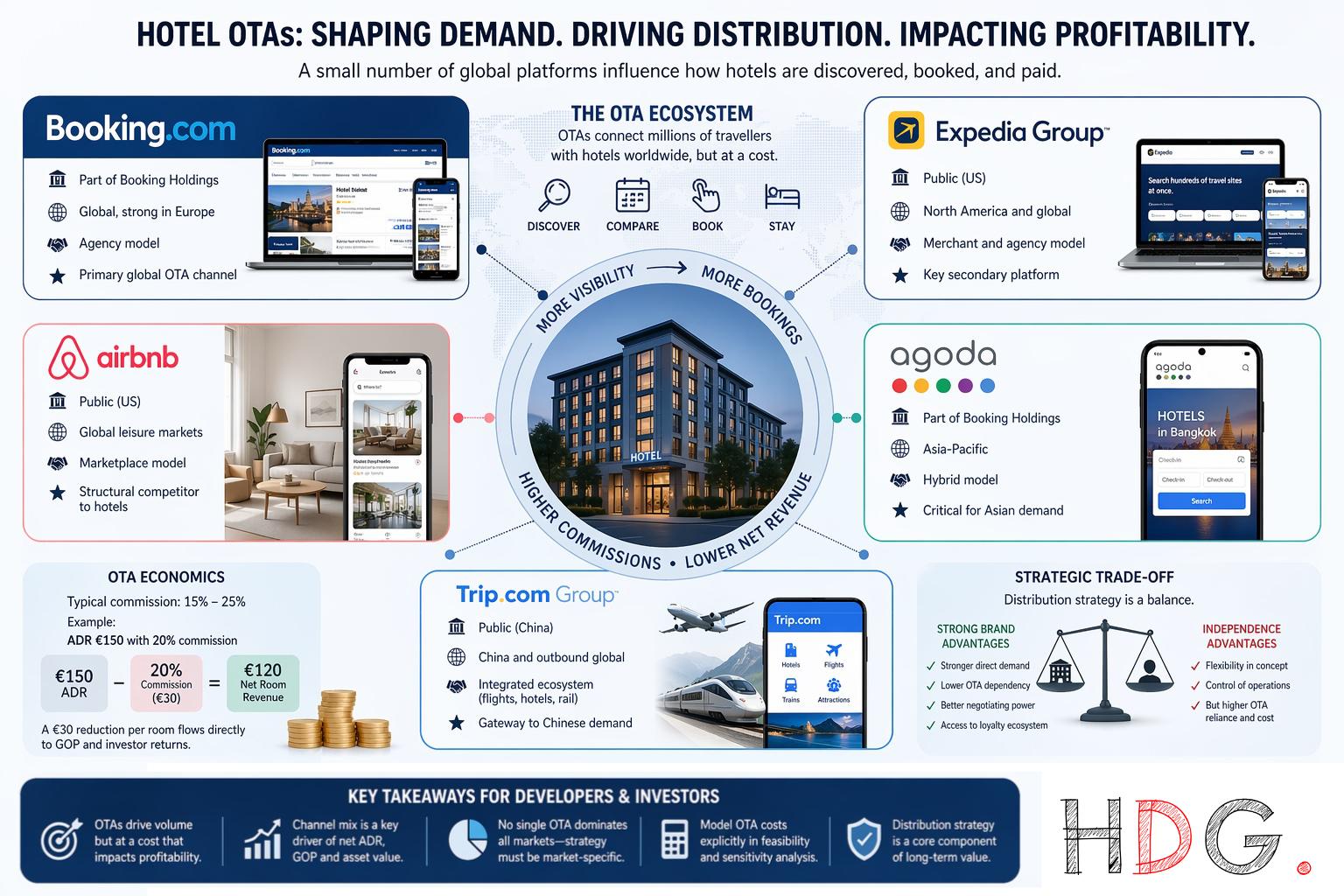
The relationship between social media and online travel agencies represents one of the defining structural dynamics within modern hotel distribution. Social media platforms create demand by influencing awareness, aspiration, and consideration, while OTAs such as Booking.com and Expedia Group capture that demand at the point of booking. Understanding the distinction between these roles is essential for developers and investors, as it shapes both revenue strategy and distribution costs.
A common misconception is that strong social media performance inherently reduces reliance on OTAs by driving direct bookings. In practice, this outcome is far from guaranteed. While social media can generate significant visibility and interest, conversion behaviour is influenced by a range of factors, including brand recognition, booking convenience, perceived security, and loyalty programme benefits. In many cases, users who discover a hotel on Instagram or TikTok will subsequently complete their booking through an OTA, particularly if the property lacks a robust direct-booking ecosystem. As a result, social media often acts as a feeder channel, increasing overall demand while leaving the capture of that demand to intermediary platforms.
For hotel developers and investors, the core consideration is not simply whether social media drives demand, but how that demand is ultimately monetised. Properties that combine a strong social media presence with an effective direct booking infrastructure, supported by brand distribution systems, loyalty programmes, and user-friendly digital interfaces, are better positioned to convert visibility into higher-margin revenue. Conversely, hotels that rely heavily on OTAs may benefit from increased demand but still face elevated distribution costs, limiting the net financial impact. This dynamic reinforces the importance of aligning social media strategy with broader distribution planning, ensuring that demand creation translates into sustainable revenue performance rather than incremental dependency on third-party channels.
Hotel Social Media Strategy (Integrated Within Development and Operations)
A structured social media strategy is essential for translating visibility into measurable commercial outcomes, yet it must be understood within the broader context of hotel positioning, brand alignment, and operational capability. Unlike traditional marketing strategies, which can often be developed and implemented independently of the physical product, a social media strategy is closely linked to the underlying guest experience. Content must reflect reality; otherwise, discrepancies between expectation and delivery will quickly be exposed through reviews and guest feedback. This creates a direct connection between strategic intent, operational execution, and reputational outcomes.
At a practical level, an effective strategy begins with platform prioritisation and content positioning. Not all platforms are equally relevant for every property type or market segment. Instagram remains central for design-led and lifestyle positioning, where visual identity and aesthetic consistency play a critical role. TikTok offers broader reach and viral potential, particularly for experiential content and destination-driven storytelling, while YouTube supports deeper engagement through long-form narratives. These platforms should be aligned with the hotel’s target audience, brand positioning, and geographic market, rather than pursued uniformly. At the same time, review platforms such as Tripadvisor and Google must be actively managed as part of the strategy, as they ultimately determine whether demand converts into bookings.
The distinction between branded and independent hotels is particularly relevant in this context. Global brands typically benefit from established content ecosystems, centralised marketing resources, and integrated distribution platforms, allowing individual properties to leverage broader brand visibility. Independent hotels, by contrast, often rely more heavily on organic social media performance to build awareness and differentiate themselves within the market. While this can create opportunities for highly distinctive properties, it also introduces greater risk, as performance is more dependent on consistent content creation, audience engagement, and reputation management. For developers and investors, the chosen operating model therefore has direct implications for how social media contributes to demand generation, distribution efficiency, and overall asset performance.
Hotel Social Media Strategy: Branded vs Independent Hotels
| Strategy Element | Branded Hotels | Independent Hotels |
|---|---|---|
| Platform Role | Leverage global brand presence across platforms such as Instagram, TikTok, and YouTube | Build visibility primarily through property-level accounts and organic reach |
| Content Positioning | Aligned with brand guidelines, tone, and visual identity across the portfolio | Flexible, highly localised, often more distinctive and experimental |
| Content Creation | Supported by central brand teams, templates, and shared content libraries | Managed in-house or via agencies; dependent on property resources and creativity |
| Audience Reach | Immediate access to global audiences and established follower base | Gradual audience growth; relies on engagement, storytelling, and differentiation |
| Consistency & Frequency | Typically structured and consistent due to brand oversight | Can vary significantly depending on resources and management focus |
| Reputation Management | Supported by brand systems and protocols across Tripadvisor and Google Maps | Fully property-driven; requires active monitoring and response discipline |
| Distribution Integration | Strong integration with brand websites, loyalty programmes, and direct booking channels | Often more reliant on third-party platforms; direct booking depends on digital capability |
| Influencer & Campaign Strategy | Coordinated at brand or regional level with selected partnerships | Opportunistic or locally driven collaborations; can be highly targeted but less scalable |
| Risk Profile | Lower volatility due to brand support, but less flexibility in positioning | Higher volatility; success depends on execution quality and consistency |
| Differentiation Potential | Limited by brand standards, though supported by brand recognition | High potential for unique positioning and standout content |
Social Media and Hotel Design: Designing for Visibility and Shareability
The influence of social media on hotel design represents one of the most tangible intersections between digital behaviour and physical development. Historically, hotel design was driven by a combination of functional requirements, brand standards, cost considerations, and aesthetic positioning. While these factors remain fundamental, the rise of visually driven platforms such as Instagram and TikTok has introduced an additional layer of consideration: how guests will experience, capture, and share the space. As a result, design is no longer only about how a hotel looks and operates, but also about how it performs in a digital environment where visual impact directly influences demand.
This shift has led to the deliberate creation of “social moments” within hotel environments, spaces or features that encourage interaction, photography, and content generation. Rooftop bars with panoramic views, statement lobbies, distinctive pool areas, and signature F&B concepts are increasingly designed not only as amenities, but as content-generating assets. Lighting, material selection, spatial composition, and sightlines are all considered through the lens of how they translate into imagery and short-form video. Importantly, this does not imply superficial design; rather, it reflects an integrated approach where aesthetic, experiential, and commercial objectives are aligned. When executed effectively, these elements contribute to organic visibility, reinforcing brand positioning and reducing reliance on paid marketing channels.

For developers, integrating social media considerations into design requires a balance between authenticity and intentionality. Overly contrived or trend-driven features may generate short-term attention but risk becoming quickly outdated, while more timeless, experience-led design can sustain relevance over longer investment horizons. The challenge lies in identifying which elements of the hotel will resonate with the target market and ensuring they are embedded in the concept from the outset. This has implications for the design brief, consultant selection, and coordination between architecture, interior design, and operational planning. Ultimately, designing for visibility is not about adding superficial features, but about ensuring that the hotel’s core identity is both physically compelling and digitally translatable.
Operational Integration: Social Media as a Live System
Beyond its influence on design and positioning, social media has become an integral component of hotel operations, functioning as a real-time interface between the property and its guests. Platforms such as Google Maps and Tripadvisor capture continuous guest feedback, while channels like Instagram provide direct avenues for interaction, messaging, and public commentary. This ongoing flow of information effectively extends the operational environment beyond the hotel’s physical boundaries, requiring structured processes to monitor engagement, respond to feedback, and maintain brand consistency. In this context, social media is no longer an external communication channel, but a live operational system that reflects and influences day-to-day performance.
From an operational standpoint, this introduces both responsiveness requirements and heightened reputational exposure. Guest complaints, service failures, or misunderstandings can be communicated instantly and publicly, often reaching a wider audience than traditional feedback mechanisms. This necessitates clearly defined response protocols, staff training, and alignment between operational teams and marketing or communications functions. At the same time, positive engagement, such as reposting guest content, responding to feedback, or interacting with influencers, can reinforce brand identity and strengthen guest relationships. To manage this complexity, hotels increasingly rely on dedicated social media and reputation management platforms such as ReviewPro, TrustYou, Sprout Social, and Revinate, which enable monitoring and management across multiple channels through a centralised operational framework.
These platforms support a range of functions, from content scheduling and engagement tracking to review aggregation and sentiment analysis, effectively integrating digital feedback into operational workflows. For asset managers and investors, this has implications for both cost structures and performance monitoring, as dedicated resources and systems are required to manage this layer effectively. At the same time, these tools provide valuable data, enabling hotels to track response times, identify recurring issues, and measure engagement quality alongside traditional performance metrics. The table below outlines the typical roles of key platform types within hotel operations:
| Platform Type | Example Tools | Core Function | Operational Relevance |
|---|---|---|---|
| Social Media Management | Hootsuite, Buffer | Content scheduling, publishing, multi-channel management | Ensures consistency of brand messaging and timely engagement across platforms |
| Engagement & Analytics | Sprout Social | Monitoring interactions, analysing engagement and audience behaviour | Supports performance tracking and optimisation of content strategy |
| Reputation Management | ReviewPro, TrustYou | Aggregating reviews, sentiment analysis, benchmarking | Provides real-time visibility of guest perception and competitive positioning |
| CRM & Guest Feedback Integration | Revinate | Linking guest data, surveys, and feedback with marketing and operations | Enables personalised engagement and integration of feedback into service improvement |
Metrics That Matter: Linking Social Media Performance to Financial Outcomes
One of the key challenges in assessing social media performance is distinguishing between superficial indicators of popularity and metrics that have meaningful commercial relevance. While measures such as follower counts or content likes may provide a general sense of visibility, they do not, in isolation, offer insight into how social media contributes to revenue generation or asset value. For developers and investors, the focus must therefore be on metrics that can be linked, directly or indirectly, to financial performance and risk.
A more relevant framework considers how social media signals translate into demand consistency, pricing power, and operational stability. Engagement levels on platforms such as Instagram or TikTok can indicate the extent to which a property resonates with its target audience, while review scores on Google and Tripadvisor provide a quantifiable measure of guest satisfaction and perceived value. Sentiment analysis, whether formal or informal, can reveal emerging issues or strengths within the guest experience, often before these are reflected in occupancy or revenue metrics. Content reach, particularly on video platforms like YouTube and TikTok, can also provide insight into market penetration and awareness, especially for new or repositioned assets.
| Social Signal | Platform Context | Investment Relevance |
|---|---|---|
| Engagement levels | Instagram / TikTok | Demand visibility and audience resonance |
| Review scores | Google / Tripadvisor | Pricing power and guest satisfaction |
| Sentiment trends | All platforms | Early indicator of operational risk |
| Content reach | YouTube / TikTok | Market awareness and growth potential |
For investors, the value of these metrics lies not only in their ability to explain current performance, but also in their role as forward-looking indicators. A hotel with strong engagement, stable review scores, and positive sentiment trends is more likely to sustain its market position and deliver consistent returns. Conversely, declining engagement or deteriorating reputation may signal underlying issues that could impact future performance. Integrating these indicators into asset management frameworks allows for a more holistic understanding of risk and opportunity, aligning digital perception with financial outcomes.
Risk, Volatility and Crisis Amplification
The same mechanisms that enable social media to amplify visibility and strengthen market positioning also introduce heightened risk, particularly regarding reputational volatility. Platforms such as TikTok and Instagram, along with shareable content, both positive and negative, are spreading rapidly among global audiences, often without context or verification. A single incident, whether operational, service-related, or external, can escalate quickly, influencing perception well beyond the immediate guest base. This dynamic has effectively compressed the timeline from issue occurrence to commercial impact, reducing operators’ ability to manage reputational challenges through traditional, slower-moving channels.
From an operational and asset-management perspective, this creates a need for a structured crisis-preparedness and response capability. Hotels must be equipped not only to manage issues internally but to respond publicly, consistently, and credibly across multiple platforms. This requires coordination between operations, communications, and brand teams, as well as clearly defined protocols for escalation and resolution. In branded environments, the operator’s global infrastructure may support the management of such situations, whereas independent hotels often rely on in-house capabilities or external advisors. The effectiveness of this response can significantly influence the extent to which a reputational issue translates into financial impact.
For investors, social media-driven volatility represents a distinct category of risk that must be considered alongside more traditional factors such as market demand, economic conditions, and operational performance. Negative sentiment can lead to immediate pricing pressure, reduced occupancy, and longer-term brand damage, particularly if not addressed effectively. Conversely, well-managed responses to challenging situations can reinforce trust and demonstrate operational resilience. As such, the ability of an operator or management team to navigate the social media landscape, particularly in times of crisis, has become an increasingly relevant consideration in operator selection, underwriting assumptions, and ongoing asset monitoring.
Examples of Social Media–Driven Reputation Events in Hospitality
| Incident Type | Typical Scenario | Social Media Amplification & Commercial Impact |
|---|---|---|
| Operational failure captured on video | Guest records a service incident or conflict in real time | Video spreads rapidly across short-form platforms, removing brand control; immediate reputational damage and booking hesitation |
| Expectation vs reality mismatch | Hotel presentation differs from actual guest experience | “Instagram vs reality” content gains traction through shares and comments, accelerating trust erosion and cancellations |
| Service quality complaint (high-end segment) | Guest highlights poor service at a premium property | Posts gain visibility due to brand expectations and audience engagement, creating disproportionate reputational impact |
| Health, hygiene, or safety concern | Guest reports cleanliness or safety issue | Emotion-driven content is widely shared, amplifying perceived risk and triggering immediate demand shock |
| Technology or data-related issue | Data breach or system failure becomes public | News and social media discussion combine to extend reach and duration of the issue, deepening trust erosion |
| Influencer amplification (negative) | Influencer shares a critical experience | Large follower base accelerates exposure, rapidly scaling a local issue into a broader reputational event |
| Local incident becoming global | Minor property-level issue gains attention online | Cross-platform sharing removes geographic limits, extending impact to brand or portfolio level |
Impact on Valuation and Exit
As social media becomes more deeply embedded in the hospitality ecosystem, its influence extends beyond operational performance into the realm of asset valuation and exit strategy. Historically, hotel valuation has been driven primarily by financial metrics such as stabilised NOI, yield expectations, and comparable transactions. While these remain fundamental, there is growing recognition that digital presence and reputation play a meaningful role in shaping both perceived risk and future income potential. Buyers are increasingly aware that a hotel’s online positioning can influence its ability to sustain performance, particularly in competitive or rapidly evolving markets.
In practical terms, this means prospective investors often review a property’s digital footprint as part of their due diligence. This includes assessing review scores on platforms such as Tripadvisor and Google Maps, evaluating engagement and content positioning on social platforms, and understanding how the property is perceived relative to its competitive set. A hotel with strong, consistent digital performance is likely to be viewed as lower risk, with greater confidence in its ability to maintain pricing power and occupancy levels. This can translate into more favourable yield expectations and, ultimately, higher asset value.
Conversely, weaknesses in digital presence or reputation may result in increased scrutiny, more conservative underwriting assumptions, and downward pressure on valuation. In some cases, a gap between physical product quality and digital perception can create a misalignment that must be addressed prior to exit, either through operational improvements or targeted repositioning. For developers, this reinforces the importance of integrating social media considerations from the outset, ensuring that the asset is not only well-conceived and efficiently operated but also positioned effectively within the digital landscape. For investors, it highlights the need to incorporate digital performance indicators into valuation frameworks, recognising their role in shaping both current income and future exit outcomes.
Forward View: Social Media as Core Infrastructure in Hotel Development
The role of social media within the hotel sector continues to evolve, but its trajectory is clear: it is becoming an integral component of how hotel assets are conceived, operated, and valued. What was once considered a marketing tool has evolved into core infrastructure, influencing demand creation, guest expectations, operational processes, and investment decisions. This shift reflects broader changes in consumer behaviour, in which digital interaction and peer validation are central to decision-making at all stages of the travel journey.
Looking forward, the integration of social media into hotel development is likely to deepen further, with implications for how projects are planned and executed. Developers will need to consider digital visibility alongside traditional factors such as location and brand alignment, ensuring that concepts are both operationally viable and socially relevant. Operators will continue to refine their approach to content, engagement, and reputation management, embedding these functions more closely within day-to-day operations. At the same time, investors will increasingly incorporate digital performance into their assessment of risk and return, recognising that perception and visibility are directly linked to financial outcomes.
Ultimately, hotels can no longer be understood solely as physical assets delivering accommodation services. They are experience-driven, digitally mediated products whose success depends on how they are perceived, shared, and validated within a global network of platforms and users. For those involved in hotel development and investment, the ability to navigate this landscape effectively will be a defining factor in achieving sustainable performance and long-term value creation.
Further Resources:
See HDG – Hotel OTAs and the Reshaping of Hotel Distribution Economics