
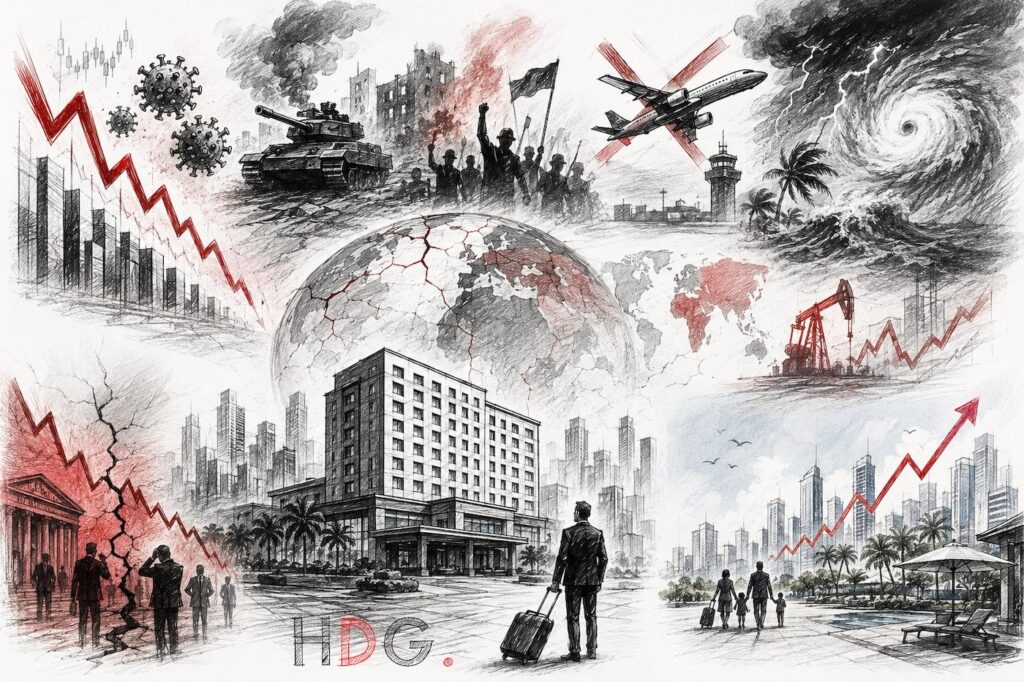
Hotel industry crises have repeatedly reshaped global tourism, hotel performance, investment activity, and development strategy over the past several decades. The hotel sector is uniquely exposed to disruption because it sits at the intersection of mobility, consumer confidence, aviation, finance, and geopolitics. Economic downturns, pandemics, wars, political instability, terrorism, energy shocks, and regional conflicts can all rapidly affect travel demand and hotel profitability, often with immediate consequences for occupancy, ADR, investment liquidity, and development feasibility.
At the same time, the global hotel industry has historically demonstrated a strong capacity for recovery. While some crises create prolonged structural damage, others produce sharp but relatively temporary disruptions followed by surprisingly rapid rebounds in demand and investor confidence. However, recovery patterns are rarely uniform. Different hotel types, destinations, and regions recover at different speeds depending on factors such as domestic tourism strength, airline connectivity, geopolitical perception, financing conditions, and supply dynamics. Understanding hotel industry crises and recovery cycles has therefore become increasingly important for hotel developers, investors, operators, lenders, and asset managers.
- Why Hotels Are Highly Sensitive to Disruption
- Types of Hotel Industry Disruption
- Major Hotel Industry Crises Since 2000
- Why Some Hotel Markets Recover Faster Than Others
- Recovery Patterns by Hotel Type
- What Investors Learned from Recent Crises
- How Crises Affect Hotel Development
- Typical Recovery Timeline by Crisis Type
- The Myth and Reality of Hotel Recovery
Why Hotels Are Highly Sensitive to Disruption
Mobility and Confidence Dependence
Hotels are fundamentally dependent on human mobility. International tourism relies on functioning aviation networks, open borders, stable diplomatic relations, and consumer willingness to travel. Even relatively localised events can have global effects because modern travel behaviour is heavily influenced by media coverage and rapidly shifting public perception. Security incidents, disease outbreaks, political unrest, or geopolitical tensions can trigger immediate booking cancellations and reduced forward demand, even in markets not directly affected by the underlying event.
Consumer and corporate confidence also play a critical role. Leisure travel is often discretionary spending, while corporate travel budgets are among the first expenses reduced during economic downturns. Hotels therefore experience a double exposure during crises: reduced willingness to travel and reduced financial capacity to travel. This sensitivity can create abrupt declines in occupancy and revenue, particularly in gateway cities, convention destinations, and markets heavily reliant on international arrivals.
Operating Leverage and Financial Exposure
Hotels also operate with relatively high fixed costs compared to many other real estate sectors. Staffing, utilities, maintenance, management infrastructure, insurance, and debt servicing continue even when occupancy falls sharply. While operators can partially reduce variable costs, many expenses remain difficult to eliminate entirely. This operating leverage means that modest declines in occupancy or average daily rate (ADR) can produce disproportionately large impacts on profitability and cash flow.
In addition, hotels are highly exposed to financing conditions and investment sentiment. During major financial disruptions, lenders often reduce liquidity, tighten underwriting standards, and increase pricing, which can significantly reduce transaction activity and the feasibility of development. The Global Financial Crisis demonstrated how rapidly hotel investment markets can freeze when debt becomes scarce, while the post-pandemic period illustrated the importance of government support, lender flexibility, and stronger cashflow management practices.
Recovery following the COVID-19 pandemic was supported by a hotel industry that was financially more cautious and operationally more resilient than it had been before the Global Financial Crisis (GFC) of 2008. After the financial crisis, lenders, investors, and hotel owners generally adopted lower leverage levels, stricter financing structures, and a greater focus on cash flow management and operational efficiency. This meant that, despite the unprecedented disruption caused by the pandemic, many hotel businesses entered the crisis with stronger balance sheets and improved ability to manage periods of severe volatility.
Types of Hotel Industry Disruption
Hotel industry disruptions vary considerably in scale, duration, and impact profile. Some crises are global and systemic, affecting nearly all markets simultaneously, while others are regional or localised. Certain disruptions primarily affect financing conditions and investment markets, whereas others directly restrict travel activity itself. Understanding these distinctions is important because recovery patterns often depend more on the nature of the disruption than on the scale of the initial shock.
Some disruptions also create redistribution effects rather than universal demand destruction. Political instability in one region may redirect demand to competing destinations, while aviation disruption or currency fluctuations can alter travel flows between markets. As a result, hotel crises rarely affect all destinations equally. Markets with strong domestic tourism, diversified demand bases, resilient infrastructure, or perceived political stability often recover faster than those heavily reliant on a narrow segment of international demand.
| Disruption Type | Example Events | Typical Hotel Impact | Typical Recovery Pattern |
|---|---|---|---|
| Financial Crisis | Global Financial Crisis (2008) | Demand collapse, financing freeze, distressed assets | Slow, multi-year recovery |
| Pandemic | COVID-19 | Occupancy collapse, border closures, shutdowns | Sharp rebound once travel resumes |
| Regional Conflict | Russian Invasion of Ukraine | Demand displacement, aviation disruption | Uneven regional recovery |
| Political Instability | Arab Spring | Destination reputation damage | Recovery linked to stability perception |
| Terrorism & Security | Paris attacks, Istanbul attacks | Short-term booking decline | Often relatively rapid recovery |
| Energy/Oil Shock | Oil crises, Red Sea disruptions | Higher travel costs, airline pressure | Demand compression and route shifts |
| Natural Disaster | Earthquakes, tsunamis | Local operational shutdown | Infrastructure dependent |
| Currency Crisis | Türkiye, Argentina | Mixed effects on inbound/outbound demand | Market-specific outcomes |
Major Hotel Industry Crises Since 2000
September 11 and the Security Era
The September 11 attacks in 2001 fundamentally reshaped global travel behaviour and aviation security. Corporate travel declined sharply in the immediate aftermath, while international air travel experienced widespread disruption and increased passenger anxiety. Hotels in major gateway cities, airport locations, and convention destinations were particularly affected as business travel budgets contracted and travel restrictions tightened. The event also accelerated permanent structural changes in airport security and traveller behaviour that continue to influence the industry today.
Despite the severity of the initial shock, recovery in many markets was relatively rapid once confidence gradually returned. The crisis demonstrated an important characteristic of hotel demand: in many cases, travel is deferred rather than permanently destroyed. Major cities eventually regained international visitation, although recovery speed varied significantly depending on local economic conditions and airline connectivity. The post-9/11 period also reinforced the importance of diversification across demand segments and source markets.
SARS and Early Pandemic Lessons
The SARS outbreak in 2003 represented an early modern example of how disease outbreaks could severely affect hotel demand, particularly in Asia-Pacific markets. While geographically concentrated compared to COVID-19, the outbreak highlighted the sensitivity of tourism flows to health concerns and media coverage. Hotels in affected cities experienced rapid occupancy declines, particularly those dependent on international business travel and regional aviation networks.
Importantly, the SARS recovery also demonstrated how quickly hotel demand could rebound once public confidence improved. Unlike financial crises, where economic weakness can persist for years, health-related disruptions may produce shorter but sharper declines followed by accelerated recovery. This distinction later became highly relevant during the COVID-19 pandemic, when leisure demand in many markets rebounded far faster than initially anticipated.
Global Financial Crisis (2008–2012)
The Global Financial Crisis was one of the most significant financial disruptions in the modern hotel industry’s history. Hotel demand weakened sharply across both corporate and leisure segments as consumer confidence collapsed, business spending declined, and access to financing deteriorated. Occupancy declines placed pressure on ADR, while lenders withdrew liquidity from the market, freezing many hotel transactions and development projects. Higher leverage levels and tighter cash flows contributed to widespread distress in parts of Europe during this period.
Recovery from the GFC was relatively slow compared to later crises. Western European markets gradually recovered during the early 2010s, while Southern and Eastern European destinations often faced more prolonged structural challenges. Hotel values took several years to recover to pre-crisis levels, and transaction activity remained subdued for an extended period. The crisis fundamentally reshaped hotel financing practices, leading to more conservative underwriting standards, reduced leverage, and greater focus on asset resilience.
Arab Spring and Regional Instability
The Arab Spring uprisings beginning in 2010 had profound effects on tourism markets across North Africa and parts of the Middle East. Destinations such as Egypt and Tunisia experienced sharp declines in international visitation as political instability, civil unrest, and security concerns damaged traveller confidence. Resort markets heavily dependent on European package tourism were particularly vulnerable, while broader regional perception effects influenced neighbouring destinations as well.
However, the recovery patterns also demonstrated how tourism demand can rebound once stability perceptions improve. Certain resort markets recovered more quickly than expected once aviation connectivity returned and international tour operators resumed programmes. The period also highlighted how geopolitical instability can redistribute tourism demand regionally, benefiting alternative Mediterranean destinations perceived as safer or more stable.
COVID-19 Pandemic
The COVID-19 pandemic produced the largest operational disruption in modern hotel industry history. Unlike the GFC, which primarily affected financial markets and consumer spending, COVID directly restricted mobility itself through lockdowns, border closures, and travel bans. Occupancy collapsed across much of the global hotel sector, with many properties temporarily closing altogether. Urban gateway hotels, conference properties, and internationally dependent markets experienced particularly severe disruption.
At the same time, the post-pandemic recovery proved significantly faster than many observers initially expected. Leisure demand rebounded strongly and became the primary driver of recovery, while corporate travel recovered more gradually. Government support programmes, lender flexibility, stronger operational efficiencies, and more conservative leverage structures also helped stabilise the sector compared to the post-GFC environment. Resort- and leisure-oriented destinations, in particular, experienced rapid ADR growth once restrictions eased, while domestic tourism became a major source of resilience in many markets.
Russian Invasion of Ukraine and Geopolitical Fragmentation
The Russian invasion of Ukraine created a different form of disruption, combining geopolitical uncertainty, energy market volatility, aviation restrictions, sanctions, and regional perception impacts. Some Eastern European markets experienced investor caution and weaker tourism demand due to perceived proximity to the conflict. The conflict also affected air routes across parts of Eastern Europe and Russia, increased operational uncertainty for airlines and tour operators, and contributed to wider inflationary pressure through higher energy and commodity costs.
The war also triggered an unprecedented corporate response from many international hotel groups operating in Russia. Several global operators suspended development activity, paused new investments, restricted corporate operations, or withdrew from the Russian market altogether following international sanctions imposed on Russia and Belarus. Existing projects faced uncertainty regarding branding, management agreements, access to financing, and long-term operational viability, and future pipeline growth for international hotel brands in Russia almost ceased. The situation demonstrated how geopolitical events can rapidly affect not only hotel demand but also brand expansion strategy, development pipelines, investor confidence, and the practical ability of international operators to function within certain markets.
Why Some Hotel Markets Recover Faster Than Others
Domestic Demand and Leisure Strength
One of the strongest determinants of recovery speed is the strength of domestic and regional demand. Markets with large domestic tourism bases are often better positioned to recover from international disruptions because internal travel can resume more quickly than long-haul international demand. During COVID-19, many resort and drive-to destinations recovered substantially faster than international gateway cities because domestic leisure travellers returned first.
Leisure-oriented destinations also frequently recover faster than convention or corporate-heavy markets. Leisure demand tends to rebound rapidly once restrictions ease because travellers often prioritise postponed holidays and experiential spending. By contrast, corporate travel recovery can be slower due to cost controls, hybrid working practices, and structural changes in business travel behaviour. This distinction became particularly visible during the post-pandemic recovery period.
Access, Perception, and Supply Conditions
Aviation connectivity and destination perception are equally important. Markets with strong airline networks, diversified source markets, and positive international reputations generally regain demand more quickly once confidence improves. Conversely, destinations suffering from prolonged political instability, infrastructure damage, or reputational challenges may experience slower recovery even after conditions stabilise.
Supply dynamics also influence recovery trajectories. Markets with limited new hotel supply often recover profitability faster because returning demand is absorbed by a relatively constrained inventory base. By contrast, destinations with aggressive pre-crisis development pipelines may face prolonged pressure on occupancy and rates if supply growth continues during periods of weakened demand. In some cases, crises also delay future supply, indirectly benefiting incumbent hotels during the recovery phase.
Recovery Patterns by Hotel Type
Different hotel categories experience crises differently depending on their customer base, operating structure, and market positioning. Some sectors are highly exposed to corporate travel or international aviation, while others benefit from domestic tourism, flexibility, or longer-stay demand. These distinctions can significantly influence both the depth of disruption and the speed of recovery.
In recent crises, extended-stay, select-service, and leisure-oriented properties have often demonstrated stronger resilience than large urban convention hotels. Resort destinations with strong domestic access also frequently outperform during recovery periods. However, long-term performance depends heavily on the specific nature of each disruption, as different crisis types affect traveller behaviour in different ways.
| Hotel Type | Crisis Vulnerability | Typical Recovery Speed |
|---|---|---|
| Luxury Urban Hotels | High exposure to international and corporate demand | Moderate |
| Resort Hotels | Medium exposure, strong leisure rebound potential | Fast |
| Budget Hotels | Lower ADR exposure, domestic focus | Fast |
| Extended Stay Hotels | Strong resilience during operational disruptions | Very fast |
| Conference Hotels | High reliance on events and business travel | Slow |
| Lifestyle Hotels | Flexible positioning and mixed demand | Moderate to fast |
What Investors Learned from Recent Crises
The major crises of the past two decades significantly reshaped hotel investment strategies and underwriting practices. Following the Global Financial Crisis, investors and lenders became more cautious regarding leverage levels, debt structures, and cash flow assumptions. Hotels were increasingly evaluated not only on growth potential, but also on resilience during periods of market stress. More conservative leverage and underwriting practices contributed to improved sector resilience during the post-pandemic recovery period.
Cashflow flexibility and operational adaptability have also become increasingly important. Investors now place greater emphasis on diversified demand segmentation, strong domestic tourism potential, efficient operating models, and flexible cost structures. Assets capable of adjusting staffing, pricing, and operational intensity during periods of volatility are generally viewed more favourably than highly rigid operational models.
Recent crises have additionally reinforced the importance of liquidity, asset quality, and long-term positioning. Prime hotels in globally recognised destinations often recover faster because they maintain stronger investor confidence and financing access during uncertain periods. Meanwhile, secondary assets with weak positioning or structural operational challenges may experience prolonged distress. The result has been an increasing focus on resilient locations, experiential demand drivers, and properties capable of adapting to changing traveller preferences.
How Crises Affect Hotel Development
Hotel development is particularly vulnerable during periods of disruption because projects typically involve long timelines, significant capital commitments, and multiple layers of financing and operational coordination. Economic uncertainty can delay investment decisions, reduce lender appetite, increase borrowing costs, and weaken development feasibility. During major crises, projects are often postponed, redesigned, or cancelled altogether as developers reassess demand assumptions and financing structures.
Construction and development costs may also increase during periods of disruption due to supply chain instability, labour shortages, currency volatility, or energy price increases. Recent geopolitical tensions have highlighted how vulnerable global construction supply networks are to trade disruptions and inflationary pressures. Development costs remain highly exposed to energy pricing, supply chain conditions, and broader inflationary pressures.
At the same time, crises can create new opportunities for developers and investors with access to liquidity and long-term confidence. Distressed assets, repositioning opportunities, adaptive reuse projects, and reduced future supply pipelines may all improve medium-term market fundamentals once recovery begins. Historically, periods of disruption have often created some of the most attractive hotel investment opportunities, particularly for investors able to take a long-term view of market recovery.
Typical Recovery Timeline by Crisis Type
Recovery timelines vary significantly depending on the nature of the disruption, government response, financing conditions, and traveller psychology. Some shocks primarily affect confidence and recover relatively quickly, while others produce prolonged structural economic weakness that can suppress hotel performance for many years.
The table below illustrates broad historical recovery tendencies rather than fixed rules. Actual recovery periods vary considerably by destination, hotel type, and market positioning.
| Crisis Type | Typical Recovery Timeline |
|---|---|
| Terrorism or Security Incident | 3–12 months |
| Political Instability | 1–3 years |
| Regional Conflict | 1–5 years |
| Financial Crisis | 4–8 years |
| Pandemic | 2–5 years |
| Natural Disaster | Highly location dependent |
| Currency Crisis | Often mixed and uneven |
The Myth and Reality of Hotel Recovery
Hotel markets have repeatedly demonstrated an ability to recover from major disruption, but recovery is rarely uniform. Some destinations emerge stronger due to improved infrastructure, repositioning, reduced supply growth, or changes in traveller behaviour. Others struggle with prolonged reputational damage, structural oversupply, political instability, or weakened investment confidence. As a result, crises often accelerate differentiation between resilient and vulnerable markets rather than affecting all destinations equally.
The broader lesson is that disruption has become a structural feature of the global hotel industry rather than an occasional anomaly. Economic volatility, geopolitical fragmentation, climate-related events, energy instability, and changing travel patterns are likely to remain recurring themes over the coming decades. Many of the most significant disruptions affecting the hotel sector in recent history were either underestimated or largely absent from mainstream forecasting models before they occurred, reflecting what Nassim Nicholas Taleb described as “Black Swan” events, rare or unexpected shocks with disproportionately large consequences.
For hotel developers, investors, operators, and lenders, the practical challenge is not simply predicting every future crisis, but building assets, financing structures, and operating models capable of adapting to cyclical instability and unexpected disruption while maintaining long-term competitiveness and resilience.
Further Resources:
See HDG – Hotel Security Consultants | Risk, Certification & Safety Standards
See HDG – Reputation Management
See HDG – Artificial Intelligence – AI in Hospitality
Glion – March 2024 – “Mastering crisis management–transform your hospitality business!“
Amazon.com – The Black Swan: The Impact of the Highly Improbable