
Hotel distribution is entering a structural shift that is not immediately visible in traditional performance metrics, yet has profound implications for how demand is generated, filtered, and ultimately converted into bookings. For decades, hotel visibility followed a relatively linear pathway: awareness through marketing or brand presence, comparison across intermediaries such as online travel agencies (OTAs) or brand websites, and eventual conversion based on price, location, and perceived quality.
While this framework still exists, it is increasingly being preceded by a new layer of decision-making, one in which artificial intelligence systems interpret traveller intent, evaluate available information, and narrow options before the guest ever encounters the hotel directly. This emerging layer can be defined as AI-mediated hotel discovery, where the initial shaping of demand occurs before traditional distribution channels are even engaged.
In this context, AI-mediated hotel discovery represents a shift from visibility to interpretability. It is no longer sufficient for a hotel to be present across multiple channels; it must also be clearly understood by the systems that guide travellers toward those channels. AI-driven platforms, ranging from search engines to conversational assistants, draw on structured and unstructured data to determine which hotels are relevant for a given request. This introduces a new competitive dynamic: hotels are not only competing for attention within visible marketplaces, but also for inclusion within the underlying recommendation frameworks that increasingly define the traveller’s journey.
- From Traditional Distribution to AI-Mediated Discovery
- Visibility vs Retrievability
- The Role of Structured Content in Hotel Distribution
- Structuring Video Content for AI Discovery
- Channel Roles in the Evolving Distribution Ecosystem
- Implications for Hotel Developers and Owners
- Execution Challenges and Limitations
- Future Direction of Hotel Distribution
- Conclusion: AI-mediated Hotel Discovery
For hotel developers, investors, and asset managers, this evolution extends beyond marketing into the fundamentals of asset positioning and commercial strategy. The physical characteristics of a hotel, its room configurations, operational model, location dynamics, and service offering must be translated into structured, consistent, and machine-readable formats that support both human understanding and algorithmic interpretation. AI-mediated hotel discovery, therefore, becomes a bridge between the tangible asset and its digital representation, influencing not only how a hotel is perceived but also whether it is considered at all. In an environment where decision-making is increasingly assisted, or even initiated by AI systems, the clarity and coherence of that representation become critical determinants of performance.
From Traditional Distribution to AI-Mediated Discovery
Traditional hotel distribution has been built around a relatively stable set of channels and decision stages. A traveller becomes aware of a destination or property through marketing, brand recognition, or third-party exposure, then actively searches, compares options across OTAs or brand websites, and finally selects a hotel based on price, availability, and perceived value. This model assumes that the traveller performs most of the evaluation work, with distribution channels acting as aggregators and facilitators of comparison.
AI-mediated hotel discovery alters this sequence by shifting a significant portion of evaluation upstream. Instead of presenting a wide set of options for the traveller to filter, AI systems increasingly interpret user intent, whether through search queries, conversational prompts, or behavioural signals, and generate a narrower set of recommendations. These systems draw on structured and unstructured data sources, including hotel websites, OTA listings, reviews, editorial content, and increasingly, multimedia assets such as video transcripts and captions. The result is a pre-filtered consideration set in which only hotels that can be clearly interpreted and matched to the user’s needs are surfaced.
This compression of the consideration set has direct commercial implications. Hotels that are not well represented in the data environment may not appear in the initial recommendation layer, regardless of their quality or suitability. Conversely, properties that provide clear, consistent, and structured evidence of their offering are more likely to be included and positioned favourably. In this sense, distribution is no longer only about competing within visible channels, but about qualifying for inclusion in the decision framework itself.
From Traditional Distribution to AI-Mediated Hotel Discovery
| Stage | Traditional Hotel Distribution Journey | AI-Mediated Hotel Discovery Journey | Commercial Implication |
|---|---|---|---|
| Demand Trigger | Traveller becomes aware through marketing, brand exposure, or destination interest | Traveller expresses intent via search, prompt, or conversational AI query | Demand is no longer only created—it is interpreted at source |
| Initial Exposure | Wide set of options presented via OTAs, search results, or brand recall | AI system filters and narrows options before presentation | Hotels may never be seen if not selected into the initial set |
| Evaluation Process | Traveller compares multiple hotels manually across OTAs and websites | AI pre-selects and ranks a shortlist based on structured data and relevance | Evaluation shifts from guest-led to system-assisted filtering |
| Information Sources | Listings, photos, reviews, pricing, basic descriptions | Structured + unstructured data: websites, OTAs, reviews, transcripts, video, metadata | Content quality and structure directly influence discoverability |
| Consideration Set | Broad and user-defined; often multiple tabs and comparisons | Narrow and system-defined; pre-qualified shortlist | Consideration set compression reduces competitive field |
| Decision Drivers | Price, location, reviews, brand familiarity | Relevance, clarity, confidence of match to user intent | Hotels must clearly signal fit, not just compete on price |
| Role of Channels | OTAs and search platforms dominate comparison and visibility | AI layer sits above channels, influencing which channels are even accessed | Channels become secondary to discovery layer |
| Conversion | Booking completed via OTA or direct website | Booking still occurs via OTA or direct, but after AI-led qualification | Conversion becomes downstream of AI selection |
Visibility vs Retrievability
The distinction between visibility and retrievability is central to understanding AI-mediated hotel discovery. Traditional marketing metrics emphasise visibility, impressions, reach, engagement, and brand awareness. These measures reflect how many people have encountered a piece of content, but do not necessarily indicate whether that content can be accessed, interpreted, and reused at the moment of decision-making.
Retrievability, by contrast, refers to the ability of content to be found, understood, and applied within a specific context, often long after it was created. AI systems prioritise retrievable content because it can be indexed, parsed, and matched against user intent. This includes structured data, descriptive text, consistent terminology, and machine-readable formats such as transcripts and metadata. Content that is visually appealing but lacks descriptive depth may perform well in social feeds, yet contribute little to retrievability.
For hotel assets, this creates a divergence between short-term attention and long-term utility. A visually striking social media post may generate immediate engagement, but it quickly loses relevance once it disappears from the feed. In contrast, a well-structured piece of content, such as a detailed room description, a clearly labelled video walkthrough, or a comprehensive location guide, can continue to support discovery over time. The commercial value of retrievability lies in its persistence: it allows the hotel to remain visible within decision frameworks even when active marketing efforts have subsided.
Retrievability vs Visibility in Hotel Content
| Retrievability-Strong (Long-Term Discovery) | Visibility-Strong (Short-Term Attention) |
|---|---|
| YouTube videos with clear titles, descriptions, transcripts, and chapters | Instagram or TikTok reels showcasing lifestyle moments |
| Detailed room category pages with layouts, specifications, and clear differentiation | High-impact brand or drone films with minimal descriptive detail |
| Structured website content covering amenities, location, and operational features | Influencer posts focused on aesthetics and experience highlights |
| Evergreen guides (e.g. “how to get from airport to hotel”, “family room setup”) | Campaign-based social media content tied to specific promotions or seasons |
| Descriptive text using consistent terminology aligned with search intent | Short captions and hashtags designed for engagement |
| Content supported by metadata, schema, captions, and embedded context | Visually driven content without supporting metadata or context |
The Role of Structured Content in Hotel Distribution
Structured content forms the foundation of AI-mediated hotel discovery. It enables hotel attributes to be consistently expressed across platforms, making it easier for both humans and machines to interpret the offering. This includes not only traditional text-based content on websites and OTA listings, but also the metadata and supporting elements that define how that content is indexed and retrieved.
In practical terms, structured content encompasses a range of elements: room category descriptions, amenity lists, location details, accessibility information, and operational features such as meeting space configurations or dining options. Increasingly, it also includes multimedia assets, particularly video, where titles, descriptions, transcripts, and chapter markers provide additional layers of information. When these elements are aligned and consistently presented, they create a coherent representation of the hotel that can be reliably interpreted by AI systems.
The challenge for many hotels is that content is often fragmented across different channels and managed by different teams. Website content, OTA descriptions, social media posts, and video assets may each present slightly different versions of the same information, leading to inconsistencies that reduce clarity. In an AI-mediated environment, such discrepancies can weaken the system’s confidence in the data, potentially affecting how the hotel is ranked or whether it is included in recommendations. The objective, therefore, is not simply to produce more content but to ensure that content is aligned, structured, and mutually reinforcing. Video content provides one of the clearest examples of how structured content can support AI-mediated hotel discovery in practice.
Structuring Video Content for AI Discovery
Video content is increasingly important in AI-mediated hotel discovery, not only because it communicates the physical reality of a hotel more effectively than static imagery, but because it can be structured in ways that make it searchable, interpretable, and reusable. A video is not simply a visual asset; it is a composite of elements that can be indexed by search engines and AI systems, including titles, descriptions, transcripts, captions, and chapter markers. When these elements are properly defined, video content becomes part of the hotel’s structured data environment, contributing to how the property is understood and matched to user intent.
| Video Element | Role in Discovery |
|---|---|
| Title | Defines search intent |
| Description | Provides factual context |
| Transcript | Machine-readable content |
| Chapters | Enables granular retrieval |
| Thumbnail | Influences click-through |
| Embedding | Connects to website relevance |
The effectiveness of video in this context depends less on production quality alone and more on the clarity of the information it provides. A well-produced but poorly described video may have limited impact on discovery, whereas a clearly titled and accurately transcribed walkthrough of a room, meeting space, or guest journey can create durable, machine-readable evidence. Search engines such as Google provide guidance on how video content can be structured and surfaced within search results, emphasising the role of metadata and context in enabling discoverability. For hotel developers and operators, this reinforces a broader principle: content must not only persuade visually, but also communicate explicitly in a form that systems can interpret and retrieve.
Channel Roles in the Evolving Distribution Ecosystem
Different channels continue to play distinct roles within the distribution ecosystem, but their relative importance is being reshaped by AI-mediated discovery. Understanding these roles helps clarify how content should be developed and deployed across platforms.
| Channel Type | Primary Role | Strength | Limitation |
|---|---|---|---|
| Social Media | Demand creation | High reach, emotional engagement | Low retrievability, short lifespan |
| YouTube / Video | Evidence & explanation | Indexed, detailed, supports complex understanding | Requires structured execution and maintenance |
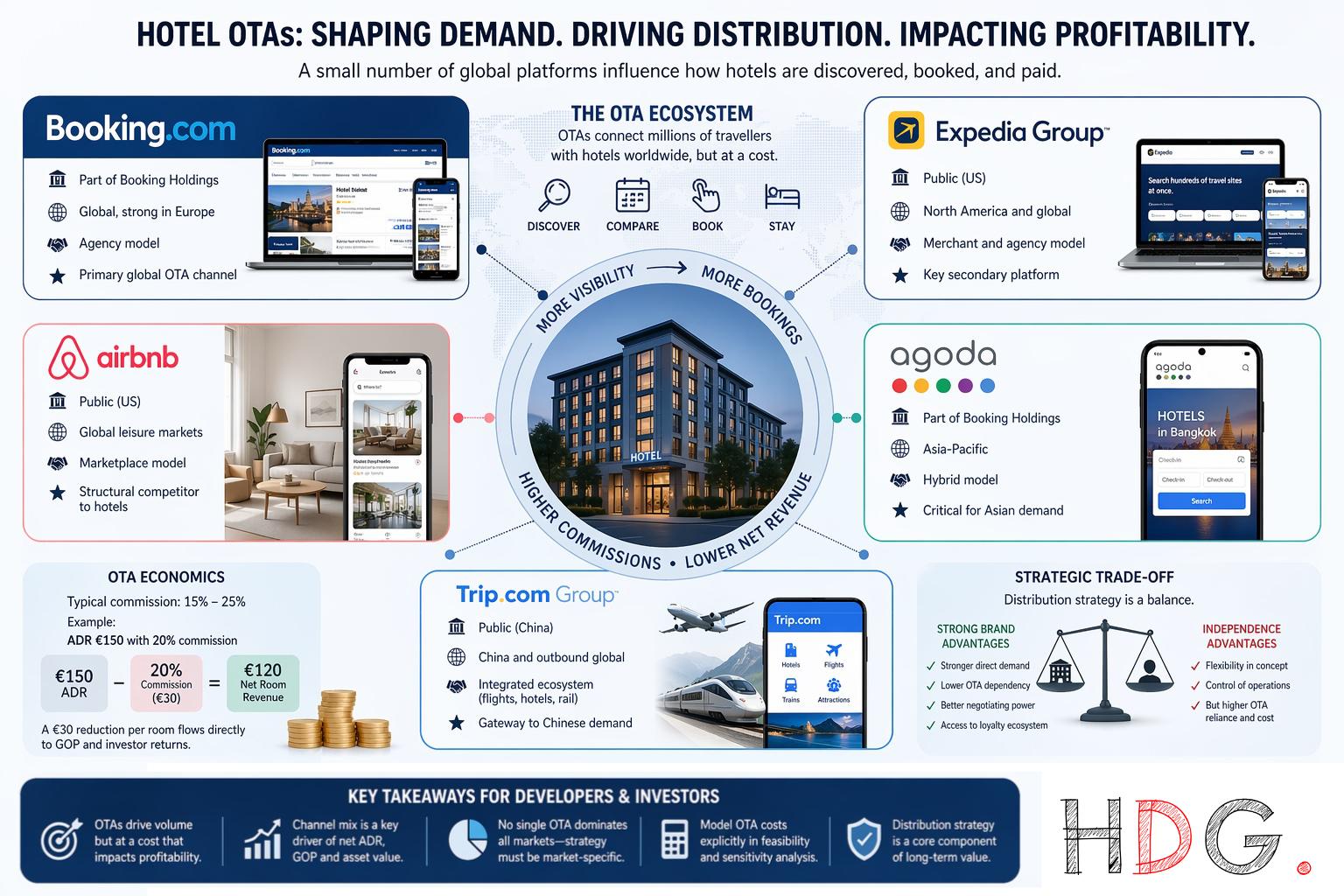
| OTAs | Comparison & conversion | Standardised data, high traffic | Margin pressure, limited differentiation |
| Brand Website | Control & depth | Full narrative control, data consistency | Dependent on traffic acquisition |
Social media platforms such as Instagram and TikTok remain highly effective for generating initial interest and shaping perception. However, their content is typically transient and not easily retrievable, limiting their impact on later stages of the decision process. Video platforms, particularly those with strong indexing capabilities, can provide more durable and detailed representations of the hotel, supporting both discovery and evaluation.
OTAs continue to serve as primary points of comparison and conversion, offering standardised information and pricing transparency. However, their ability to differentiate properties is constrained by format and structure. Brand websites, meanwhile, offer the greatest level of control and depth, but rely on effective traffic generation and content alignment to fulfil their role. In an AI-mediated environment, the interplay between these channels becomes more important than any single channel in isolation.
Implications for Hotel Developers and Owners
AI-mediated discovery has implications that extend beyond marketing and distribution teams, affecting how hotel assets are conceived, designed, and operated. For developers, the ability of a property to be clearly explained and differentiated becomes a factor in both initial feasibility and long-term performance. Design decisions that may previously have been considered primarily aesthetic or operational now also influence how easily the asset can be communicated and understood.
Room typologies provide a clear example. Hotels often offer multiple room categories with subtle differences in layout, size, or configuration. If these differences are not clearly articulated and consistently presented, they can create confusion for both guests and AI systems. This can lead to mismatched expectations, negative reviews, and reduced conversion rates. Conversely, well-defined and clearly described room categories enhance both user understanding and machine interpretation, supporting more accurate matching of supply to demand.
Operational reality also becomes more visible in an AI-mediated environment. Elements such as service levels, breakfast quality, meeting space functionality, and location accessibility are increasingly reflected in structured content and user-generated data. This reduces the gap between marketed perception and actual experience, placing greater emphasis on operational consistency. For asset managers, this reinforces the importance of aligning design, branding, and operations to ensure the property is represented accurately and competitively within the discovery ecosystem.
Execution Challenges and Limitations
While the principles of AI-mediated hotel discovery are compelling, their practical implementation presents several challenges. Content production at the required level of detail and consistency demands coordination across multiple departments, including marketing, operations, and technology. This can be resource-intensive, particularly for smaller properties or those operating in markets with limited access to specialised expertise.
Maintaining data consistency across channels is another significant challenge. As content is updated over time, whether due to renovations, changes in service offerings, or operational adjustments, ensuring that all representations remain aligned requires ongoing governance. Without this, discrepancies can emerge, undermining the clarity and reliability of the information presented to both users and AI systems.
There are also limitations related to return on investment. Not all market segments will benefit equally from enhanced structured content. For example, corporate transient demand, driven by negotiated rates and loyalty programmes, may be less influenced by detailed content than leisure demand, in which guests are more likely to engage in research and comparison. Similarly, budget or roadside properties may derive limited incremental value from extensive content development, as price and convenience remain dominant decision factors. Therefore, AI-mediated hotel discovery should be viewed as a strategic capability rather than a universal solution; its relevance and impact will vary by segment, location, and positioning.
Future Direction of Hotel Distribution
The trajectory of AI-mediated hotel discovery suggests a continued shift toward more integrated and conversational forms of travel planning. AI assistants are increasingly capable of synthesising information from multiple sources, presenting recommendations that reflect both explicit user preferences and inferred needs. This may include not only hotel selection, but also itinerary planning, transportation, and local experiences, creating a more holistic view of the travel journey.
In this context, the boundaries between channels may become less distinct. Content that is currently created for specific platforms, such as websites, OTAs, or video channels, may be aggregated and reinterpreted within unified interfaces. The emphasis will shift further toward data quality, consistency, and interoperability, as these factors determine how effectively the hotel can participate in these integrated systems.
For hotel developers and owners, this reinforces the importance of building assets that are not only physically and operationally robust, but also digitally legible. The ability to translate the complexities of a hotel into clear, structured, and consistent representations will become an increasingly important determinant of commercial performance. Distribution will continue to evolve, but the underlying principle remains: hotels that are clearly understood by both people and machines will be better positioned to capture demand in an increasingly competitive, automated environment.
Conclusion: AI-mediated Hotel Discovery
AI-mediated hotel discovery does not replace traditional distribution channels, but it reshapes how they are accessed and utilised. Introducing a layer of pre-selection and interpretation changes the criteria by which hotels are evaluated and recommended. Visibility remains important, but it is no longer sufficient on its own. The ability to present a clear, consistent, and structured representation of the hotel becomes a critical factor in entering and succeeding within the consideration set.
For the hotel industry, this represents both a challenge and an opportunity. It requires a rethinking of how content is created, managed, and aligned across channels, as well as a broader integration of marketing, operations, and asset strategy. At the same time, it offers the potential to differentiate properties based on the clarity and credibility of their offering, rather than solely on price or brand recognition.
Ultimately, AI-mediated hotel discovery reinforces a fundamental principle of hotel development: the value of an asset is determined not only by what it is but also by how effectively it can be understood.
Further Resources:
See HDG – Artificial Intelligence – AI in Hospitality
See HDG – Hotel Social Media in Development, Operations and Investment
See HDG – Hotel OTAs and the Reshaping of Hotel Distribution Economics
See HDG – Reputation Management
ahrefs blog: Top Brand Visibility Factors in ChatGPT, AI Mode, and AI Overviews