
For decades, the world’s leading hotel companies were defined by their brands. They offered owners a complete package that combined brand standards, reservation systems, loyalty programmes, marketing, technology and operational support. In return, owners accepted franchise fees, regular inspections and a degree of operational control, confident that global brand recognition would generate higher occupancy and stronger financial performance.
Today, that traditional model is beginning to change. Increasingly, hotel companies are expanding beyond their core branded portfolios by adding soft brands, independent collections, lifestyle partnerships and alternative accommodation. Rather than simply selling a hotel brand, they are creating powerful distribution platforms that connect millions of loyal customers with a far wider range of accommodation. For many owners, the ability to access guest demand has become more valuable than adopting every aspect of a traditional hotel brand.
This shift represents one of the most significant disruptions facing the hospitality industry. Competition is no longer based solely on who has the strongest hotel brands, but increasingly on who controls customer relationships, loyalty ecosystems and booking demand. As branding, technology, distribution and operations become more independent of one another, hotel companies are evolving from brand organisations into platforms that compete to own the guest long before they choose where to stay.
Hotel Distribution Platforms – Table of Contents
What Is a Hotel Distribution Platform?
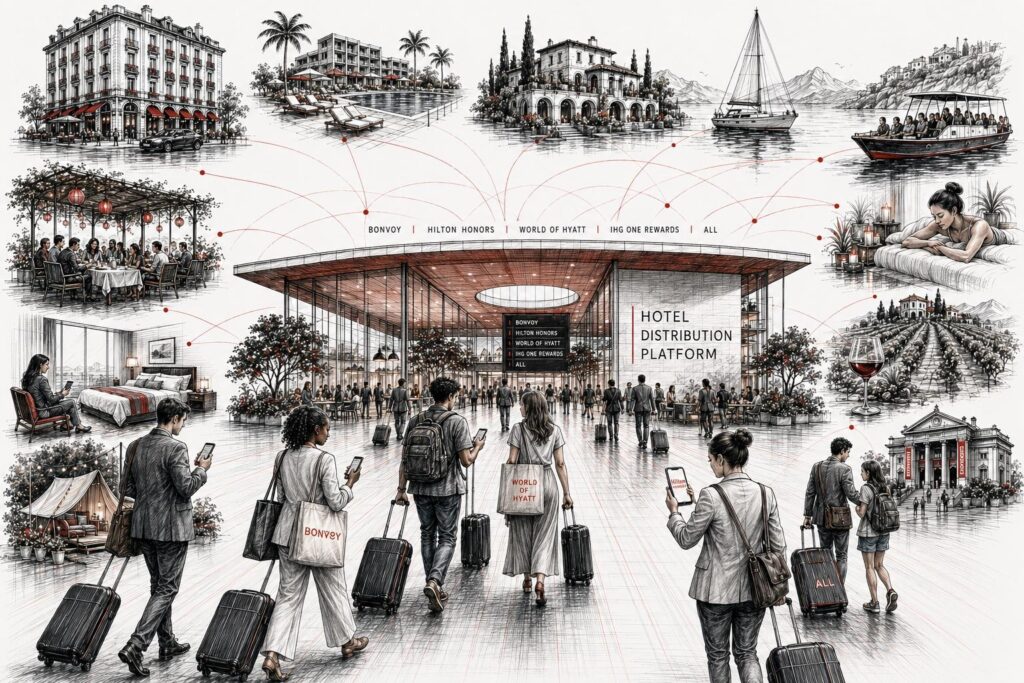
The hotel industry has traditionally been built around brands. Hotel companies developed recognised names, established design and operating standards, and built reservation systems and loyalty programmes to help owners attract guests. Today, however, the industry’s competitive landscape is changing. Increasingly, the most valuable asset is not the brand itself, but the ability to generate demand by connecting millions of travellers with accommodation through technology, loyalty programmes and digital distribution.
The term “hotel distribution platform” describes this evolution. Rather than viewing themselves solely as brand companies, hotel groups are increasingly becoming platforms that bring together guests, hotel owners, technology and distribution. While branding remains important, the ability to influence where guests choose to stay is becoming an equally significant competitive advantage.
A New Way of Thinking About Hotel Companies
A hotel distribution platform is an organisation that generates guest demand and distributes bookings across a portfolio of accommodation. That portfolio may include traditional branded hotels, soft brands, independent lifestyle properties, serviced apartments, branded residences and other accommodation types. The common factor is not necessarily a shared hotel brand, but a shared distribution ecosystem.
This represents a subtle but important shift in strategy. Historically, a hotel company expanded by adding more branded hotels that operated under consistent standards. Today, many companies are also expanding by adding a wider variety of accommodation that benefits from their reservation systems, loyalty programmes, technology platforms and customer relationships, even where operational standards may differ significantly.
Beyond Hotel Brands
Traditional hotel brands have always offered owners a package of services, including branding, distribution, loyalty, technology, marketing support and operational guidance. Owners typically accepted this bundled approach because each element reinforced the others, creating a stronger overall business proposition than any single component could achieve independently.
Increasingly, however, these services are becoming more flexible. Owners may seek access to a global loyalty programme without adopting every brand standard, or they may retain a distinctive local identity while benefiting from international reservation systems and marketing. In this environment, the platform that generates guest demand can become as valuable as the brand displayed above the hotel entrance.
A Different Type of Competitive Advantage
The emergence of hotel distribution platforms reflects a broader shift towards platform-based business models seen across many industries. Rather than competing solely through physical assets, successful platforms compete by creating connections between customers and suppliers while using technology, data and network effects to strengthen those relationships over time.
For hotel companies, this means that future competitive advantage may increasingly depend on controlling guest relationships rather than simply expanding branded portfolios. Loyalty programmes, customer data, digital marketing, artificial intelligence and distribution technology are becoming strategic assets in their own right. As a result, the industry is beginning to move beyond the traditional concept of hotel branding towards a model in which controlling guest demand becomes one of the defining measures of success.
The Traditional Hotel Brand Model
For much of the twentieth century and into the early twenty-first century, the hotel industry operated on a relatively simple business model. Hotel companies built recognised brands that promised guests a consistent experience, while owners paid franchise or management fees in exchange for access to those brands. The relationship was based on a straightforward value proposition: stronger brands attracted more guests, increased occupancy and justified higher room rates.
In practice, however, hotel companies offered far more than just a recognised name. They provided an integrated business model that combined branding, reservation systems, loyalty programmes, sales and marketing, operational standards, technology platforms, staff training and purchasing support. These services were delivered as a single package, making it difficult for owners to separate one benefit from another.
The Bundled Value Proposition
Traditionally, hotel owners did not purchase individual services. Instead, they invested in an entire ecosystem designed to maximise the hotel’s long-term performance. A recognised brand provided customer confidence, while central reservation systems generated bookings and loyalty programmes encouraged repeat business. Operational manuals, design standards and regular inspections helped maintain consistency across hundreds or even thousands of hotels operating under the same flag.
The strength of this model was that each component reinforced the others. A larger brand portfolio increased customer recognition, which strengthened the loyalty programme, generated more bookings and encouraged additional owners to join the system. As more hotels entered the network, the brand became increasingly valuable to both guests and investors, creating a virtuous cycle of growth.
The Cost of Joining a Brand
Affiliation with a major hotel company also required owners to accept significant obligations. Initial franchise fees, ongoing royalty payments, marketing contributions and technology charges formed part of the financial commitment. Hotels were also expected to comply with detailed brand standards covering architecture, interior design, guestroom specifications, operating procedures, maintenance, customer service and periodic renovations throughout the life of the property.
While these requirements limited operational flexibility, many owners viewed them as a worthwhile investment. A globally recognised brand reduced commercial risk, particularly in competitive markets or destinations with high levels of international demand. For lenders and investors, affiliation with an established hotel company often improved confidence in the project’s long-term financial performance.
Why the Model Worked
For decades, the traditional hotel brand model aligned the interests of hotel companies, owners and guests. Hotel companies expanded their brand presence, owners benefited from global recognition and reservation systems, while guests enjoyed predictable standards wherever they travelled. Success depended on maintaining consistency and continually strengthening the brand’s reputation.
That model remains highly successful today and continues to underpin much of the global hotel industry. However, advances in technology, the growth of digital distribution, increasingly sophisticated loyalty programmes and changing owner expectations are beginning to separate the individual components of this traditional package. As a result, owners are starting to question whether they need every element of the bundled model or whether some services have become more valuable than others.
The Unbundling of Hotel Services
The traditional hotel brand model was built on the principle of integration. Owners joined a hotel company because they wanted the complete package: a recognised brand, reservation systems, loyalty programmes, operational support, technology, marketing, design standards and purchasing power. These services were delivered together, with the expectation that each contributed to the overall success of the hotel.
Today, that assumption is being challenged. Many owners are no longer asking whether they need a hotel brand; they are asking which individual services create the greatest value for their particular property. Rather than purchasing an all-inclusive package, owners increasingly want the flexibility to select only the services that improve financial performance while retaining greater operational independence.
From Bundled Services to Individual Solutions
This shift reflects a broader trend that has transformed many industries. Consumers once purchased software as complete packages before cloud computing introduced subscription services. Television viewers once bought cable bundles before choosing individual streaming platforms. Similarly, hotel owners are beginning to evaluate branding, technology, distribution, revenue management and operations as separate services rather than inseparable components of a single agreement.
As a result, hotel companies are responding with increasingly flexible affiliation models. Rather than offering a single, all-inclusive solution, they now provide a range of options that allow owners to select the combination of branding, distribution, loyalty, technology and management services that best suits their objectives. The industry is moving away from a single operating model towards a spectrum of affiliation choices.
The differences between these affiliation models are not always obvious. Some provide a complete branded solution, while others focus primarily on guest demand, technology or management services. The table below illustrates how the traditional bundled hotel model is being unbundled, allowing owners to choose different combinations of services depending on their commercial priorities.
How Hotel Distribution Platforms Are Unbundling Traditional Hotel Services
| Model | Brand | Demand | Loyalty | Tech | Manage | Rules | Flexibility |
|---|---|---|---|---|---|---|---|
| Hard Brand | ✓ | ✓ | ✓ | ✓ | ✓ / ○ | High | Low |
| Soft Brand | ✓ | ✓ | ✓ | ✓ | ✓ / ○ | Medium | Medium |
| White Label | ✗ | ○ | ○ | ✓ | ✓ | None | High |
| Independent | ✗ | ○ | ✗ | ○ | ✓ | None | Very High |
| Independent + Platform | ✗ | ✓ | ✓ | ✓ | ✓ | Low | High |
The hotel industry no longer offers owners a binary choice between joining a global brand or remaining fully independent. Instead, a growing range of affiliation models enables owners to select the combination of branding, guest demand, technology, management and operational flexibility that best supports their commercial objectives. This gradual unbundling of hotel services is one of the defining characteristics of the emerging hotel distribution platform.
Choosing What Creates Value
Every hotel has different commercial priorities. A luxury resort with an established reputation may value access to an international loyalty programme while wishing to preserve its own identity. A boutique hotel may seek global distribution but reject highly prescriptive design standards. A mixed-use development may prioritise branded residences and marketing support while outsourcing operations to a specialist management company.
This flexibility enables owners to assemble business models that better reflect their individual markets and investment objectives. Rather than accepting a standardised package, they can increasingly choose the combination of branding, technology, revenue management, distribution, operational expertise and marketing that best supports their long-term strategy.
Distribution Emerges as the Most Valuable Service
As hotel services become unbundled, one component has become increasingly important: the ability to generate guest demand. Brand recognition remains valuable, but in many markets the deciding factor is no longer the name above the entrance. Instead, success increasingly depends on how effectively a hotel can reach potential guests through loyalty programmes, digital marketing, reservation technology and direct distribution channels.
This shift is changing the balance of power within the hospitality industry. If guest demand can be delivered independently of a traditional hotel brand, then distribution itself becomes a product that can be offered to a much wider range of accommodation. The hotel company evolves from being primarily a brand owner into a platform that connects guests with hotels, regardless of whether every property shares the same identity. That transition lies at the heart of the emergence of hotel distribution platforms.
Why Controlling Guest Demand Matters
For decades, hotel companies created value by developing recognised brands that attracted guests and gave owners confidence in long-term financial performance. Brand recognition was often the primary reason owners joined a hotel chain, with reservation systems, marketing support and loyalty programmes reinforcing that competitive advantage. While these services remain important today, the balance of value is beginning to shift.
Increasingly, the most valuable asset is not the hotel brand itself, but the ability to influence where guests choose to stay. In a world of digital booking platforms, mobile apps, loyalty ecosystems and artificial intelligence, controlling guest demand has become one of the hospitality industry’s most important competitive advantages. The organisations that successfully influence booking decisions can create value across a wide range of accommodation, regardless of whether every property shares the same brand identity.
Guest Demand Drives Hotel Performance
Every hotel depends on a consistent flow of guests. Occupancy, average daily rate (ADR), revenue per available room (RevPAR) and ultimately profitability all rely on generating sufficient demand throughout the year. While location, product quality and service remain fundamental, they have little commercial value if potential guests never discover the hotel or choose to book elsewhere.
Generating demand has also become increasingly expensive. Hotels compete across search engines, online travel agencies, social media, metasearch platforms and direct marketing channels, all while investing heavily in customer acquisition. The ability to deliver repeat business through established customer relationships can significantly reduce marketing costs and improve long-term profitability. As a result, demand generation has become a strategic asset rather than simply a marketing activity.
Loyalty Is More Than a Rewards Programme
Modern loyalty programmes do far more than reward repeat guests with free nights or room upgrades. They create long-term relationships that encourage travellers to remain within a particular ecosystem, regardless of which individual hotel they ultimately choose. A guest may decide to stay at an unfamiliar property simply because it participates in a loyalty programme they already trust and use regularly.
For hotel companies, this creates a powerful network effect. Every new member increases the value of the loyalty programme, while every additional hotel provides members with more opportunities to earn and redeem points. Over time, the loyalty ecosystem itself becomes a major source of competitive advantage, encouraging both guests and hotel owners to participate in the same distribution platform.
Distribution Becomes a Strategic Asset
Historically, distribution supported the hotel brand. Today, the relationship is becoming more balanced, with distribution increasingly supporting a much broader portfolio of accommodation. Soft brands, independent collections, serviced apartments and lifestyle hotels can all benefit from access to the same reservation systems, loyalty programmes and customer relationships, even when their individual identities remain distinct.
This represents a significant shift in the economics of the hotel industry. If a hotel company can successfully generate guest demand without requiring every property to adopt a traditional hard brand, then distribution itself becomes one of the company’s most valuable products. The ability to connect travellers with accommodation is evolving from a supporting function into a core business strategy, laying the foundations for the emergence of hotel distribution platforms.
Who Owns the Guest?
For decades, the relationship between hotels and their guests appeared relatively straightforward. Guests selected a hotel because they recognised a trusted brand, appreciated its standards and expected a consistent experience. Hotel companies invested heavily in advertising, reservation systems, staff training and loyalty programmes, while owners accepted franchise fees and operating standards in return for access to that customer base. The guest relationship was largely controlled by the hotel brand, supported by the individual property delivering the experience.
Today, however, the guest journey has become significantly more complex. Travellers discover, compare and book hotels through search engines, social media, online travel agencies, metasearch platforms, loyalty programmes, corporate booking tools and increasingly artificial intelligence. A guest may interact with several different organisations before arriving at reception, each attempting to influence the booking decision. As a result, one of the hospitality industry’s most important strategic questions has become: who really owns the guest relationship?
Competing for the Guest Relationship
The answer is no longer straightforward because several different organisations are competing for exactly the same customer. The individual hotel wants guests to book directly, reducing commission costs while building long-term relationships that encourage repeat visits. The hotel brand wants travellers to remain within its portfolio, choosing another affiliated property whenever they travel to a different destination. Meanwhile, the loyalty programme encourages guests to remain within the same ecosystem by rewarding repeat bookings with points, upgrades and exclusive benefits, making the programme itself a powerful influence over future travel decisions.
Other participants are equally determined to become the traveller’s preferred booking channel. Online travel agencies (OTAs) compete by offering extensive choice, price comparison and convenience across thousands of hotels and destinations. Corporate travel managers influence business travellers through negotiated rates, preferred supplier agreements and company travel policies. Looking ahead, artificial intelligence travel assistants may become another influential participant, analysing traveller preferences, comparing accommodation options and recommending or automatically booking hotels on behalf of their users. Each organisation is competing for much more than a single reservation; they are competing to become the trusted relationship that influences every future booking.
Data, Loyalty and Customer Relationships
Every interaction between a traveller and a hotel generates valuable information. Booking behaviour, travel frequency, preferred destinations, length of stay, ancillary spending and guest feedback all help organisations better understand customer preferences. Combined with advances in artificial intelligence and customer relationship management systems, this data enables increasingly personalised marketing, pricing and recommendations. The better an organisation understands its customers, the more effectively it can influence future booking decisions.
This explains why loyalty programmes have evolved far beyond simple rewards schemes. Their primary purpose is no longer just to offer free nights or room upgrades, but to create an ongoing relationship with the traveller. Every booking, every stay and every interaction strengthens that relationship while generating additional data that can be used to personalise future offers. Over time, the loyalty ecosystem becomes one of the organisation’s most valuable commercial assets, encouraging guests to remain within the same distribution platform even when choosing different hotels.
Why the Guest Relationship Is the Prize
Hotels remain physical assets, and recognised brands continue to play an important role in attracting guests and reassuring investors. However, competitive advantage is increasingly shifting away from ownership of physical buildings towards ownership of customer relationships. The organisations that consistently influence booking decisions gain access to repeat business, lower customer acquisition costs, richer customer data and greater opportunities to cross-sell accommodation across multiple brands and destinations. In many respects, guest demand has become more valuable than the physical inventory itself.
Increasingly, the hotel industry’s most valuable asset is not the hotel building, and it may not even be the hotel brand. It is the guest relationship. The organisations that successfully control guest demand are likely to become the hospitality industry’s most influential businesses over the coming decade. Understanding this shift helps explain why hotel companies are investing so heavily in loyalty programmes, technology, digital distribution and customer data, and why many are evolving beyond traditional hotel brands towards the hotel distribution platform model.
Are Hotel Companies Becoming Platform Businesses?
The hotel industry has traditionally been organised around brands. Hotel companies developed portfolios of properties operating under consistent standards, supported by central reservation systems, loyalty programmes and global marketing. Their primary objective was to expand the number of branded hotels while maintaining quality and consistency across the portfolio. Distribution existed largely to support the brand rather than to become a business in its own right.
That model is beginning to evolve. Increasingly, many hotel companies are investing as much in technology, loyalty ecosystems and customer acquisition as they are in developing new brands. As they add soft brands, independent collections, branded residences and alternative accommodation to their portfolios, their competitive advantage shifts from simply owning recognised brands to controlling guest demand across a much broader range of properties. In doing so, they begin to exhibit many of the characteristics associated with platform businesses.
From Brand Companies to Platform Companies
Traditional hotel companies expanded by persuading owners to adopt one of their recognised brands. Success was measured by the number of branded hotels, the consistency of the guest experience and the strength of the brand’s reputation. Every new hotel reinforced the brand, while every additional guest strengthened the loyalty programme and reservation system.
Hotel distribution platform businesses operate differently. Their value comes from connecting customers with suppliers through technology, data and network effects rather than through ownership of physical assets. As hotel companies broaden the types of accommodation they distribute, they increasingly resemble platforms that connect travellers with a diverse portfolio of hotels. Whether a property is a traditional branded hotel, a soft brand, an independent lifestyle hotel, or another accommodation type becomes less important than its ability to participate in the same demand-generation ecosystem.
Similarities and Differences with Online Travel Agencies
There are clear similarities between hotel distribution platforms and online travel agencies. Both seek to influence booking decisions, generate guest demand and distribute reservations across a wide range of accommodation. Both invest heavily in technology, digital marketing, customer data and user experience. Most importantly, both understand that controlling the customer relationship creates long-term commercial value that extends far beyond a single booking.
The differences, however, remain significant. Online travel agencies are generally open marketplaces that aggregate accommodation from many different hotel companies and independent operators, with little influence over how those hotels are managed or presented beyond their online listings. Hotel distribution platforms, by contrast, operate within their own ecosystems. They combine distribution with loyalty programmes, technology, brand affiliation, quality assurance and long-term owner relationships. While an OTA primarily facilitates transactions, a hotel distribution platform seeks to build lasting relationships with both guests and hotel owners.
Distribution Becomes the Business
As this evolution continues, the role of the hotel company is changing. Distribution is no longer simply a supporting function for branded hotels; it is becoming one of the company’s principal products. The greater the number and diversity of hotels connected to the platform, the more attractive the ecosystem becomes to travellers. Likewise, the more loyal guests the platform attracts, the more valuable it becomes to hotel owners seeking access to that demand.
This does not mean that hotel brands will disappear or that hotel companies will become identical to online travel agencies. Strong brands, operational expertise and quality standards will continue to differentiate hotel companies from other distribution channels. However, the balance of competitive advantage is changing. In the future, the world’s most successful hotel companies may be recognised not only for the strength of their brands, but for the scale and effectiveness of the platforms they have built to generate and control guest demand.
Soft Brands, Collections and Independent Hotels
The evolution from traditional hotel brands to hotel distribution platforms is already evident across much of the global hospitality industry. Over the past two decades, major hotel companies have introduced a growing number of soft brands, collection brands and partnership models that allow independent hotels to access global distribution, loyalty programmes and technology while retaining much of their individual identity. Rather than requiring every hotel to conform to a single brand standard, these models recognise that many owners value authenticity and local character alongside international commercial support.
This trend reflects changing market demand from both guests and hotel owners. Travellers increasingly seek unique experiences rather than standardised accommodation, while owners often wish to preserve the history, architecture and personality of their properties. Soft brands provide a commercial compromise, allowing independent hotels to remain distinctive while benefiting from the scale and customer reach of a much larger organisation.
The Rise of Soft Brands
Soft brands have become one of the fastest-growing segments of the international hotel industry. Unlike traditional hard brands, they generally allow greater flexibility in architecture, interior design, food and beverage concepts and guest experience, while still providing access to central reservation systems, loyalty programmes, digital marketing and global sales networks. Owners gain many of the commercial advantages of brand affiliation without sacrificing the characteristics that make their properties unique.
Examples can be found throughout the industry. Major hotel companies have developed collections that appeal to independent hotels seeking international exposure while maintaining their own identity. These brands demonstrate that commercial success no longer depends solely on standardisation. Increasingly, guests are prepared to trade uniformity for individuality, provided they continue to benefit from the reassurance of a trusted booking ecosystem.
Beyond the Traditional Hotel Brand
The evolution extends beyond soft brands alone. Hotel companies are increasingly incorporating independent lifestyle hotels, luxury collections, serviced apartments, branded residences and other accommodation formats into their distribution platforms. In many cases, the relationship between the hotel company and the property focuses less on enforcing detailed brand standards and more on providing technology, distribution, loyalty and marketing support.
Recent developments illustrate this shift. Independent hotel collections are becoming increasingly integrated into global loyalty ecosystems, allowing guests to earn and redeem points across properties that may share little operational similarity. Partnerships between hotel companies and lifestyle operators, luxury collections and alternative accommodation providers further demonstrate that controlling guest demand is becoming as strategically important as expanding traditional branded portfolios.
A New Choice for Hotel Owners
For hotel owners, these developments create significantly more strategic choices than existed in previous decades. The decision is no longer limited to operating under a global brand or remaining entirely independent. Owners can now choose from a spectrum of affiliation models that balance commercial support with operational flexibility, selecting the combination of branding, technology, loyalty and distribution that best aligns with their investment objectives.
This expanding range of options also reinforces the emergence of the hotel distribution platform. As more independent hotels join these ecosystems without becoming traditional branded properties, the platform’s value increasingly comes from its ability to generate guest demand rather than simply enforce brand standards. The competitive focus shifts from creating more hotel brands to building stronger customer relationships across a more diverse portfolio of accommodation.
Major Hotel Companies Are Expanding Beyond Traditional Brands (Examples)
| Hotel Company | Hard Brands | Soft Brands | Collections | Alternative Accommodation |
|---|---|---|---|---|
| Marriott | Marriott, Sheraton, Westin | Tribute Portfolio, Four Points Flex, StudioRes | Autograph Collection, Design Hotels, Luxury Collection | Homes & Villas, MGM Collection, Sonder |
| Hilton | Hilton, DoubleTree, Hampton | Spark by Hilton, LivSmart Studios, Motto | Curio Collection, Tapestry Collection, Small Luxury Hotels | AutoCamp, Graduate Hotels |
| IHG | InterContinental, Crowne Plaza, Holiday Inn | voco, Garner, avid hotels | Vignette Collection, Mr & Mrs Smith | Ruby Hotels* |
| Accor | Novotel, Pullman, Sofitel | Handwritten Collection, greet, Tribe | MGallery, Emblems Collection | Onefinestay |
| Hyatt | Grand Hyatt, Hyatt Regency, Hyatt Place | Caption by Hyatt, Hyatt Studios, UrCove | The Unbound Collection, JdV by Hyatt, Destination by Hyatt | Under Canvas, Standard International |
The examples above illustrate how major hotel companies are expanding well beyond the traditional hard-brand franchise model. Each group has developed its own combination of soft brands, curated collections and alternative accommodation partnerships to broaden its appeal to both owners and travellers. Although the strategies differ, they all reflect the same underlying objective: increasing guest demand by offering a wider range of accommodation through a single distribution platform.
The New Competitive Battlefield
For decades, competition between hotel companies focused primarily on the strength of their brands. Success was measured by the number of hotels carrying a particular flag, the consistency of guest experience and the ability to expand into new markets. Marketing, technology and reservation systems were important, but they largely existed to support the brand rather than becoming competitive advantages in their own right.
Today, the competitive landscape is changing. While strong brands remain valuable, they are increasingly only one component of a much broader commercial ecosystem. Hotel companies are investing heavily in loyalty programmes, digital technology, customer data, artificial intelligence and distribution capabilities because these assets influence guest demand across an entire portfolio of accommodation. The focus is gradually shifting from building the strongest hotel brands to building the strongest customer ecosystem.
Loyalty Ecosystems
Modern loyalty programmes have evolved into sophisticated commercial platforms rather than simple rewards schemes. Their objective is to encourage guests to remain within a single ecosystem, regardless of which individual hotel they choose for their next trip. Every additional member increases the value of the programme, while every new hotel provides members with more opportunities to earn and redeem rewards, creating a powerful network effect.
For hotel companies, loyalty has become one of the most effective methods of reducing customer acquisition costs while increasing repeat business. For owners, participation in a strong loyalty ecosystem can provide access to a global customer base that would be difficult and expensive to develop independently. As a result, loyalty is becoming one of the industry’s most important competitive assets.
Technology and Customer Data
Technology has become central to almost every aspect of the guest journey. Reservation systems, mobile applications, digital check-in, revenue management, customer relationship management systems and personalised marketing all depend on collecting, analysing and acting upon customer data. The organisations that invest most effectively in these capabilities are better positioned to understand traveller behaviour and influence future booking decisions.
Customer data has therefore become a strategic asset. Every search, booking, stay and interaction provides additional insight into guest preferences, allowing hotel companies to personalise communications, improve pricing strategies and develop stronger long-term relationships. As the volume and quality of data increase, so too does the competitive advantage of the organisations that control it.
Distribution and Digital Marketing
Digital distribution has transformed how hotels compete for guests. Traditional advertising and travel agents have been supplemented by search engines, online travel agencies, metasearch platforms, social media, content marketing and direct booking campaigns. Hotel companies now invest significant resources in ensuring that their hotels are visible wherever travellers begin their booking journey.
At the same time, digital marketing has become increasingly data-driven and personalised. Rather than promoting individual hotels alone, many companies now market entire ecosystems, encouraging guests to join loyalty programmes, download mobile applications and remain engaged long after their stay has ended. The objective is not simply to generate today’s booking, but to influence every future booking as well.
Artificial Intelligence
Artificial intelligence is likely to become the next major battleground in hotel distribution. AI is already helping hotel companies improve pricing, personalise marketing, forecast demand and enhance customer service. As these technologies continue to develop, they will increasingly shape how travellers discover, compare and select accommodation.
Looking further ahead, AI travel assistants may become the first point of contact for many travellers, recommending destinations, comparing hotels and making reservations based on individual preferences. If that occurs, hotel companies will need to ensure that their properties and distribution platforms are optimised not only for human decision-making but also for AI-driven recommendation engines. The competition for guest demand will increasingly involve influencing both travellers and the intelligent systems acting on their behalf.
Competing for the Future
The future of hotel competition is unlikely to be determined solely by who develops the strongest brands or opens the most hotels. Increasingly, success will depend on who builds the most effective ecosystem for attracting, understanding and retaining guests. Loyalty, technology, customer data, digital marketing, artificial intelligence and distribution are becoming interconnected competitive advantages that reinforce one another over time.
This changing competitive landscape helps explain why the world’s largest hotel companies are investing far beyond traditional branding. The future leaders of the hospitality industry are likely to be those who build the strongest relationships with travellers, supported by powerful technology and distribution platforms that can generate guest demand across an increasingly diverse range of accommodation options.
What This Means for Hotel Owners
The emergence of hotel distribution platforms gives owners more strategic options than ever before. For much of the modern hotel industry’s history, the decision was relatively straightforward: either operate independently or affiliate with a recognised international brand. Today, however, owners can choose from a wide spectrum of affiliation models that offer different combinations of branding, guest demand, loyalty, technology and operational support. The challenge is no longer whether to join a hotel company, but which combination of services creates the greatest long-term value.
This increased flexibility also requires more careful decision-making. Every hotel has different objectives, market conditions and financial constraints. An urban business hotel may benefit from a global loyalty programme, while a luxury resort may place greater value on preserving its unique identity. A boutique lifestyle hotel may prioritise international distribution without wishing to adopt highly prescriptive brand standards. Owners must therefore evaluate affiliation models strategically rather than assuming that one solution is appropriate for every project.
Rethinking the Value of Brand Affiliation
The traditional argument for joining a hotel brand centred on recognition, reservation systems and operational expertise. These benefits remain important and, for many hotels, continue to justify the associated franchise fees and operating requirements. Well-established international brands can provide confidence for lenders, attract international travellers and improve the commercial performance of new developments, particularly in competitive markets.
However, owners are increasingly asking whether every element of the traditional package remains essential. If access to guest demand can be achieved through softer affiliation models, while retaining greater operational flexibility and a stronger local identity, the commercial balance begins to change. The question is no longer simply, “Should I join a hotel brand?” but “Which services genuinely create value for my hotel?”
Choosing the Right Affiliation Model
There is no universally correct solution. A hard brand may be appropriate for an airport hotel, a convention property or a business-focused development where consistency and international recognition are critical. A soft brand may be better suited to a boutique hotel wishing to preserve its character while benefiting from global distribution. Luxury independent hotels may choose collection brands that provide access to loyalty programmes without imposing extensive design standards, while some owners may conclude that remaining independent offers the strongest long-term commercial return.
The growing availability of these alternatives means that owners can increasingly assemble an affiliation strategy tailored to their individual objectives. Distribution, technology, revenue management, branding and operations no longer have to be sourced from a single organisation. As the market evolves, hotel owners are gaining greater control over how these services are combined to support their business.
Questions Every Hotel Owner Should Ask
The changing competitive landscape encourages owners to evaluate affiliation decisions more strategically than in the past. Before selecting a hotel company or operating model, it is worth considering several fundamental questions:
| Strategic Question | Why It Matters |
|---|---|
| Do I need a hard brand? | Some hotels benefit from global brand recognition, while others can achieve similar results through softer affiliation models. |
| How valuable is guest demand? | Estimate how much occupancy and revenue could be generated through loyalty programmes and global distribution. |
| How much flexibility do I need? | Consider whether mandatory brand standards support or restrict your long-term business objectives. |
| Will branding strengthen my hotel? | Assess whether an international brand enhances or dilutes your property’s identity and market positioning. |
| Which technology is essential? | Decide which systems, revenue management tools and digital platforms genuinely add value. |
| Who should own the guest relationship? | Determine whether direct customer ownership is strategically important to your business. |
| Am I buying the right combination of services? | Evaluate whether branding, management and distribution should all come from the same organisation. |
As hotel distribution platforms continue to evolve, these questions are likely to become increasingly important. Owners who understand which services create genuine commercial value and which can be sourced more flexibly will be better positioned to select affiliation models that maximise both profitability and long-term asset value. The future is unlikely to be defined by a choice between branded and independent hotels, but rather by finding the right balance among identity, flexibility, and access to guest demand.
Hotel Owner Decision Matrix
| Priority | Best Option |
|---|---|
| Maximum brand recognition | Hard Brand |
| Strong distribution with flexibility | Soft Brand |
| Unique identity with global reach | Collection Brand |
| Operational expertise only | White-Label Operator |
| Maximum independence | Independent Hotel |
| Distribution without traditional branding | Platform Affiliation |
What This Means for Hotel Companies
The emergence of hotel distribution platforms is changing not only the decisions made by hotel owners but also the strategies of hotel companies themselves. For decades, growth was driven primarily by adding more branded hotels to a portfolio. Success was measured by the number of properties operating under a company’s flags, the consistency of its standards and the geographical reach of its brands. While these measures remain important, they are no longer sufficient on their own.
Increasingly, hotel companies are competing to build the strongest commercial ecosystems rather than simply the largest brand portfolios. Loyalty programmes, technology platforms, customer data, digital distribution and owner services have become strategic assets that create value across multiple brands and accommodation types. Future growth is likely to depend as much on the strength of these capabilities as on the number of hotels carrying a particular brand.
Competing for Loyalty Members
Loyalty programmes have become one of the most powerful competitive tools available to international hotel companies. Every new member represents a potential lifetime customer whose future travel decisions can be influenced through rewards, personalised offers and exclusive member benefits. As membership grows, so does the platform’s attractiveness to hotel owners seeking access to that customer base.
This creates a powerful network effect. More members encourage more hotels to join the platform, while more hotels provide additional destinations where members can earn and redeem rewards. The value of the ecosystem therefore increases for both guests and owners, making loyalty membership one of the most important measures of long-term competitive strength.
Competing Through Customer Data and Technology
Technology is no longer simply an operational support function; it has become a core competitive advantage. Reservation systems, customer relationship management platforms, revenue management tools, artificial intelligence and mobile applications all contribute to a better understanding of guest behaviour and enable increasingly personalised experiences. Hotel companies that invest successfully in these capabilities are better positioned to attract, retain and understand their customers.
Customer data underpins much of this advantage. Every booking, search, stay and interaction provides valuable information that can improve pricing, marketing and guest engagement. As artificial intelligence becomes more sophisticated, the quality and depth of customer data will become even more valuable, allowing hotel companies to anticipate traveller preferences and influence booking decisions more effectively than ever before.
Distribution and Owner Services
Distribution has evolved from a support function into one of the principal products offered by many hotel companies. Owners increasingly expect access to global reservation systems, loyalty programmes, digital marketing, revenue optimisation and customer acquisition alongside traditional branding. In many cases, these commercial services now represent the primary reason for joining a hotel platform.
As owner expectations continue to evolve, hotel companies are also expanding the range of services they provide. Technology solutions, development advice, operational support, procurement, sustainability programmes, artificial intelligence tools and data analytics are becoming increasingly important elements of the owner proposition. The ability to deliver these services flexibly, rather than through a single standardised model, is likely to become an important source of competitive differentiation.
The Hotel Company of the Future
The hotel companies most likely to succeed over the coming decade will be those that create the strongest relationships with both guests and owners. Their competitive advantage will not depend solely on the number of brands they operate, but on the strength of their loyalty ecosystems, the quality of their technology, the depth of their customer data and their ability to generate guest demand across a diverse portfolio of accommodation.
In many respects, the role of the hotel company is expanding. Rather than acting simply as a brand owner or franchisor, it is becoming a technology provider, marketing organisation, customer relationship platform and distribution business simultaneously. Those companies that successfully combine these capabilities will be best positioned to lead the next phase of the hospitality industry’s evolution towards hotel distribution platforms.
Future Trends
The transition from traditional hotel brands to hotel distribution platforms is still in its early stages. While the established franchise and management models will remain central to the hospitality industry for many years, the forces driving change are unlikely to slow. Advances in technology, changing owner expectations, increasingly sophisticated loyalty programmes and the rapid development of artificial intelligence are all reshaping how hotels attract guests and how hotel companies create value.
Rather than replacing traditional hotel brands, these developments are likely to expand the range of business models available to both hotel companies and owners. The industry is moving towards greater flexibility, where branding, distribution, technology and management can be combined in different ways to suit different types of hotels, destinations and investment strategies. The result will be a more diverse and commercially adaptable hospitality sector than existed only a decade ago.
More Flexible Operating Models
One of the most significant changes is likely to be the continued growth of flexible affiliation models. White-label operators, soft brands and collection brands are expected to become increasingly common as owners seek access to global demand while retaining greater control over their properties. Rather than choosing between complete independence and a traditional hard brand, owners will increasingly assemble combinations of services that best match their commercial objectives.
This greater flexibility may also encourage new forms of partnership between hotel companies, technology providers and specialist operators. Management, branding, technology, and distribution are likely to become increasingly independent of one another, allowing owners to purchase individual services rather than a single bundled package.
The Expansion of Platform Ecosystems
Loyalty programmes are expected to continue growing beyond traditional hotel portfolios, incorporating a wider variety of accommodation, travel experiences and complementary services. As these ecosystems expand, their value to both guests and hotel owners will increase, creating stronger incentives for additional properties to join the platform. Scale will increasingly be measured not only by the number of hotels, but also by the number of active members, customer relationships and booking opportunities.
Hotel companies are also likely to broaden the range of services they offer to owners. Technology platforms, artificial intelligence tools, revenue management, sustainability support, procurement, customer analytics and digital marketing may increasingly be delivered through subscription-based or modular service models. Rather than purchasing a complete operating system, owners may be able to select individual services according to their business needs.
Artificial Intelligence and Guest Demand
Artificial intelligence has the potential to reshape hotel distribution even more profoundly than online booking did in previous decades. AI will increasingly personalise marketing, optimise pricing, forecast demand and improve operational efficiency. At the same time, AI-powered travel assistants may begin to influence how travellers search for destinations, compare accommodation and make reservations, creating entirely new channels through which guest demand is generated.
These developments are likely to place even greater importance on customer data, digital visibility and platform integration. Hotel companies will need to ensure that their distribution platforms are optimised not only for human travellers but also for the intelligent systems that increasingly assist them. The competition for guest demand may therefore extend beyond traditional marketing into the rapidly evolving world of AI-driven travel planning.
Hotel Distribution Platforms Conclusion
The evolution towards hotel distribution platforms is no longer a theoretical concept. It is already visible across the world’s largest hotel companies as they expand beyond traditional branded hotels into soft brands, independent collections, lifestyle partnerships and alternative accommodation. What began as a strategy to broaden customer choice is gradually changing the nature of the hotel company itself.
Consider a hotel company that distributes traditional branded hotels alongside independent lifestyle properties, luxury collections, branded residences and holiday homes, all connected through a single loyalty programme and technology platform. If guests remain within the same ecosystem regardless of which accommodation they choose, the source of competitive advantage begins to shift. The platform that generates guest demand may become more valuable than the individual hotel brand.
This raises an important strategic question for hotel owners. If a distribution platform can deliver occupancy, loyalty members and global customer reach to an independent hotel, why should every owner adopt a traditional hard brand with its associated standards, fees and operating restrictions? Increasingly, owners may conclude that they require access to guest demand rather than complete brand integration.
This does not mean that hotel brands are becoming less important. Strong brands will continue to provide trust, quality assurance and market positioning. However, branding is increasingly a component of a much broader commercial ecosystem built around loyalty, technology, customer data, and distribution. The value proposition is evolving from “Join our brand” to “Join our platform.”
Perhaps the greatest disruption facing the hospitality industry is not competition between Marriott, Hilton, Hyatt, IHG or Accor. It is the possibility that all major hotel companies are evolving into businesses whose primary competitive advantage lies in controlling guest demand rather than simply operating hotel brands. If that transition continues, the hotel distribution platform may become the defining business model of the next generation of hospitality.
Further Resources:
See HDG – Hotel OTAs and the Reshaping of Hotel Distribution Economics
See HDG – AI-Mediated Hotel Discovery
See HDG – Consolidation of Hotel Operators
The LA Times – June 2026 – “L.A.’s Palisociety Inks Deal with Design Hotels Amid Historic Tourism Super-Cycle“
Hyatt Newsroom – April 2024 – World of Hyatt Elevates Luxury Portfolio by Adding More Than 700 Boutique and Luxury Hotels and Villas from Mr & Mrs Smith
CoStar – June 2023 – “Marriott, MGM Announce Loyalty, Distribution Partnership“