
by Hotel Development Guide – Darren Blanchard
Last Updated: July 2026
Opaque hotel booking allows guests to reserve a room before the booking provider confirms which hotel they will stay in. The offer typically shows the price, general location, hotel category and selected facilities. Guests accept uncertainty about the property in exchange for a potentially lower rate. Once the reservation is confirmed, the provider discloses the hotel’s name and address.
For owners and operators, opaque hotel inventory means rooms made available under these terms. The opaque rate is the price attached to the offer, and the opaque distribution channel is the route through which the rooms are sold. The strategy, known as opaque selling, lets hotels reach price-sensitive guests while limiting the visibility of the discount against the property’s name. Its commercial value depends on whether it fills rooms that would otherwise go unsold or replaces bookings the hotel could have secured at a higher net rate.
Opaque Hotel Booking
History of Opaque Hotel Booking
Online hotel bidding grew out of a model first used for airline tickets. Priceline launched Name Your Own Price for leisure flights in April 1998 and extended it to hotel reservations that October. Hotel customers proposed a price and selected criteria such as the district and hotel category. They learned the property’s identity once their offer was accepted and the reservation was made.
Hotwire introduced an upfront-price model in 2000, giving travellers a price to accept without having to bid. The format spread to other online travel agencies, including lastminute.com in Europe. Priceline introduced fixed-price Express Deals in 2012 and added Pricebreakers in 2020. Pricebreakers reduced the uncertainty by showing three named hotels before purchase and confirming which one the guest had booked afterwards.
| Date | Development | Significance |
|---|---|---|
| April 1998 | Priceline launches Name Your Own Price for leisure airline tickets. | Travellers bid for a fare and learn the carrier’s identity after booking. |
| October 1998 | Priceline extends Name Your Own Price to hotel rooms. | Travellers can bid for accommodation within a selected area and hotel category. |
| 2000 | Hotwire launches with an upfront-price opaque travel model. | Travellers see the price before purchase and learn the supplier’s identity afterwards. |
| By 2009 | lastminute.com offers Top Secret Hotels in Europe, and Travelocity introduces its own opaque hotel product. | The format spreads beyond the original providers and becomes a distinct product within mainstream online travel agencies. |
| 2012 | Priceline launches Express Deals for hotels. | Priceline customers can accept a displayed hotel rate without submitting a bid. |
| 2013 | Hotwire reports that more than 30,000 hotels use its opaque model. | The figure shows the scale of hotel participation reported by one platform at the time. |
| 2020 | Priceline introduces Pricebreakers. | Travellers can assess three named hotels before committing to one price. |
How Opaque Hotel Booking Works
Fixed-Price Offers and Hotel Shortlists
A fixed-price opaque offer gives the guest enough information to assess the general standard and location of the hotel. The listing may include a neighbourhood, star category, guest review score and facilities such as parking, a pool or breakfast. The guest accepts the displayed offer before the exact property is confirmed. The level of detail varies by platform and can make a material difference to whether the offer suits the trip.
A named shortlist is a semi-opaque offer because the potential hotels are disclosed before the guest commits. The customer can check the location, facilities and reviews of every property on the list. The booking provider confirms the assigned hotel after purchase. A single unsuitable property can make the offer unattractive even if the other hotels represent good value.
Booking Windows and Rate Conditions
Opacity describes when the hotel’s identity is disclosed, while the booking window describes how far ahead the room is sold. A hotel can make opaque inventory available close to arrival or open it earlier for a future date that is tracking below forecast. The appropriate release window depends on booking pace, the likelihood of stronger demand and the controls available through the platform. A late booking window may suit one property, while another may use the channel ahead of a predictable low-demand period.
The relevant price is the total cost of the stay, including mandatory charges and any differences in room inclusions. Cancellation, change and refund conditions vary by product and rate. Operators should check which room features and services the listing guarantees and which it treats as requests. The information presented at checkout sets expectations the hotel will have to manage at arrival.
Opaque Hotel Booking Platforms
The principal products differ in how much information they give customers before purchase. Hotwire Hot Rates, lastminute.com Top Secret Hotels and Agoda Secret Deals withhold the property’s name. Priceline uses that approach for Express Deals and offers a named shortlist through Pricebreakers. The format influences how customers assess the offer and how much certainty they have about the location, facilities and hotel standard.
An online travel agency may sell named hotels worldwide while offering opaque inventory in selected destinations. A dedicated opaque listing shows that the product has been offered in a particular market, while availability for any given stay depends on the dates and participating properties. For owners, the practical questions are whether their hotel can participate, who supplies the inventory and which source markets the product reaches.
Hotwire “Hot Rates”
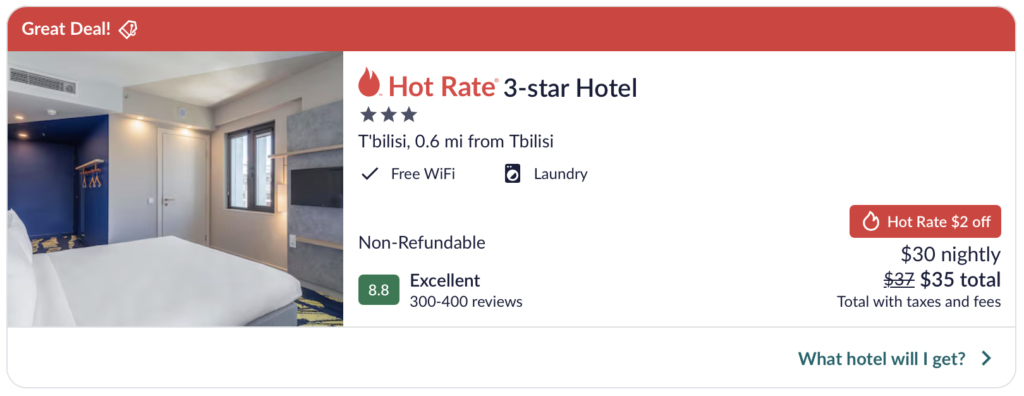
Hotwire, part of Expedia Group, sells both standard hotel rates and opaque offers under its Hot Rate brand. Travellers start in the Hotels section on Hotwire’s website or app and enter their destination, check-in and check-out dates, and number of guests. Where opaque offers are available, Hotwire marks them as Hot Rate in the search results or on the booking details page. A standard listing identifies the hotel before purchase, while a Hot Rate listing shows an approximate area on a map, the hotel’s star category, customer ratings and selected facilities.
The traveller selects a listing based on the area, hotel standard, facilities and price, then reviews the total cost before paying. Hotwire confirms the reservation and discloses the hotel’s name and exact address after payment. Under Hotwire’s standard Hot Rate terms, bookings are final, and the hotel determines the room type based on the number of guests entered. The product therefore suits travellers who are comfortable with the area shown and can commit before knowing the exact property or room configuration.
For hotel operators, Hotwire describes Hot Rates as specially negotiated rates designed to help suppliers sell rooms that might otherwise go unsold. Keeping the hotel’s identity out of the listing lets the property offer a lower price without showing that discount against its name in search results. Hotwire’s wider hotel business covers North America, Europe, Latin America and Asia. The volume of Hot Rate inventory available to travellers depends on the destination, stay dates and participating hotels.
Priceline “Express Deals” and “Pricebreakers”
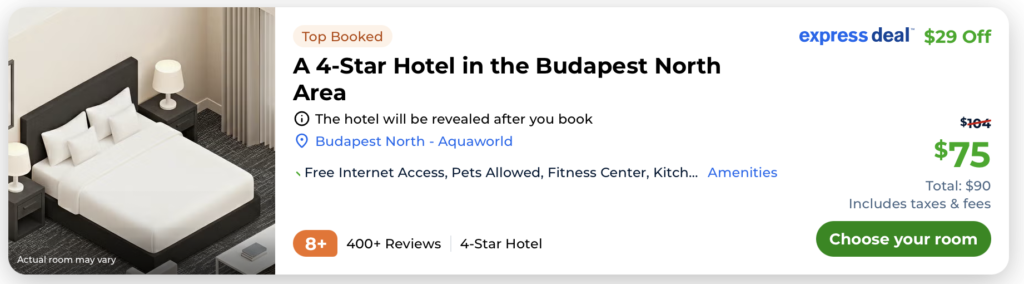
Priceline, part of Booking Holdings, offers two ways to book a discounted hotel before the exact property is confirmed. Travellers start in the Hotels section on Priceline’s website, enter their destination and stay dates, and look for Express Deals or Pricebreakers in the results, where available. An Express Deal shows a fixed price and details such as the neighbourhood, star category, review score and selected facilities. Travellers can filter by criteria such as location, category and amenities, then select an offer and learn the hotel’s name after completing the booking.
Pricebreakers gives the traveller three named hotels at a single price. Before paying, the traveller can check the locations and reviews of all three and decide whether each would suit the stay. The traveller books the group, and Priceline confirms which of the three hotels has been assigned after purchase. Both products are generally non-refundable and cannot be changed or transferred unless Priceline expressly states otherwise at checkout and on the itinerary.
For hotel operators, Express Deals keeps the property’s name out of the offer during the search, while Pricebreakers puts the hotel on a named shortlist without confirming which property will receive the booking. That distinction matters when assessing how visibly the discounted price is associated with the hotel. Priceline sells named hotels internationally, but its public product information gives limited destination-level detail on the reach of either programme. An operator assessing the channel should confirm which format is available in its market, who supplies the rooms and who controls rates and availability.
lastminute.com “Top Secret Hotels”
lastminute.com Top Secret Hotels Website
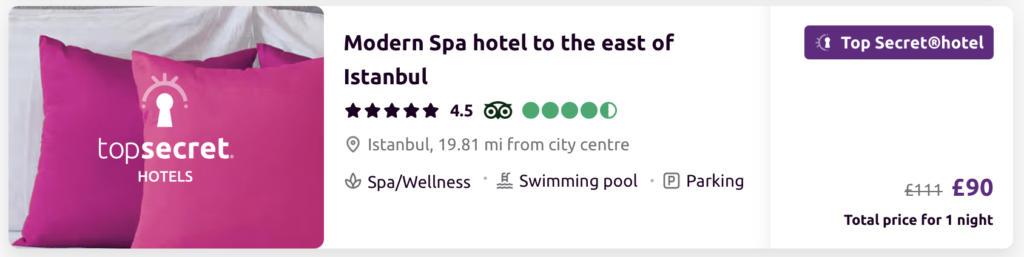
Top Secret Hotels is the fixed-price opaque booking product of lastminute.com, the flagship brand of lastminute.com Group. Travellers start on the dedicated Top Secret Hotels page and search for their destination, stay dates and number of guests. The offers show a price and describe the general location, facilities and guest reviews while withholding the property’s name. In London, for example, lastminute.com promotes offers in areas such as the West End, Covent Garden and Mayfair, giving travellers a neighbourhood to assess before they commit.
After selecting an offer, the traveller reviews the room details, meal plan, total price and cancellation conditions shown for that booking. The traveller can use the neighbourhood and facilities to decide whether the hotel meets the trip’s needs. lastminute.com discloses the property’s identity after the reservation is completed. Any flexibility to change or cancel the stay should be checked against the specific offer before payment.
For hotel operators, Top Secret Hotels gives lastminute.com a way to market a discounted room using the property’s location, facilities and reviews while keeping its name out of the offer before purchase. The UK is the clearest market on the dedicated product pages, with London and Manchester specifically promoted, and the product has a documented history in continental Europe. An operator considering the channel should confirm whether the product is available in its destination and how it can control the rates, stay dates and rooms released.
Who Uses Opaque Hotel Booking?
The Target Customer
The core target is a price-sensitive traveller who is flexible about the exact property. A leisure guest may need accommodation in a particular district and expect a certain hotel standard while being willing to stay at several properties that meet those criteria. A 2015 study by Chen and Yuan found that perceived value played a central role in purchase intention, with concerns about hotel performance and booking-site credibility also influencing the decision. A separate 2018 experiment by Chen and Lai found that respondents would compromise on some aspects of the hotel experience, such as room décor, in exchange for an opaque price.
Travellers booking close to arrival can also be a good fit. In 2012, PhocusWire reported that around half of lastminute.com’s Top Secret Hotels customers booked the day before they needed the accommodation. The figure describes one product at one point in time, and booking patterns can vary by platform and destination. For operators, it illustrates how an opaque offer can reach guests whose dates and destination are settled but who have yet to choose a property.
Hotel Participation and Booking Volumes
Historical research provides some indication of the channel’s scale. Huang and Yu cite TravelClick data putting opaque bookings at 6% of reservations at major hotel brands in 2012. A separate study cited in the European Commission’s hotel distribution report found that 53.3% of responding properties used some form of opaque selling, based on a sample of 140 revenue managers in the United States and Europe. The first figure measures reported reservation share at major brands, while the second measures participation within a survey sample.
Hotwire reported in early 2013 that it had doubled hotel bookings over the previous 12 months and that more than 30,000 hotels used its opaque model. An earlier Expedia investor presentation reported more than 20,000 room nights per day for Hotwire’s hotel business overall, without a separate figure for opaque room nights. More recent group reporting also makes it difficult to isolate individual products such as Express Deals or Secret Deals. The historical figures show that the channel achieved meaningful scale, while a reliable current estimate of its share of hotel bookings remains difficult to establish.
Advantages and Disadvantages for Hotel Operators
Incremental Demand and Rate Cannibalisation
Hotels use opaque selling to reach guests who are willing to give up some control over the property in exchange for a lower rate. A guest who needs a specific location, facility or loyalty benefit has a reason to book a named hotel. A guest who would accept several comparable properties has more incentive to take the opaque offer. This allows the hotel to serve customers with different willingness to pay while limiting how visibly the discount is associated with its name.
The principal risk is rate cannibalisation. It occurs when a guest takes the discounted offer and would otherwise have booked the same hotel at a higher rate. A separate risk arises when an early low-rated booking takes a room that could have been sold later to another guest at a higher rate. The revenue manager should assess both risks by stay date, particularly when demand is strengthening or available inventory is limited.
| Factor | Potential advantage | Potential disadvantage |
|---|---|---|
| Occupancy | Fills rooms that are likely to remain unsold. | Can displace higher-rated bookings if the hotel releases too many rooms or opens the offer too early. |
| Rate visibility | Limits the public association between the discounted price and the hotel’s name. | A distinctive location, category or combination of facilities can make the hotel easier to identify. |
| Distribution reach | Reaches flexible, price-sensitive guests who might otherwise choose a competing property. | Distribution costs reduce the amount retained, and the platform may control much of the pre-arrival relationship. |
| Inventory control | Supports selected dates and room allocations where the agreement allows. | The hotel may have limited ability to close an offer supplied through an intermediary. |
| Guest relationship | Introduces first-time guests to the property. | Limited information before purchase can lead to mismatched expectations about rooms, facilities or inclusions. |
Measuring Contribution and Controlling Inventory
The hotel should calculate the room revenue it retains after distribution costs and deduct the variable cost of servicing the occupied room. If an otherwise empty room generates €80 after distribution costs and costs €20 to service, the booking contributes €60 towards fixed costs and profit. If the same room could instead have generated €120 after distribution costs, the opaque booking contributes €40 less, assuming the same servicing cost. The revenue manager must weigh the contribution from a booking today against the likelihood of a higher-rated sale for the same stay date.
The operator should establish who supplies the offer, which room types and dates it covers, and how quickly it can be withdrawn. An allocation controlled by the hotel gives the revenue team scope to adjust availability as demand changes, subject to the agreement. Where an intermediary supplies the inventory, the hotel needs to understand who can close the rate and how long changes take to reach the booking site. Reviewing production by stay date helps the team decide whether to adjust the rate, reduce the allocation or shorten the release window.
Implications for Guests
An opaque rate is most suitable when the guest would accept several hotels of a similar standard in the area shown. The relevant comparison is the full cost of the stay against a named offer with comparable room inclusions and cancellation terms. A saving can be worthwhile when the guest’s plans are firm, and the exact address is secondary. Uncertainty carries more weight when accessibility, bedding configuration, or proximity to a venue determines whether the booking is usable.
Booking terms also affect what guests can expect after confirmation. Changes, refunds, loyalty points and on-property benefits depend on the rate and the relevant programme. A guest who normally books direct may assume the same benefits apply to a discounted reservation made through a third party. Clear booking descriptions and consistent handling at check-in help prevent those differences from becoming service complaints.
Hotel Reveal Tools and Rate Visibility
Hotel reveal tools, sometimes called hotel decoders, use listing details to suggest which property is behind an opaque offer. BetterBidding has helped travellers interpret these clues, and the TravelArrow browser extension offers a similar function as travellers browse booking sites. The suggested match may draw on the neighbourhood, hotel category, facilities or review profile. Several properties can share those characteristics, so the booking confirmation remains the definitive identification.
For the owner, the relevance is that a credible match allows some guests to compare the opaque price with the hotel’s direct and other published rates. This is more consequential when the same discount recurs and the property is easy to identify. Public evidence gives little indication of how often guests use reveal tools or how frequently a match influences a booking. The hotel’s primary measures remain the incremental demand generated, the net contribution retained and its control over the rooms and dates released.
Further Resources:
See HDG – Hotel Distribution Platforms: Controlling Guest Demand
See HDG – AI-Mediated Hotel Discovery
See HDG – The Hotelisation of Real Estate
See HDG – Co-Working Spaces and Hotels: A Converging Hospitality Model