
by Hotel Development Guide – Darren Blanchard
Last Updated: November 2026
An express owner buyout right is rare in long-term management agreements with major branded hotel operators. Operators generally do not offer this flexibility in their initial proposals and may firmly resist its inclusion during negotiations. Where a buyout clause is accepted, it usually comes with restrictions on timing, notice and compensation. Independent management companies and shorter appointments can offer greater flexibility, depending on the commercial arrangement. A hotel buyout clause is therefore a negotiated concession rather than a standard feature of the agreement.
The contractual starting point is that the agreement continues for its agreed term unless it expires, a specified termination right becomes available, or the parties agree to end it. Termination provisions may address material default, failure of performance tests or particular events, each subject to its own conditions and procedures. Without a buyout clause, an owner seeking to leave for other commercial reasons has no pre-agreed convenience exit or price. An early departure may consequently require a negotiated settlement or lead to a dispute over termination and compensation. Arbitration or litigation can resolve that dispute, but neither provides an automatic contractual right to buy out the operator.
A hotel buyout clause gives the owner an agreed route to terminate in exchange for a defined payment, subject to the contractual conditions. Its value depends on when the right becomes available, how compensation is calculated and whether the owner can realistically fund and execute the exit. The provision should be assessed alongside the contract term, renewal rights, performance tests and obligations under related agreements. Similar questions arise under franchise agreements, although royalty payments and management fees belong to different commercial relationships. For owners, the objective is to understand the full commitment before signing and the practical options available if the investment strategy changes.
Hotel Buyout Clause
Why Hotel Operators Resist Buyout Clauses
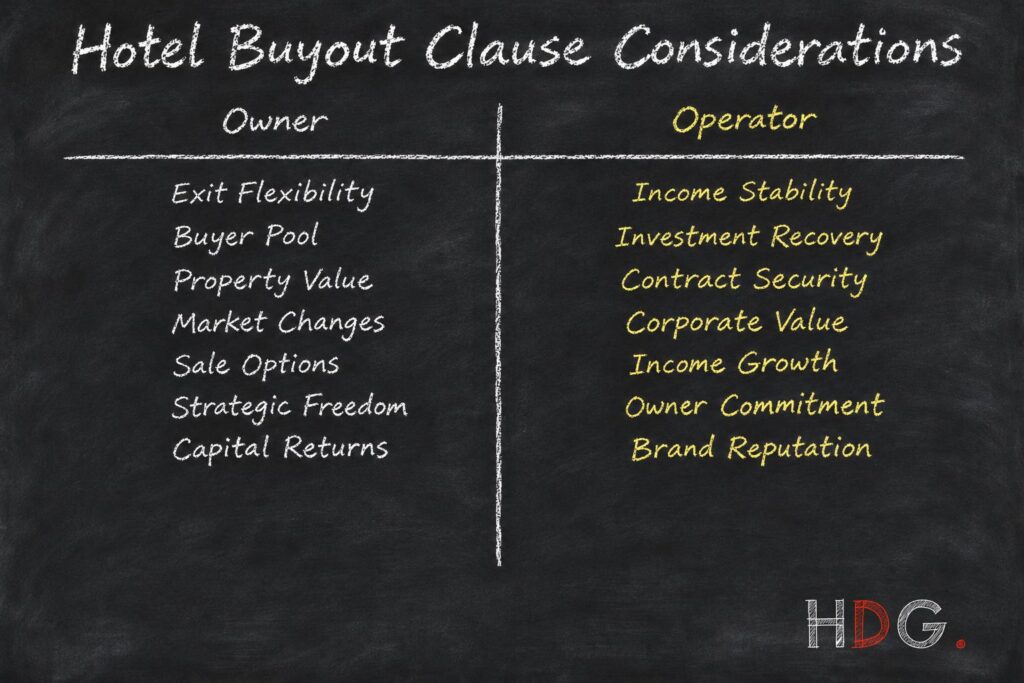
Stability and Future Fee Income
A management agreement represents an expected stream of future income for the operator. The value of that relationship depends partly on the reliability of the income and the contractual protection against early termination. A lengthy agreement with restricted exit rights offers greater visibility than one that the owner can end whenever another opportunity becomes attractive. The operator commits resources to opening, positioning and supporting the hotel in anticipation of a long relationship. An owner’s buyout right therefore affects the commercial value of the agreement from the outset.
The operator’s expectations can extend beyond the fees earned during the hotel’s early years. A new property may take time to establish its market position, develop demand and generate incentive fees. The operator may accept that initial period because it expects higher income as the business matures. An owner’s ability to terminate once the hotel becomes established can interrupt that expected progression, and the operator requires a substantial protected period before considering any convenience exit.
The Value of the Operator’s Contract Portfolio
An individual hotel agreement also contributes to the value of the operator’s wider business. Its portfolio of management and franchise agreements supports projected earnings, corporate planning and potential transactions involving the operating company. One valuation approach estimates future cash flows and discounts them to present value, while another applies earnings multiples informed by the quality and durability of income. Under either approach, contractual stability will influence the assessment. A hotel that can leave at short notice creates a different income expectation from one committed for a lengthy remaining term.
The operator expects a longer income stream, future fee growth, and strategic benefits from keeping the hotel in its portfolio. The property may support geographic coverage, brand recognition, brand reputation or relationships with other owners and investors. Replacing the agreement with an equivalent opportunity may take time and additional expenditure. From the operator’s perspective, the proposed payment must be considered against the full relationship it would surrender.
Termination Without a Buyout Clause
Default and Performance Provisions
Where no convenience buyout exists, the owner should examine the termination rights actually provided by the agreement. These may address material breach, insolvency, failure of performance tests or specified events affecting the property. The thresholds for qualifying breaches and failures are usually set at a high bar, and owners should not assume that these provisions will be easy to activate. Each route has its own notice requirements, evidential requirements and possible cure periods. Performance termination may depend on failures over consecutive years and may exclude circumstances outside the operator’s control. The presence of termination provisions therefore does not establish a straightforward right to change operators.
An owner’s dissatisfaction also needs to be distinguished from a qualifying contractual failure. The hotel may fall below the investment’s original projections while remaining above the agreement’s performance thresholds. A disagreement over strategy, staffing or expenditure may not amount to a material breach. Even where a test is failed, the operator may have a contractual opportunity to cure the failure and preserve the agreement. Owners should assess how these provisions would operate in realistic scenarios before relying on them as an exit mechanism.
Negotiated Release and Dispute Resolution
If no contractual exit right applies, an owner can seek a negotiated release. The operator may assess the hotel’s strategic importance, its remaining income expectations and the circumstances of the proposed departure. A settlement can address compensation, contribution repayments, unpaid fees and cooperation during handover. Its amount and conditions are negotiated at that time rather than determined through an existing buyout mechanism. This can make it difficult for an owner to establish a reliable exit budget in advance.
Arbitration or litigation becomes relevant if the parties disagree about whether termination is permitted or what financial consequences follow. The dispute resolution clause determines how such disagreements are handled. It does not create a general right to leave the agreement for a fixed payment. Proceedings may address the existence of a default, compliance with notice requirements or a claim arising from allegedly wrongful termination. The governing law, contractual wording and available evidence all influence the outcome.
Claims for Future Fees
Some agreements expressly provide compensation linked to future fees over the remaining contractual term. Such wording can create exposure considerably greater than a multiple of recent annual fees. The calculation may raise questions about projected revenue, incentive fees, future growth and discounting. Potential renewal periods may also become relevant, depending on the drafting. Owners should establish exactly when the provision applies and whether it concerns a permitted exit, owner default or another event.
The absence of an express future-fee formula does not necessarily eliminate a claim for future losses. An operator may seek damages following an allegedly wrongful termination, including compensation for income it says it would otherwise have earned. Recoverability depends on applicable law, the agreement, proof and relevant legal principles. A claim is not automatically equal to every projected fee over the remaining term. Nevertheless, an agreement without a defined buyout price can leave the owner facing uncertainty about the cost of departure.
Contract Term, Renewals and Owner Flexibility
Assessing the Effective Commitment
The initial contract term is only one part of the owner’s commitment. Performance termination rights, buyout provisions and renewal mechanics determine how much flexibility exists during and after that period. A lengthy agreement may be more manageable where effective exit rights are available at an affordable price. A shorter agreement may remain restrictive if the operator controls extensions or the owner must act within narrow notice windows. Owners should therefore evaluate the complete contractual framework rather than focus exclusively on the stated number of years.
The intended investment holding period provides an important reference point. A developer planning to sell after stabilisation may have different requirements from an owner intending to retain the property for several decades. The operator’s proposed commitment may extend well beyond either the original financing period or the owner’s preferred sale date. These differences should be discussed during operator selection and negotiation of the principal terms. A buyout available only after the intended exit may provide limited assistance to the investment strategy.
Renewal Rights and Compensation
Renewal provisions can extend the relationship beyond the initial term through unilateral options, mutual agreement or automatic mechanisms. The owner should establish who controls renewal and what notices are required to prevent an unwanted extension. The owner should also review conditions attached to renewal, including performance requirements and how existing defaults are treated. Failure to respond within a specified period may have consequences under the particular agreement. Those dates should form part of the owner’s ongoing contract management.
Renewals also matter when compensation is linked to future fees. Owners should establish whether a buyout calculation includes only the remaining initial term or potentially extends to renewal periods. An option that the operator can exercise alone creates a different commercial issue from a continuation requiring both parties’ agreement. The drafting should make the treatment clear rather than leave it to interpretation when an exit is proposed. Otherwise, the owner may underestimate both the effective commitment and the compensation being discussed.
What a Hotel Buyout Clause Should Establish
Buyout Rights and Negotiated Exits
Termination for Convenience
A termination-for-convenience provision allows the owner to end the agreement without establishing operator fault, subject to the agreed conditions. Where this right requires compensation, the buyout clause establishes the financial terms of departure. The right may become available only after a protected period or on specified break dates, with advance notice and payment required. Its commercial value depends on whether those conditions fit the owner’s investment timetable and financial capacity. Convenience termination describes the right to leave, while the buyout mechanism defines the price and process for exercising that right.
Termination on Sale
A sale-related buyout gives the owner an exit linked to a qualifying transaction rather than a general right to terminate at any time. The agreement should define the transactions covered, the compensation payable and any conditions concerning the purchaser. Notice and payment arrangements need to work with the sale timetable, particularly where compensation will be funded from completion proceeds. The wording should also address what happens if the proposed sale does not complete. Owners should establish whether the provision allows them to offer the hotel free of the existing agreement and what achieving that outcome will cost.
Negotiated Release
Where no applicable buyout right has been agreed, an owner seeking a commercial exit may need to negotiate a release with the operator. There is then no pre-agreed price or assurance that the operator will consent. The discussion may address expected future fee income, the hotel’s strategic importance, repayment obligations and the proposed handover. Any settlement should establish the payment, termination date, releases and continuing responsibilities. This differs from exercising an existing buyout clause because the parties must first agree both the right to leave and the terms of departure.
Protected Periods and Notice
An operator willing to discuss buyout flexibility may require an initial protected period. Its commencement could be linked to signing, opening or another defined event. These dates can differ materially where development is delayed or the hotel opens in phases. The owner should calculate the effect using the agreement’s definitions rather than an informal description of the commercial terms. A provision described as a ten-year buyout may produce a longer practical commitment.
The distinction between the earliest notice date and the earliest termination date is particularly important. A clause permitting notice only after a protected period adds the notice requirement to that commitment. Another clause may permit advance notice for termination immediately after the protected period ends. References to completed Full Fiscal Years can extend the timeline further when the opening period is shorter than a complete fiscal year. Owners should translate the wording into actual dates before evaluating it.
Calculating the Buyout Payment
Historical Fee Multiples
One possible calculation applies an agreed multiple to historical management fees. The reference figure might be the previous completed year or an average across several years. Historical accounts provide a basis for checking the amount, although the contractual definitions remain important. Renovation, closure, exceptional demand or changes in fee rates can materially affect the result. The multiple should therefore be negotiated together with the reference period and any adjustment provisions.
A formula using the higher of two historical measures gives the operator additional protection. A longer average may determine compensation where the latest year was weak. The latest year may instead determine it where recent performance was strong. Owners should model both rising and declining fee scenarios to understand how the calculation behaves. The result depends on the interaction of the provisions rather than the headline multiplier alone.
Declining Schedules and Remaining-Term Calculations
A declining compensation schedule can give owners greater visibility over the cost of leaving at different stages. Different years may carry different multiples or fixed payments. The owner can then assess whether an immediate departure is preferable to waiting for the next reduction. The agreement should establish whether the applicable band is determined at notice or effective termination. It should also explain the treatment of extensions and the period approaching expiry.
A remaining-term formula requires assumptions about future performance and income. The parties should establish which fees are projected, how growth is treated and whether future receipts are discounted. The calculation should also distinguish projected fees from any agreed measure of loss or earnings. Caps, minimum payments and renewal assumptions can materially change the exposure. An owner needs a worked model of the actual wording before assessing whether the proposed price is commercially acceptable.
Defining the Fee Base
The agreement may distinguish base management fees, incentive fees and payments under related service arrangements. Each category should be checked against the buyout definition. Taxes, reimbursements, central service charges and third-party costs should receive explicit treatment where relevant. The difference between fees paid, payable and earned can also matter if amounts are deferred or disputed. Clear definitions make the calculation easier to verify and reduce uncertainty after notice.
| Calculation feature | Question to resolve |
|---|---|
| Fee categories | Which base, incentive and related charges are included? |
| Reference period | Which completed years or months determine compensation? |
| Measurement date | Is the calculation fixed at notice or termination? |
| Payment structure | Is the amount fixed, declining or linked to the remaining term? |
| Renewal periods | Can extensions increase the calculation? |
| Limits and adjustments | Are there caps, minimums or exceptional-period provisions? |
An Illustrative Management Agreement Buyout
A Ten-Year Protected Period
The example below provides an express exit while preserving a substantial initial commitment. The owner cannot serve notice under the supplied wording before the protected period is complete. The higher-of formula also prevents a single weak final year from automatically determining compensation. The wording contains no declining multiple or express remaining-term cap, although the full agreement would require review. Its commercial significance lies in the combined effect of timing, calculation and exceptions.
An illustrative clause permits the owner to terminate after completing the tenth Full Fiscal Year from the Opening Date. Written notice must specify a termination date at least six months later. Compensation equals four times the higher of the management fee paid in the previous Full Fiscal Year or the average annual management fees paid during the last three Full Fiscal Years. Payment must be made on or before the termination date. The provision excludes that payment obligation for termination under separately identified early-termination and material-underperformance sections.
Worked Calculation
Assume the management fees paid during the relevant three completed years were €300,000, €450,000 and €600,000. Their annual average would be €450,000. The previous Full Fiscal Year’s fee would be €600,000, making it the higher reference amount. Applying the contractual multiple of four produces a buyout payment of €2.4 million. Other liabilities or adjustments under the full agreement would need separate assessment.
| Calculation component | Illustrative amount |
|---|---|
| First relevant year | €300,000 |
| Second relevant year | €450,000 |
| Previous Full Fiscal Year | €600,000 |
| Three-year annual average | €450,000 |
| Higher reference amount | €600,000 |
| Contractual multiple | 4 |
| Calculated buyout payment | €2,400,000 |
A notice period crossing a fiscal year-end highlights the importance of the measurement date. The parties need to know which completed years apply when the final calculation is prepared. The definition of management fees determines which amounts enter each year’s figure. The owner should also establish whether payment fully resolves future management fee claims arising from that permitted termination. A numerical example is most useful when these surrounding contractual questions are addressed.
Key Money and the Full Cost of Exit
Repayment of Contributions
Key money and other contributions should be reviewed separately from the management agreement buyout. Repayment obligations may appear in the main agreement, a side letter, a loan document or another arrangement. Their dates and conditions may differ from those used to calculate termination compensation. An owner should identify every relevant document before estimating the overall exposure. A clear buyout price can otherwise create a misleading impression of certainty.
Where repayment reduces over time, the owner should confirm the amortisation period and starting date. Different treatment may apply to convenience termination, operator default and performance termination. The owner should also check whether related provisions create overlapping claims concerning the same contribution. Any negotiated waiver or offset should be documented clearly. The purpose is to understand the combined obligation and the circumstances in which each component becomes payable.
Transition and Repositioning Expenditure
The cost of changing an operating arrangement extends beyond payments to the departing counterparty. Depending on the strategy, the budget may include systems, signage, distribution arrangements, recruitment, training and physical alterations. Professional fees, working capital and disruption during handover also require consideration. Some expenditure may arise even where termination compensation is excluded. Owners should therefore assess a complete transition budget before deciding whether replacement is financially attractive.
An illustrative €2 million buyout could be accompanied by €500,000 of contribution repayment and €750,000 of transition expenditure. That produces a €3.25 million requirement before other applicable liabilities or taxes. The owner needs to understand when each payment falls due and which funds will be available. An incoming operator’s contribution may assist, but its conditions and timing must be confirmed. Expected future operating improvements cannot automatically fund obligations payable before the new arrangement begins.
Buyouts on Sale and Refinancing
Sale Flexibility and Net Proceeds
Some purchasers prefer an existing operator to remain, while others require a hotel free of the appointment. Owners should assess both possibilities against their likely buyer pool. A higher offer requiring termination may produce lower net proceeds after compensation and transition costs. A transaction retaining the agreement may offer greater certainty or a stronger financial outcome. The relevant comparison is between complete transaction scenarios.
A sale-related termination provision should coordinate with the transaction’s completion mechanics. The owner should establish whether notice can be conditional and what happens if the purchaser fails to complete. Payment timing needs to match the availability of sale proceeds or other funding. Buyer eligibility, consent requirements and assignment restrictions may affect the route. Clear drafting helps prevent an operator departure from taking effect while the intended transaction remains unresolved.
Ownership Structures and Lender Consents
Property sales, share transfers and internal reorganisations may be treated differently under the agreement. Owners should establish which transactions qualify and whether indirect changes of control are covered. Financing documents may separately require consent before replacing the manager or making substantial termination payments. Agreements between the operator and lender can add further requirements that affect continuity and enforcement. These obligations should be reviewed together before an exit timetable is established.
Negotiating a Commercially Usable Exit
Raising Buyouts During Operator Selection
Owners should raise buyout flexibility at the very beginning of operator selection, before investing substantial time in proposals and negotiations. Depending on market conditions, many hotel operators will not entertain a buyout clause, so establishing their position early avoids pursuing a commercial relationship that cannot meet the owner’s requirements.
The owner should explain its holding period, sale strategy and whether an agreed exit mechanism is essential to the investment. Prospective operators can then confirm whether they will consider a general buyout, a sale-related exit or a narrower break mechanism. Where buyout flexibility is essential, and an operator rules it out, that disagreement should inform the shortlist before negotiations progress. This lets the owner focus time and resources on operators whose contractual approach matches the investment strategy.
An operator willing to negotiate may seek compensation through a longer protected period, a higher payment or changes elsewhere in the agreement. The owner should evaluate the complete package. An earlier right can be more valuable than a lower price available only after the expected sale date. A predictable declining schedule may support planning better than an uncertain future negotiation. Financial modelling should connect these alternatives to the investment strategy.
Modelling the Decision to Leave
The owner’s model should test stronger and weaker trading, alternative sale dates and different replacement strategies. It should show how compensation changes as historical fees develop. Dates that trigger material reductions or end protected periods should be identified. Contribution repayments and transition funding should be incorporated. These comparisons demonstrate the practical value and cost of exercising the right.
The analysis should also compare replacement with retaining the existing arrangement. Projected revenue improvements or savings need to justify the expense and disruption of change. A replacement operator or brand may impose new capital commitments and contractual restrictions. Those obligations should be understood before assuming that departure improves the investment. A buyout right creates an option, while exercising it remains a separate commercial decision.
Disputes, Payment and Finality
The agreement should explain how compensation is verified and how calculation disagreements are resolved. Access to supporting records and an appropriate independent determination process can improve certainty. The owner should understand whether a disputed amount prevents termination and whether agreed security can address that situation. Accrued fees, surviving claims and releases require explicit attention. The intended outcome is a process that delivers the degree of finality the parties have negotiated.
Legal treatment also depends on more than the label attached to the payment. Buyout compensation, liquidated damages and claims arising from wrongful termination can raise different issues. Applicable law may affect interpretation, enforceability and remedies. Owners should obtain advice on the actual wording and circumstances before relying on a perceived exit price. This is particularly important where future fees or extended terms create substantial exposure.
Operational Handover
Maintaining Continuity of Trading
A successful exit requires preparation for the transfer of operational responsibility. Reservations, deposits, supplier commitments, accounting records and systems access need to be addressed. Employee arrangements, licences, and permissions require attention based on the property’s structure and applicable law. An incoming operator needs sufficient preparation time. A properly funded buyout can still disrupt trading if these dependencies remain unresolved.
The contractual package should address cooperation, final accounts, removal of branding and access to records after departure. Data transfers must respect contractual rights and privacy requirements. Owners should identify which systems and accounts they control and which depend on the departing organisation. A transition programme can assign responsibilities and connect them to the effective termination date. Operational readiness gives practical value to the exit right.
Assessing the Owner’s Real Commitment
The first question is whether the operator or franchisor will accept an express buyout right at all. If it will, the owner must establish when the right becomes available, what it costs and how it interacts with other obligations. If it will not, the owner should understand the available termination grounds and the uncertainty surrounding a separately negotiated departure. That distinction belongs within the original investment assessment. It can influence operator selection, financing and the preferred ownership strategy.
The usefulness of a hotel buyout clause depends on its complete operation throughout the ownership period. Timing, compensation, consents, and handover requirements must support an exit the owner can realistically execute. Assess renewal and performance provisions alongside it because they affect the relationship’s effective duration. Owners should revisit these arrangements before refinancing, renewal or sale. A clear view of the contractual commitment provides a stronger basis for future investment decisions.
Further resources:
See HDG – Hotel Management Agreement Term
See HDG – Hotel Performance Tests in Hotel Management Agreements
See HDG – Hotel Contract Lawyer Contacts
See HDG – Hotel Operator Links
Akerman (May 2026) – “Unlocking Value: Key Drivers of EBITDA Multiples in Hotel Management Company Transactions“
AAHOA (November 2023) – 12 Points of Fair Franchising “Early Termination Rights, and Liquidated Damages”
Disclaimer
This page provides general information for educational purposes only. It does not constitute legal, financial, tax or investment advice and should not be relied upon when negotiating, interpreting, entering into or terminating any agreement. Examples, calculations and contractual provisions are illustrative only; they do not establish market standards, legal entitlements or the enforceability of any provision.
Contractual rights, termination procedures, compensation obligations and available remedies depend on the complete agreement, related documents, applicable law and the specific circumstances. Obtain independent advice from a qualified lawyer experienced in hotel management and franchise agreements in the relevant jurisdiction before making decisions or taking action.
Hotel Development Guide and its authors make no representation or warranty regarding the accuracy, completeness or applicability of this information. To the fullest extent permitted by applicable law, they disclaim liability for losses, costs, claims or damages arising from reliance on, or use of, this page. Reading this page does not create a professional advisory relationship.