
A hotel business plan explains how a proposed hotel will be developed, funded, positioned, operated, and managed to achieve the owner’s objectives. It brings the commercial concept, market evidence, delivery strategy, operating approach, and financial expectations into one coordinated document. For a developer, its value lies in connecting decisions that might otherwise be considered separately by consultants, designers, operators, and financing partners. A well-prepared plan makes these relationships explicit and identifies the actions, resources, responsibilities, and assumptions on which the project depends.
The business plan should develop as the project progresses from an initial opportunity to a defined investment and operating business. Early versions may contain provisional assumptions about the brand, facilities, development programme, and funding structure. Later versions should incorporate the results of feasibility work, design development, operator negotiations, cost planning, and financing discussions. The owner should maintain responsibility for the overall plan, even where an external adviser coordinates its preparation.
Hotel Business Plan: Developing the Strategy Behind the Hotel Investment
What Is a Hotel Business Plan?
A Strategy for Developing and Operating the Hotel
A hotel business plan describes the business the owner intends to create and the strategy for making it successful. It explains the intended guests, the hotel’s competitive position, its facilities and services, and the way the operating organisation will deliver the guest experience. It also addresses how the project will be developed, what capital it requires, and how performance will be monitored. These elements should form a coherent business proposition in which the physical product, operating model, and investment objectives support one another.
The document should be specific to the property and its circumstances. A city hotel serving corporate demand requires a different commercial and operating strategy than a seasonal resort, an extended-stay property, or a hotel in a mixed-use development. Ownership objectives also influence the plan, particularly where the owner intends to retain the asset, sell after stabilisation, or pursue a wider portfolio strategy. The business plan should explain these choices and their consequences rather than relying on general statements about tourism growth or service quality.
Development Business Plans and Annual Operating Plans
A development business plan covers the creation, conversion, acquisition, or substantial repositioning of the hotel business. Its scope spans capital investment, development delivery, opening, and the transition to established trading. An annual operating business plan focuses on the actions and financial targets for a particular operating year. Both documents are useful, but they answer questions over different time horizons and at different levels of detail.
The development plan establishes the broader strategy against which annual decisions can be assessed. Once the hotel opens, management should translate that strategy into annual commercial priorities, departmental actions, staffing requirements, and budgets. Actual performance may reveal that some original assumptions require revision. The relationship should therefore work in both directions, with the long-term plan guiding operations and operating evidence informing future investment decisions.
Business Plan, Feasibility Study and Financial Plan: What Is the Difference?
Testing the Opportunity and Explaining Its Execution
A feasibility study tests whether the proposed hotel represents a commercially supportable opportunity. It investigates market demand, competitive conditions, achievable performance, and the relationship between the expected benefits and required investment. The business plan uses that evidence to explain how the owner intends to deliver and manage the chosen opportunity. It adds the implementation strategy, organisational responsibilities, commercial actions, and management framework required to move the project forward.
The distinction matters because a business plan should remain open to conclusions that challenge the original concept. If the feasibility work indicates that the proposed room count, positioning, or facilities are unsuitable, the strategy should change accordingly. Commissioning a detailed business plan before testing fundamental assumptions can create a polished document around a weak proposition. The process should allow the owner to refine, postpone, or abandon the project where the evidence supports that decision.
Quantifying the Strategy and Presenting a Funding Request
The financial model calculates the consequences of the project’s assumptions about development costs, operating performance, financing, and ownership returns. The business plan explains why those assumptions are appropriate and what actions are required to achieve the expected outcome. An investment memorandum or financing proposal then presents a particular capital request to investors or lenders. These documents should draw on a consistent information base, while giving appropriate emphasis to their intended readers.
Hotel Business Plans Compared With Related Documents
The table below summarises the different questions these documents answer and how each contributes to the development and investment process.
| Document | Main question | Principal contribution |
|---|---|---|
| Hotel feasibility study | Does the proposed hotel make commercial sense? | Tests market support, forecast performance, investment requirements, and viability |
| Hotel business plan | How will the hotel business be developed and managed successfully? | Explains strategy, implementation, responsibilities, operating approach, and risks |
| Financial model and financial plan | What are the funding needs and expected financial outcomes? | Quantifies costs, cash flow, financing, profitability, and returns |
| Investment memorandum | Why should an investor commit capital to this opportunity? | Presents the investment proposition, proposed structure, evidence, and risks |
| Loan proposal | Why should a lender provide the requested financing? | Explains borrowing requirements, repayment capacity, security, and borrower strength |
| Annual operating business plan | What should the operating hotel achieve this year? | Establishes commercial actions, operating priorities, and annual targets |
The term financial plan is often used broadly to describe funding arrangements, forecasts, cash requirements, and financial objectives. In practice, those subjects may be presented through a financial model, development budget, operating projections, and supporting schedules. The business plan should summarise its conclusions and explain the strategy behind them. Detailed calculations can remain in the model or appendices, with the intended reader in mind: present the figures needed to understand the business case without overwhelming the main document with too many pages and too much technical detail. Readers who need to examine the calculations should be able to locate them easily and trace the relationship between the narrative and the numbers.
When Should the Business Plan Be Prepared?
What Comes First: Market Study, Feasibility Study or Business Plan?
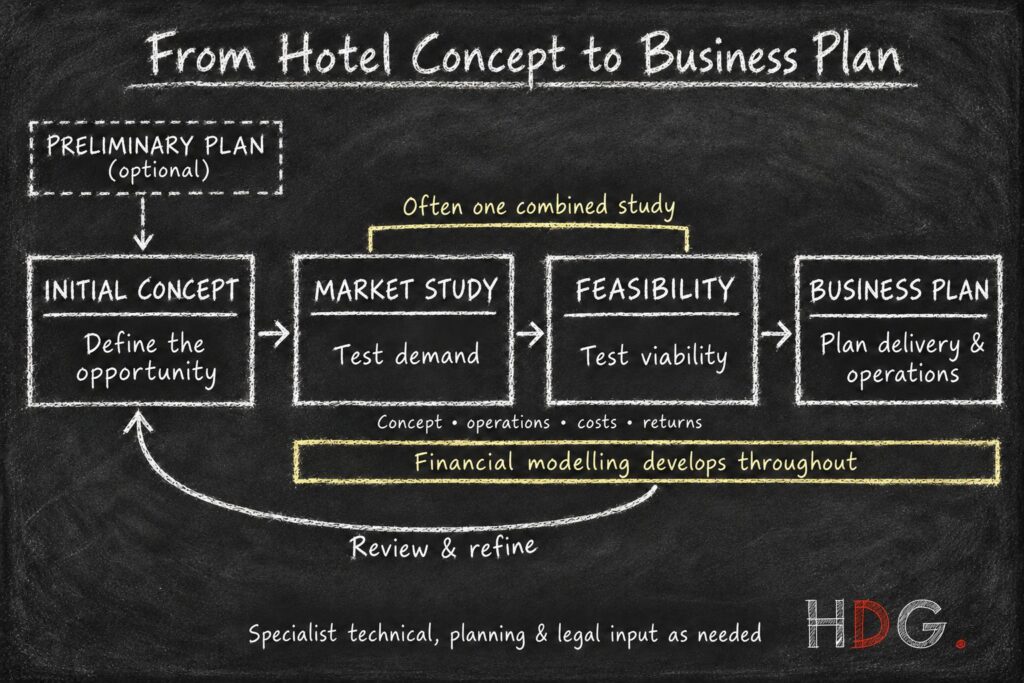
The usual starting point is an initial hotel concept or development brief, followed by market and feasibility analysis, and then a detailed business plan. A market study assesses demand, competition, positioning, and achievable trading performance. A financial feasibility assessment uses that evidence, together with development costs and operating forecasts, to test whether the proposed investment is viable. These investigations may be commissioned separately or combined in a single hotel market and financial feasibility study. The detailed business plan then explains how the supported opportunity will be funded, developed, marketed, operated, and managed.
An owner may prepare a short preliminary business plan before commissioning these studies to record objectives, assumptions, and questions requiring investigation. That early document provides a starting framework and should be revised in response to the findings. Financial modelling begins during feasibility and becomes more detailed as the concept, costs, operating arrangements, and financing terms develop. The process is therefore iterative, although the detailed business plan should be grounded in market and feasibility evidence before it supports major investment commitments.
Begin With a Proportionate Initial Plan
An initial business plan can be prepared once the owner has a sufficiently clear concept and an identifiable opportunity to investigate. At this stage, the document should record objectives, preliminary assumptions, key uncertainties, and the work needed to reach the next decision. It should avoid presenting unresolved issues as settled facts. A concise working plan can help coordinate early advisers without incurring the cost of a fully developed document too soon.
The detailed plan should become more substantial as market evidence, development scope, operating arrangements, and costs become clearer. Feasibility findings should inform the commercial strategy before major capital commitments are made. Operator and brand discussions can then refine the service proposition, staffing model, fees, and technical requirements. Financing discussions may introduce further conditions affecting the capital structure, programme, and required contingency.
Update the Plan at Investment Milestones
The business plan should be reviewed when the project reaches decisions that materially change its risk or funding exposure. Relevant milestones include site acquisition, concept approval, operator appointment, investment approval, financing, construction commitment, and opening. A review should also follow significant changes in development cost, market conditions, scope, or completion date. The purpose is to determine whether the business case remains supportable and whether corrective action is needed.
Each approved version should identify its date, principal assumptions, and relationship to the current budget and financial model. Responsibility for maintaining the document should be assigned to the developer, development manager, or another designated owner representative. Supporting advisers should update the inputs within their respective areas of expertise. This approach helps prevent different project participants from relying on incompatible versions of the same investment case.
Who Prepares and Uses the Hotel Business Plan?
Owner Leadership and Specialist Contributions
The owner or development sponsor should lead the business plan because it expresses the owner’s objectives and commitments. A hotel consultant, development adviser, or internal investment team may prepare the document and coordinate specialist inputs. If appointed, the operator should contribute operating assumptions, commercial strategy, staffing requirements, and pre-opening considerations. Architects, cost consultants, financial advisers, project managers, and legal advisers provide information relevant to the development and ownership structure.
An externally prepared plan still requires active owner involvement. Advisers cannot determine the owner’s acceptable risk, investment horizon, additional funding capacity, or preferred exit strategy without clear instructions. The owner should challenge optimistic assumptions and ensure that proposed actions are achievable with the available team and resources. Formal approval should establish who is authorised to implement the plan and which decisions require further consent.
Different Readers Need Different Levels of Detail
Owners and investment committees use the plan to evaluate the strategy and approve commitments. Operators and development teams use it to understand the concept, delivery responsibilities, and performance expectations. Investors and lenders may review it alongside independent studies and their own underwriting. Each audience needs a clear explanation of the project, but the supporting detail relevant to their decisions will differ.
The document should therefore provide a concise executive summary followed by clearly organised sections and supporting schedules. A prospective investor may initially focus on the sponsor, funding requirement, returns, and major risks. An operator may examine positioning, facilities, market segments, service expectations, and operating economics. Technical and financial reviewers may need access to detailed assumptions, calculations, and source documents before reaching their conclusions.
| Contributor | Typical contribution to the plan |
|---|---|
| Owner or sponsor | Investment objectives, risk appetite, capital commitment, governance, and ownership strategy |
| Hotel consultant | Market interpretation, positioning, concept recommendations, and operating forecasts |
| Operator | Commercial strategy, staffing, service delivery, systems, and opening requirements |
| Architect and design team | Facilities, physical scope, design assumptions, and development constraints |
| Cost consultant | Development costs, allowances, contingencies, and cost risks |
| Project manager | Delivery programme, procurement strategy, responsibilities, and implementation risks |
| Financial adviser or modeller | Funding structure, cash flow, financial analysis, and scenario testing |
| Legal and tax advisers | Relevant ownership, contractual, regulatory, and tax considerations |
How Long Should a Hotel Business Plan Be?
Match the Length to the Project and Audience
For many hotel development projects, approximately 20–35 pages of main narrative and summary tables provides a useful working target. This is an editorial guide rather than an industry requirement, and the appropriate length depends on project complexity and recipient expectations. A small independent hotel may need a shorter document, while a phased resort or mixed-use project may require substantially more explanation. Detailed market research, technical reports, drawings, and financial schedules can be provided separately.
Length should reflect the information required to understand and assess the strategy. Repeating the feasibility study or inserting every spreadsheet output can obscure the decisions the reader needs to make. The plan should explain the relevant findings and direct readers to the supporting evidence. Where a lender or investor specifies a required format, that requirement should be established before the document is prepared.
Use an Executive Summary and Supporting Layers
The executive summary should normally allow a reader to understand the opportunity and principal issues within one or two pages. It should state what is proposed, why it is supportable, how it will be delivered, and what capital is required. It should also identify material uncertainties and the next decision sought from the reader. The main document then develops the reasoning, while appendices and a data room provide the evidence needed for detailed review.
Recommended Hotel Business Plan Structure
1. Executive Summary
The executive summary presents the essential business proposition in a form that can stand on its own. It should identify the hotel’s location, proposed size, positioning, target customers, ownership, and current development status. It should summarise investment requirements, funding arrangements, delivery milestones, and headline financial expectations. Material risks and unresolved conditions should be stated clearly so that the summary provides a balanced introduction.
Write this section after the main plan has been developed and reconciled with its supporting information. Financial figures should match the approved model and specify the relevant forecast period or year. Descriptions such as premium, sustainable, or differentiated should be supported by concrete features and commercial implications. The reader should finish the summary understanding the proposal and the reasons for examining it further.
2. Ownership Objectives and Project Overview
This section explains who is promoting the project and what the owner intends to achieve. It should describe the sponsor’s relevant experience, ownership structure, site interest, project status, and intended investment horizon. Objectives may include long-term income, capital appreciation, portfolio expansion, or support for a wider development. The plan should explain how these objectives influence the hotel concept, funding approach, and management structure.
The project overview should distinguish existing assets and completed work from future intentions. Site ownership, design progress, approvals, operator negotiations, and financing status should be described accurately. Dependencies such as land assembly, infrastructure provision, or third-party consent should be identified. Readers should be able to understand what the developer controls and what remains to be secured.
3. Hotel Concept and Facilities
The concept section explains the intended hotel experience and the physical facilities required to deliver it. It should identify the proposed market position, service level, room mix, food and beverage offering, meeting facilities, leisure amenities, and other significant components. These choices should respond to guest needs and market evidence. The section should also explain how the concept fits the site and the owner’s investment parameters.
Major facilities should have a clear commercial or operational rationale. A large restaurant, extensive spa, or substantial meeting area can increase revenue potential while adding capital cost, staffing, maintenance, and operating complexity. The plan should explain whether each component serves staying guests, external customers, or both. Where demand or operating assumptions remain uncertain, further investigation should be identified before the scope is fixed.
4. Market Opportunity and Competitive Position
The market section summarises the evidence supporting the proposed hotel and explains its strategic implications. It should identify principal demand generators, target segments, seasonality, source markets, competitors, and relevant future supply. Market findings should inform the proposed scale, facilities, pricing position, and operating approach. Reference the underlying feasibility study and make clear when its research was undertaken.
The competitive assessment should explain why guests would choose this hotel at the intended price. Location, facilities, brand distribution, room configuration, service, and access to particular demand sources may all contribute. Claims of superior quality or limited competition should be examined carefully and supported by evidence. The plan should also consider how competitors may respond and how new supply could affect performance.
5. Brand, Operator and Management Strategy
This section explains how the hotel will be branded and operated. It should describe the proposed management model, the reasoning behind it, and the responsibilities retained by the owner. Where a brand or operator is appointed, the plan should summarise the commercial implications relevant to the business case. Where selection is incomplete, it should identify the alternatives being considered and the assumptions used in the forecasts.
The operating arrangement can influence distribution costs, staffing, service requirements, technical standards, fees, and owner control. These effects should be considered together when evaluating the proposed structure. A strong brand may support demand generation but also introduce commitments that affect capital expenditure and operating profitability. The business plan should explain why the selected arrangement suits the property and ownership objectives.
6. Sales, Marketing and Revenue Strategy
The commercial strategy explains how the hotel will attract, convert, and retain profitable demand. It should identify priority customer segments, geographic markets, distribution channels, sales relationships, and pricing principles. The proposed segment mix should correspond with the room product, facilities, location, and market forecasts. The plan should also explain how business will be built during the opening and ramp-up period.
Distribution should be assessed through both revenue contribution and acquisition cost. Direct bookings, online travel agencies, corporate accounts, tour operators, groups, and brand channels may play different roles across the year. The strategy should recognise the trade-offs between occupancy, achieved rate, commissions, payment terms, and operating demands. Commercial actions should have identified responsibilities, budgets, and measures of effectiveness.
7. Operating Strategy and Organisation
The operating section explains how the hotel will deliver its service promise within the forecast cost structure. It should address the organisational model, staffing approach, departmental responsibilities, systems, purchasing, maintenance, and quality controls. Staffing assumptions should reflect local labour availability, skill requirements, productivity, and service expectations. The plan should also identify activities that will be outsourced or supported by shared services.
Operating resilience deserves attention during development planning. Utility reliability, supplier availability, transport, staff accommodation, security, and maintenance capability can materially affect hotel performance. In markets where infrastructure is constrained, backup systems and logistics arrangements may require additional investment and ongoing expenditure. These conditions should be reflected in both the operating strategy and financial forecasts.
8. Development and Delivery Strategy
The development section explains how the project will move from its current state to a completed, operational hotel. It should summarise design status, approvals, procurement approach, construction strategy, programme, and principal responsibilities. Key dependencies should include financing, infrastructure, imported equipment, operator approvals, and specialist commissioning. The level of detail should allow readers to assess whether the proposed opening date and delivery approach are credible.
The business plan should identify the owner’s process for controlling scope, expenditure, and change. It should explain how design decisions will be tested against the budget and commercial objectives. Cost contingencies and programme allowances should reflect the stage of design and known risks. Detailed schedules and project controls can sit in separate delivery documents, with their main conclusions summarised here.
9. Pre-Opening and Ramp-Up Strategy
The pre-opening strategy covers the work required to establish the operating business before guests arrive. It should address recruitment, training, sales activity, systems, licences, supplier agreements, operating supplies, and opening readiness. The owner, project team, operator, and general manager should coordinate responsibilities. Include the associated budget in the overall funding requirement and cash flow.
The plan should also explain the expected transition from opening to more established trading. Occupancy, pricing, staffing efficiency, and operating margins may take time to develop. A phased opening can add complexity when construction continues alongside guest operations. The forecast should reflect the chosen opening approach and include adequate working capital for the ramp-up period.
10. Development Budget and Funding Strategy
This section presents the total capital required and the proposed sources of funding. It should distinguish land, construction, professional fees, furniture and equipment, financing costs, pre-opening expenditure, working capital, and contingency. The funding structure should identify sponsor equity, external equity, debt, and any other expected sources. Uncommitted capital should be described clearly rather than treated as secured funding.
The timing of funding matters as much as the total amount. Equity contributions, loan drawdowns, supplier payments, and opening expenditure need to align throughout delivery. The plan should identify conditions that must be satisfied before funds become available. It should also explain how overruns, delays, or additional working capital requirements would be addressed.
11. Financial Outlook and Investment Returns
The financial section summarises the hotel’s expected performance and its implications for the owner. It should present the main assumptions for occupancy, average daily rate, ancillary revenue, operating costs, fees, and replacement expenditure. Financial measures should be defined consistently, particularly where different reports use different profit terminology. Forecasts should identify the opening period, ramp-up assumptions, and the basis for the stabilised operating year.
Owner cash flow and investment returns should be shown alongside hotel operating performance where relevant. Debt service, taxes, capital expenditure, additional equity, and disposal assumptions can materially affect investor outcomes. Any assumed sale should state its timing, valuation approach, transaction costs, and sensitivity to market conditions. The narrative should explain the drivers of returns rather than relying on a single headline percentage.
12. Risks, Sensitivities and Contingency Actions
The risk section identifies the factors most likely to prevent the project from achieving its objectives. These may include weaker demand, new supply, cost inflation, delayed approvals, financing conditions, currency exposure, staffing constraints, and operator performance. Each material risk should be connected to its potential effect on the project and the proposed response. Responsibility for monitoring the risk should also be clear.
Sensitivity and scenario results should show how the business performs under less favourable conditions. Useful tests may combine lower room rates, slower occupancy growth, higher costs, delayed opening, and more expensive financing. The plan should explain the consequences for liquidity, debt obligations, and additional equity requirements. Contingency actions should be realistic and supported by the owner’s financial and organisational capacity.
13. Implementation, Governance and Monitoring
The final section converts the strategy into an accountable programme of decisions and actions. It should identify major milestones, responsible parties, approval requirements, reporting arrangements, and escalation procedures. Governance should clearly distinguish responsibilities among the owner, developer, operator, project manager, and advisers. This helps prevent important decisions from falling between organisations or proceeding without appropriate approval.
Performance monitoring should evolve with the project stage. During development, the focus may be on approvals, funding, cost, procurement, and programme. Before opening, attention shifts towards recruitment, bookings, systems, training, and readiness. Once operating, the owner should monitor commercial performance, profitability, cash flow, guest satisfaction, asset condition, and progress against the wider investment strategy.
| Business plan section | Main question it should answer |
|---|---|
| Executive summary | What is proposed, why does it merit consideration, and what decision is required? |
| Ownership and project overview | Who is responsible, what do they control, and what are their objectives? |
| Concept and facilities | What hotel will be created, for whom, and why does the proposed scope fit? |
| Market and positioning | What evidence supports the demand and competitive proposition? |
| Brand and management | How will the operating arrangement support the business case? |
| Commercial strategy | How will the hotel generate profitable demand? |
| Operating strategy | How will service be delivered within the expected cost structure? |
| Development and pre-opening | How will the hotel be delivered and prepared for trading? |
| Funding and financial outlook | What capital is required and what outcomes are expected? |
| Risks and implementation | What could change the outcome and who is responsible for responding? |
Supporting Documents and Appendices
Reference Evidence Without Repeating Entire Reports
The business plan should be supported by evidence that readers can access when required. Relevant materials may include the feasibility study, concept brief, financial model, development budget, programme, drawings, and operator information. Existing-property projects may also require valuation, technical due diligence, condition assessments, and brand improvement requirements. The plan should explain the relevance of these documents and identify their dates and status.
Supporting information should be organised so that readers can locate assumptions and verify important claims. A short document index can identify the author, version, date, and purpose of each major report. Confidential or extensive materials may be held in a controlled data room. The main plan should remain understandable without requiring the reader to search through every supporting document.
Common Weaknesses in Hotel Business Plans
Unsupported Optimism and Inconsistent Assumptions
A common weakness is treating an attractive concept as sufficient evidence of commercial demand. Broad tourism statistics, favourable location descriptions, or strong brand recognition do not establish that the proposed hotel can achieve its forecast performance. Revenue assumptions need to reflect the relevant competitive market, segment mix, seasonality, and opening conditions. Operating costs and capital expenditure must support the service proposition being promised.
Another weakness is inconsistency between the narrative, programme, budget, and financial model. A plan may describe one room count while the cost estimate and operator forecast assume another. An opening delay may be reflected in construction costs but omitted from interest, pre-opening payroll, or revenue projections. A coordinated review should reconcile these relationships before using the document for approval or fundraising.
Generic Actions and Unclear Accountability
Statements about delivering excellent service, building brand awareness, or controlling costs provide little guidance without specific actions. The plan should identify the activities, resources, responsibilities, and timing needed to achieve those intentions. It should also distinguish what the owner can control from outcomes that depend on market conditions or third parties. This makes the document more useful as a management tool and easier to evaluate as an investment proposition.
Reviewing and Maintaining the Business Plan
Keep the Plan Aligned With the Investment Decision
The business plan should remain a working reference throughout development and the early operating period. Reviews should focus on whether the original strategy remains appropriate, whether assumptions remain supportable, and whether corrective action is required. Material changes should be reflected across the narrative, financial model, budget, and implementation programme. The owner should approve revisions that alter the scope, funding requirement, risk exposure, or expected investment outcome.
The strongest hotel business plans make the relationship between evidence, strategy, expenditure, and accountability easy to follow. They explain what the owner intends to achieve and what must happen for that outcome to be realised. They also make uncertainty visible and establish how the team will respond as the project develops. Used in this way, the business plan supports both the initial investment decision and the continuing management of the hotel business.
Further Resources:
See HDG – Homepage
See HDG – Hotel Development Documents: Plans, Studies, Reports & Investment Materials
See HDG – Hotel Market & Feasibility Studies
See HDG – The Hotel Operator Proposal
See HDG – Site Location Factors in Hotel Development
See HDG – Property Improvement Plans (PIPs) in Hotel Franchise Agreements
See HDG – Hotel Valuation | A Guide to Cap Rates, EBITDA, DCF & Development Exit Value
See HDG – Hotel Performance Analysis and Benchmarking
Les Roches (January 2024) – “How to Create a Business Plan for a Hotel“
Hospitality Net (May 2024) – “How to Determine a Hotel’s Feasibility and Land Value in 60 Seconds“