
by Hotel Development Guide – Darren Blanchard
Last Updated: November 2026
Hotel price parity developed as travellers began comparing the same room across hotel websites and online travel agencies (OTAs). Hotels wanted guests to trust the prices on their own websites, while booking platforms wanted to offer competitive rates for the properties they displayed. Over time, some platforms incorporated parity clauses into their accommodation agreements, limiting the better rates or terms a hotel could offer elsewhere. Such clauses were documented by the mid-2000s, and regulatory interventions from the 2010s onwards changed how they could be used in different markets.
A series of antitrust crackdowns changed the position in major travel markets. Some authorities targeted clauses that restricted competition between booking platforms, while others examined restrictions on the hotel’s own website. A national law can give hotels broader pricing freedom, while a competition authority’s decision or a platform’s commitments may address particular clauses or companies. For a property selling through several channels, those differences determine where it can publish a better offer and which terms it needs to check first.
Price parity also affects decisions about member rates, opaque bookings and last-minute promotions. A discount can be public, limited to a defined audience or sold through a channel that withholds the hotel’s identity until purchase. The fact that it is available for only a few hours or appears behind a login tells the operator only part of what it needs to know. Booking.com’s published General Delivery Terms provide a practical illustration of how the definitions, geographic categories and exceptions can work together in one agreement.
Hotel Price Parity
What Is Hotel Price Parity?
Hotel price parity, also called hotel rate parity, describes the alignment of rates for equivalent accommodation across sales channels. A hotel can maintain parity voluntarily by publishing the same rate on its booking engine and through its OTAs. A contractual parity clause generally requires the property to offer a platform at least as favourable as the offers available through the channels covered by the clause. The term most-favoured-nation clause is also used in competition law and distribution agreements. competition-policy.ec.europa.eu
To compare equivalent offers, the hotel needs to compare the same room type, dates, occupancy, and booking terms. Breakfast, flexible cancellation or a later checkout can make one offer more attractive even when the headline prices are identical. Some agreements extend parity to those conditions, while others also require the property to give the platform comparable room availability. The wording determines whether the hotel needs to compare price alone or a wider set of terms and inventory commitments. c
Wide Parity, Narrow Parity and No Parity
Wide parity, also called broad parity, generally reaches across the hotel’s own channels and competing third-party channels. It can restrict a hotel from offering a better rate through a competing OTA even if that OTA charges a lower commission. Narrow parity typically focuses on the hotel’s own public online offer and leaves more scope to vary rates between independently operated OTAs. The precise coverage of brand websites, apps, call centres and offline sales depends on the agreement.
Where there is no parity obligation in the relevant OTA agreement, the hotel can differentiate its offers as far as that agreement permits. It can still choose to keep prices aligned or give direct customers a benefit that matters to them. Separate obligations, such as room allotments or restrictions on the resale of wholesale rates, may still affect what the hotel can distribute. The practical starting point is to establish which agreement governs the particular OTA offer to the hotel.
| Type of parity | Usual scope | Practical effect |
|---|---|---|
| Wide or broad parity | The hotel’s own channels, competing OTAs and other specified third parties. | A better equivalent offer may be restricted both on the hotel website and through another OTA. |
| Narrow parity | Typically the hotel’s own public online sales channels. | A better public direct offer may be restricted, while a competing OTA can receive different terms. |
| No parity obligation | The platform allows the relevant offers to differ across channels. | The hotel can use a better direct price, different booking terms or another channel-specific offer, subject to its other obligations. |
How Hotel Price Parity Developed
The growth of online distribution made it easier for travellers to compare the same property across several sellers. A Cornell study* published in 2007 documented how hotels and third-party intermediaries were already using best-rate pricing and guarantees in this environment. A guest-facing guarantee gives customers a reason to book with a particular seller and may offer a remedy if they find a qualifying lower price. A contractual parity clause helps the platform secure competitive terms from the property in the first place. The two approaches developed alongside each other and could influence the same booking decision.
*Customers’ Perceptions of Best Available Hotel Rates by Kristin V. Rohlfs and Sheryl E. Kimes, May 2007 – download report .pdf
Platforms argued that travellers could use their search and comparison services to find a hotel, then book the same room more cheaply on the hotel’s website. In that situation, the platform would have helped generate demand without earning a commission, an argument often referred to as free-riding. Competition authorities also considered the effect on rival platforms. If a lower-commission OTA could secure a lower room rate, it could give guests a reason to use its service and give incumbent platforms a reason to compete more actively on commissions. Wide parity could limit that incentive, which helps explain why several authorities addressed wide clauses before turning to narrow ones.
Antitrust Crackdowns on Hotel Price Parity
One of the early European interventions came in 2013, when Germany’s Federal Cartel Office ordered HRS to stop using its wide parity clause. In 2015, commitments to competition authorities and changes to OTA terms shifted parts of the European market from wide to narrow parity. Germany challenged the remaining narrow restriction in Booking.com’s case, and its Federal Court of Justice upheld the competition authority’s position in 2021. Other jurisdictions took different approaches, including platform-specific agreements in Brazil and Japan and statutory restrictions in France and Switzerland.
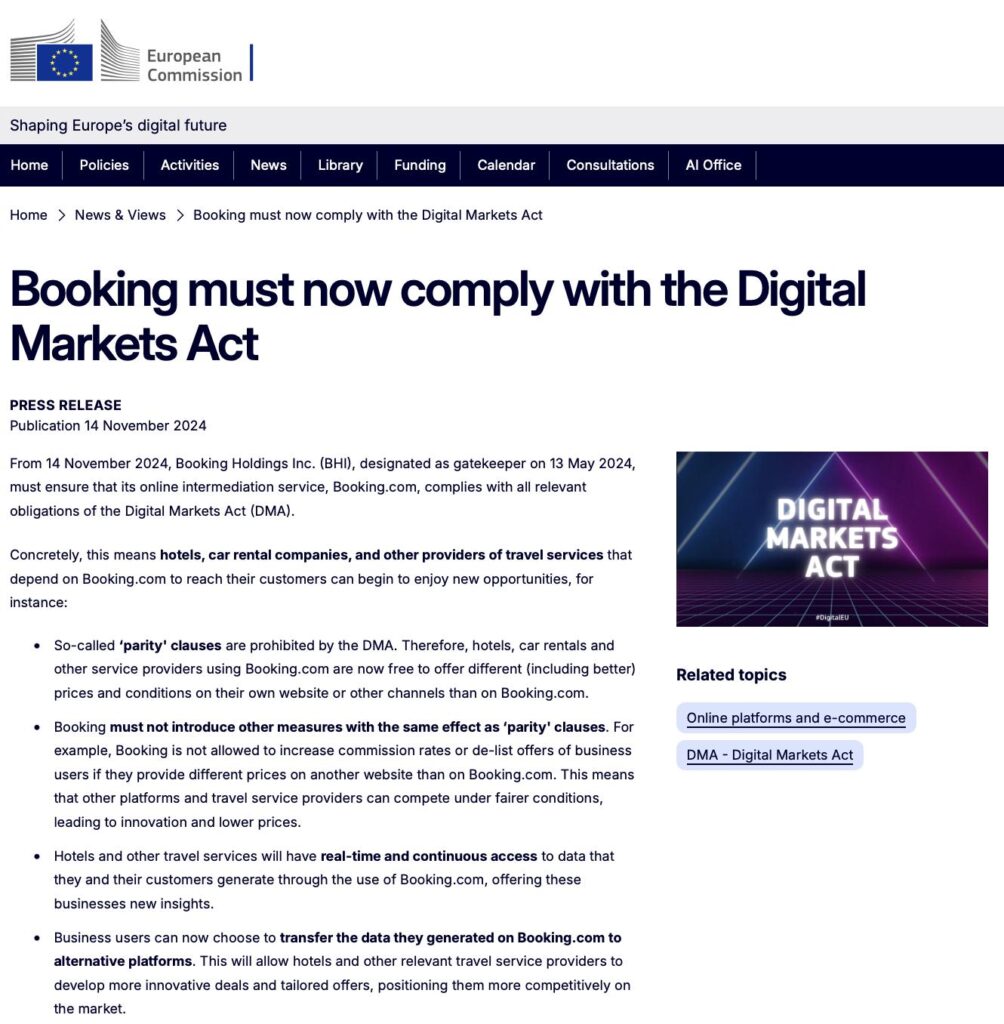
In September 2024, the Court of Justice of the European Union held in Case C‑264/23 that wide and narrow hotel parity clauses could not escape scrutiny under Article 101(1) merely by being treated as ancillary to the OTA agreement. The ruling matters for assessing such clauses under competition law. The Digital Markets Act (DMA) sets out a separate obligation for designated gatekeepers, including Booking.com in respect of its designated online intermediation service. That obligation gives covered hotels freedom to offer different prices or conditions through their own websites or other channels and addresses measures that would achieve the same effect as a parity clause.
How the Position Differs by Market
A national statute, a court decision, and a commitment to a competition authority can each produce different results for the same type of offer. Switzerland’s legislation addresses parity provisions in accommodation booking platforms’ general terms. The UK’s vertical agreements regime treats wide retail parity as a hardcore restriction for block-exemption purposes, meaning an agreement containing it loses the benefit of that exemption. In Brazil and Japan, the scope of particular platform commitments matters when assessing what a hotel can do.
For an owner with hotels in several markets, the individual property’s location and the agreement covering it are the practical starting points. The hotel’s revenue team can then ask whether a rule affects competing OTAs, the property’s own website or both. This is particularly important when the only published evidence is a regulator announcement about a specific company or an OTA’s standard country definitions. Those sources establish what was decided or what the published terms say, while the relevant property agreement and applicable law govern the pricing decision. a
| Market | Legal or regulatory development | Implication for the hotel |
|---|---|---|
| European Economic Area | The European Commission’s September 2026 factsheet describes Booking.com’s removal of contractual parity and subsequent programme changes in the EEA. | Covered hotels can give their website or another channel better prices and conditions without facing equivalent parity measures from Booking.com. |
| France and Germany | France’s Tourism Code protects hoteliers’ freedom to grant discounts or other price advantages. Germany’s Federal Court of Justice upheld the competition authority’s position against Booking.com’s narrow clause. | These markets illustrate two routes to greater pricing freedom through national legislation and case-specific enforcement. |
| Switzerland | Article 8a of the Unfair Competition Act addresses booking-platform terms that restrict accommodation providers’ pricing, availability or conditions through parity clauses. | Hotels can point to a separate national statutory rule outside the EEA. |
| United Kingdom | Wide retail parity is a hardcore restriction under the block exemption. The CMA also recorded assurances from Booking.com and Expedia that hotels are free to vary offers across competing OTAs. | The treatment of a lower competing OTA rate and a lower public direct rate should be checked separately. |
| Türkiye | In 2017, the Turkish Competition Board found that Booking.com’s best-price-guarantee practices at issue infringed Article 4 of Law No. 4054 and imposed an administrative fine. | The decision should be read alongside the current property agreement and any later decisions relevant to the type of clause. |
| Brazil | CADE reached agreements with Booking.com, Decolar and Expedia in 2018 to end wide parity with accommodation suppliers. | The commitments on competing channels should be distinguished from restrictions concerning the hotel’s own website. |
| Japan | The Japan Fair Trade Commission approved commitments involving Rakuten Travel, Booking.com and Expedia. The Booking.com and Expedia matters cited here excluded narrow room-rate parity from the provisions investigated. | A property should check the scope of the commitment for its platform and the wording of its agreement. |
| Australia | The ACCC secured amendments to Expedia and Booking.com accommodation contracts in 2016. Booking.com later told the ACCC that its contracts included narrow clauses but did not enforce parity clauses. | The wording in the contract and the platform’s stated enforcement practice can differ. |
| United States | The US falls within the residual wide-parity category under the Booking.com country definitions reviewed for this article. | The classification describes the platform’s published contract wording. Enforceability requires a separate assessment of the agreement and applicable law. |
Measures That Can Have the Same Effect as Parity
A hotel’s practical freedom to set its price can also be affected by the way a platform operates its search results or commercial programmes. A platform could, for example, discourage a lower direct rate by tying commission, listing status or access to a programme to the prices a hotel offers elsewhere. The European Commission explains that the DMA also addresses measures with the same effect as parity for Booking.com’s designated service. This matters because changing an agreement gives a hotel more pricing freedom only if the platform’s commercial practices allow it to exercise that freedom.
The Commission’s September 2026 factsheet records that Booking.com stopped using external prices to determine eligibility for Booking Sponsored Benefit in the EEA. The factsheet says external prices were already excluded from default ranking and eligibility for Genius, Preferred and Preferred Plus as described there. Booking Sponsored Benefit is funded by Booking.com, which pays the difference when it reduces the guest’s price under the programme. A hotel investigating a lower OTA price should therefore establish whether the platform funded the reduction or whether the property supplied the lower rate.
Claims Relating to Historical Parity Clauses
Hotels have also pursued compensation in relation to historical parity arrangements. HOTREC has reported that a collective action seeking compensation from Booking.com was formally initiated before the Amsterdam District Court (January 2026). Booking.com disputes the claims and has published its position on the commercial and legal context in which the clauses were used. For operators, a damages claim concerns alleged historical harm, while the current contract and regulatory framework determine what offers a property can make today.
What Parity Means for Hotel Websites and Special Rates
Where applicable terms allow, a hotel can use its website to offer a better public price or more attractive booking conditions. Breakfast, flexible cancellation or late checkout may influence the guest’s decision at a lower cost to the property than a room-rate discount. Where rate and conditions parity applies, the hotel should assess the full package before promoting it. The best choice depends on what the guest values, the cost to the property and whether the offer will generate an additional booking or move an existing booking to a less expensive channel.
For example, on an OTA booking of €150 with 18% commission, the hotel retains €123 before other costs. If the equivalent room sells direct for €140 with €8 in direct acquisition and payment costs, the hotel retains €132 on the same basis. The hotel gains €9 if the offer moves a booking from the OTA to its website under those assumptions. If the guest would have booked direct at the original rate anyway, the hotel gives up revenue on a booking it would already have received. The performance measure is the effect on total room revenue after distribution costs, alongside the change in booking mix.
Member, Opaque and Last-Minute Offers
A member rate limits who can book, but how the savings are advertised can affect whether it qualifies as a private offer. A public banner may disclose the discounted price or give the guest enough information to calculate it, even when the booking engine then requires a login. A hotel should check how the agreement defines an unpublished rate and what qualifies as a closed user group. The review should include the hotel’s advertising, affiliates and metasearch listings, as well as the point where the guest enters a password.
An opaque rate limits what the guest knows before purchase, while a last-minute rate limits when the offer can be booked. Hiding the property’s identity may reduce the public association between the hotel and the discounted price, but the agreement still determines whether the channel and offer fall within parity. A same-day rate on the hotel’s public website should be assessed under the rules applicable to public direct offers. A hotel releasing a limited allocation through an opaque partner should also know who supplied the inventory, whether it can be resold and how quickly the offer can be withdrawn.
Booking.com’s Published Parity Terms
Booking.com’s published General Delivery Terms show how a platform can use one set of definitions and then vary the operative wording by property location. Clause 1.1 defines narrow-parity, no-parity and wide-parity countries. Clause 2.2.6 determines whether the standard narrow provisions apply, are disapplied or are replaced by Annex 5. The version referenced for this section is the publicly accessible English-language version for UK properties, v2611_GB_i (as at November 2026), which includes the wider country definitions. A hotel should verify the version and any addenda that apply to its property.
The distinction is easiest to see by following the clauses in order. Start with the property’s country category, then read the provisions that apply to the intended sales channel. Next, compare the complete offer, including any benefits, restrictions or room allocation that the relevant wording covers. Finally, check the exception the property intends to rely on and how the offer will appear to the guest. The same promotion can be treated differently when sold publicly through the hotel website, offered privately or distributed through an independent OTA.
| Published category | Geographic coverage | How the agreement applies it |
|---|---|---|
| No parity | The EEA, Chile, Indonesia, Russia, South Africa and Switzerland, plus any further jurisdictions Booking.com designates. | Clause 2.2.6 disapplies clauses 2.2.1 and 2.2.2. Clause 2.1.4 addresses the freedom to differentiate rates and conditions. |
| Narrow parity | Armenia, Australia, Brazil, China, Hong Kong SAR, Israel, Japan, New Zealand, South Korea, Türkiye and the UK are among the markets expressly named, alongside any further jurisdictions Booking.com designates. | Clauses 2.2.1 and 2.2.2 set out rate and conditions parity and the applicable exceptions. |
| Wide parity | The residual category for countries and regions outside the narrow-parity and no-parity definitions. | Clause 2.2.6 replaces the standard wording with Annex 5, which sets out rate and availability parity. |
How the Narrow-Parity Wording Works
Clause 2.2.1 requires the property to give Booking.com equivalent or better rates and conditions for comparable accommodation. The comparison can include the room and bed type, number of guests, stay dates, amenities and cancellation terms. Clause 2.2.2 excludes offers made through online reservation services outside the direct or indirect control of the property or its chain. This is why an offer published through an independently operated OTA can be treated differently from a better offer on the hotel’s own booking engine.
The standard narrow wording also includes exceptions for qualifying offline and unpublished rates. A price quoted by telephone or at reception can fall within the offline exception if the conditions on online publication and marketing are met. An unpublished rate must also meet the terms’ condition on online marketing. A hotel planning to use either exception should examine how it promotes the rate and the channel that ultimately processes the reservation.
How the Wide-Parity Wording Works
Annex 5 extends the rate comparison to the property’s websites, apps and call centres, offers made directly at the property, competitors of Booking.com and other covered third parties. It also contains a separate availability obligation comparing the rooms made available to Booking.com with those provided to covered competing or third-party channels. A lower rate through another intermediary can therefore raise a parity question under Annex 5, while a different room allocation can raise an availability question even when the rates match. The annex also contains replacement provisions concerning equivalent prices offered elsewhere and certain unresolved claims under Booking.com’s We Price Match programme.
Annex 5’s closed-user-group exception illustrates why a login alone may be insufficient. The group must have defined membership limits, members must opt in and complete a customer profile, and any online or mobile interface used by members must be password-protected. The guest must also have made at least one previous booking as a member, and the rate must remain unavailable to the public, directly or indirectly. A property reviewing a loyalty offer can use those conditions to check who qualifies, how the rate is displayed and whether it could surface on a third-party site.
Further Resources:
See HDG – Hotel Distribution Platforms: Controlling Guest Demand
See HDG – Opaque Hotel Booking
See HDG – AI-Mediated Hotel Discovery
See HDG – The Hotelisation of Real Estate
See HDG – Co-Working Spaces and Hotels: A Converging Hospitality Model
The European Commission (November 2024) – “Booking must now comply with the Digital Markets Act“
The European Commission (September 2026) – “Factsheet – How the DMA ensures businesses using Booking.com are free to set their prices on and off Booking.com“
Legal and Commercial Disclaimer
This article reflects information available to Hotel Development Guide (HDG) as of 26 November 2026, including published legislation, court judgments, regulatory decisions and publicly accessible platform terms. It is intended for general information and discussion. It does not constitute legal advice, and HDG is not a law firm or a provider of legal services. Readers should obtain independent advice from qualified legal counsel in the relevant jurisdiction before relying on this article to interpret an agreement, assess the enforceability of a clause or make a pricing or distribution decision.
The legal treatment of hotel price parity varies by jurisdiction and depends on the facts of each case. The position may turn on the property’s location, the applicable competition law, the wording of the agreement, and any local addenda or individually negotiated terms. A ruling or regulatory commitment involving one online travel agency (OTA) may have a different scope from legislation that applies across a market. A platform’s published country classification describes its standard contractual approach, while the enforceability of a particular provision is a separate legal question.
Legislation, case law, regulatory guidance, platform terms and commercial programmes can change after the date stated above. Publicly available standard terms may also differ from the version applicable to an individual hotel. Before publishing a direct discount, launching a member or opaque offer, changing room availability or taking any other action based on parity provisions, readers should verify the current law and the terms of their own agreements. HDG makes no representation that the information will remain current or that it covers every jurisdiction, contractual exception or regulatory development.
HDG does not favour or endorse any OTA, hotel group or distribution channel in this article. References to Booking.com, Expedia, HRS and other platforms illustrate documented industry practices, published contract wording or specific regulatory developments. The inclusion of a company does not imply that HDG considers its current practices unlawful or that a historical decision applies to its present terms. Where the article discusses disputed claims, those claims should be understood in light of their procedural status and the positions of the parties involved.