
by Hotel Development Guide – Darren Blanchard
Last Updated: November 2026
The energy transition in hospitality is changing how hotels use, source and manage energy. It includes reducing demand, moving suitable systems and services away from fossil fuels, and increasing the use of lower-carbon electricity. For developers, it can influence site selection, the design brief and the infrastructure needed before a hotel opens. For owners and operators, it affects utility costs, capital spending and the ability to maintain guest services while changes are made.
Within hotel sustainability, the energy transition covers how the property meets its energy needs and reduces the emissions associated with them. It can make a substantial contribution to a wider net-zero strategy, which may also cover emissions from construction, purchased goods and other activities beyond the hotel’s energy systems. Understanding that wider boundary helps a hotel group explain what its energy programme will deliver. At property level, the programme starts with four practical questions about how much energy the hotel needs, when it needs it, where it will come from and how reliably it can be supplied.
Energy Transition in Hospitality
Why the Energy Transition Matters to Hotels
A hotel needs energy throughout the day, even when many guestrooms are unoccupied. Refrigeration, ventilation, hot-water circulation and some building services continue to run, while kitchens, laundry, meeting rooms and leisure facilities create additional peaks. The way these demands overlap affects which systems make sense and how much infrastructure the property needs. The energy strategy should therefore reflect the facilities and service standards in the hotel concept, with operating assumptions that the owner, operator and design team can test together.
Fossil fuel use and purchased electricity expose a hotel to different costs, supply constraints, and emission sources. A city hotel may have dependable electricity but limited capacity to expand its connection, while a remote resort may rely on fuel deliveries and its own generators. A multi-property group must also consider who controls the equipment and supply contracts at each hotel. These differences can lead to equally credible strategies with different combinations of efficiency, electrification, generation and procurement.
Where Hotels Use the Most Energy
Heating, cooling and ventilation, domestic hot water, kitchens, laundries and leisure facilities are the first systems to examine when assessing a hotel’s energy use. Their relative importance depends on the climate, the facilities provided, and how the hotel trades. Cooling and dehumidification may be major electricity users at a resort in a hot, humid climate, while space heating and hot water may account for much of the fuel use at a city hotel in a colder market. An on-site laundry, a large banqueting operation or a heated pool can materially change the energy profile of either property.
The owner should look at each system in three ways. Annual energy use shows where the hotel consumes the most electricity or fuel over time and where efficiency measures may have the greatest effect. Peak electrical demand shows how much power the hotel draws at one time and helps determine the capacity it needs, especially if several systems are being electrified. Operational criticality shows which services must remain available during an interruption and for how long. A chiller may be a major annual electricity user, several kitchen appliances operating together may contribute to the electrical peak, and fire alarms or emergency communications may use relatively little energy while requiring continuous power.
| Hotel system or area | Typical energy sources | When it can be a major load | What may need to remain available |
|---|---|---|---|
| Heating, cooling and ventilation | Electricity, gas, other fuels or district heating and cooling | Long operating hours, severe weather, extensive public areas or high ventilation and dehumidification demand | Designated areas or functions may need continued heating, cooling or ventilation, depending on climate, occupancy and the hotel’s continuity plan. |
| Domestic hot water | Gas, electricity, recovered heat or district heat | Guest showers, housekeeping and other uses overlap. Storage and circulation also contribute to energy use. | The hotel may need to maintain a defined level of hot-water service during a prolonged interruption, depending on storage and the duration of the outage. |
| Kitchens, banqueting and refrigeration | Electricity and, in some hotels, gas or LPG | Cooking, extraction and dishwashing coincide at meal or event peaks. Cold rooms and freezers also create a continuous load. | Refrigeration and temperature monitoring may be priorities during an outage. Continued cooking and dishwashing depend on the service the hotel plans to maintain. |
| On-site laundry | Electricity, gas, steam or hot water from central plant | Large volumes of washing, drying and finishing, especially where the laundry serves other properties | Production can often be rescheduled for a short interruption. Linen stocks and access to an alternative laundry influence how long it can be deferred. |
| Pools and spas | Electricity, fuel or recovered heat | Pool heating, pumps and indoor pool dehumidification can run for long periods. Outdoor pool demand can vary with weather and season. | The hotel should define which circulation, treatment or ventilation functions must continue or be restored before facilities reopen. |
| Lighting, guestrooms and plug loads | Electricity | Long hours in public and back-of-house areas, combined with lighting and equipment across many guestrooms | Emergency lighting and lighting for designated operating areas have different continuity requirements from general or decorative lighting. |
| Lifts, pumps, life-safety and communications systems | Primarily electricity, with backup arrangements where required | Some equipment draws significant power when it operates, even if its annual consumption is modest. | Identify which alarms, communications, lifts and pumps require backup under applicable require |
Understanding Hotel Energy Demand
An energy review should establish how much electricity and fuel the hotel uses, which services drive demand, and when those services operate. Utility bills give an annual and seasonal picture, while interval meter data can show the short periods when electricity demand is highest. Submetering can help distinguish loads from cooling, hot water, kitchens, laundry, and other major uses. In a new hotel, the design team can build an estimated profile from the proposed facilities, hours of operation and assumptions about occupancy and events.
Annual consumption, peak electrical demand and critical loads answer different questions. Annual consumption helps estimate operating costs and emissions, while peak demand informs the size of the incoming supply and may affect the tariff. Critical loads determine which services must keep running during a power interruption and for how long. A hotel with modest annual consumption can still have a demanding electrical peak if cooling, kitchen equipment and hot-water production operate together during a busy event.
| Hotel or portfolio | Typical energy question | What to establish before choosing an approach |
|---|---|---|
| New city hotel | Can the site support the intended heating, cooling and hot-water strategy? | Available electrical capacity, connection date, plant space and peak demand |
| Operating full-service hotel | Which systems can change while guestrooms, kitchens and events remain in use? | Condition of existing equipment, measured loads, replacement timetable and temporary service needs |
| Remote resort | How can the property reduce fuel dependence while keeping essential services running? | Seasonal demand, generation potential, storage requirements and exposure to supply interruptions |
| Multi-property hotel group | Which decisions can be made across the portfolio, and which require property-level approval? | Ownership, utility contracts, procurement volumes and access to comparable performance data |
Practical Energy Transition Solutions for Hotels
A hotel can reduce its energy needs, recover heat already available on site, change how its equipment operates, and obtain energy from different sources. These measures affect annual consumption, peak electrical demand, operating costs, and emissions differently. Better shading can reduce the cooling load, for example, while heat recovery can use some of the heat rejected by the cooling system to preheat domestic hot water. The owner should assess these measures together because reducing demand or recovering heat can change the size of the equipment and the electrical connection the hotel needs.
The range of viable options will depend on the property and its location. An urban hotel may have access to district heating or cooling and have little space for on-site generation. A coastal or rural resort may have land and a viable wind resource, while a thermal resort may be able to use naturally heated water for building services. The energy strategy should establish which resources are genuinely available, how closely they match the hotel’s demand and what the property will still need from its grid connection or backup supply.
Reducing Energy Demand and Avoiding Losses
The first step is to establish how much heating, cooling, hot water and electrical power the hotel actually needs to deliver its services. In a new hotel, orientation, shading and the building envelope can affect plant size before the equipment is specified. At an operating property, the team can review whether equipment runs when it is needed and investigate persistent losses from hot-water circulation, uninsulated pipework or poorly controlled systems. Measures should be checked against guest comfort, ventilation and service requirements so the expected savings can be sustained in operation.
Some improvements reduce total energy use, while others also reduce the hotel’s highest electrical demand. A well-shaded guestroom can need less cooling during the hottest part of the day, when other parts of the hotel may also be approaching peak load. An efficient motor can save electricity across its operating hours, with the overall effect depending on the load it serves and how often it runs. Both outcomes matter when the hotel is planning to add electrical loads through heat pumps, kitchens or laundry equipment.
| Option | What it addresses | Where to look first |
|---|---|---|
| External shading, better glazing and insulation | Reduces unwanted summer heat gain or winter heat loss. | Guestrooms and public areas with persistent overheating, cold surfaces or high heating and cooling demand. |
| Air sealing, entrance design and zoning | Limits uncontrolled air movement and allows different areas to be conditioned separately. | Frequently opened lobby entrances, underused function space and properties with large differences in operating hours between departments. |
| Better controls and operating schedules | Matches lighting, heating, cooling and ventilation to use. | Vacant guestrooms, meeting rooms between events and back-of-house areas with predictable hours. |
| Efficient chillers, refrigeration, lighting, fans and pumps | Reduces electricity consumption for the same service. Variable-speed drives can help where loads vary. | Equipment with long running hours or approaching replacement, particularly where actual operation differs from the original specification. |
| Hot-water and distribution improvements | Reduces the amount of water that needs heating and limits heat loss from storage, pipework and circulation. | Large properties with long distribution runs, high shower demand or substantial circulation losses. |
| Pool covers and better pool-hall controls | Limits evaporation and heat loss and can reduce the energy needed for pool heating or dehumidification. | Heated outdoor pools and indoor pools with significant ventilation and humidity-control loads. |
Recovering Heat, Electrifying and Shifting Demand
A hotel can sometimes use heat that it is already paying to remove. Chillers and refrigeration equipment reject heat, while some exhaust air and wastewater streams carry heat away from the building. Recovery is most useful where the hotel has a suitable demand at the same time or can store the heat for later. A resort that cools its guestrooms throughout the day and also needs substantial hot water or pool heating may have a stronger case than a property whose heating and cooling demands fall in different seasons.
Electrification changes how the hotel provides the remaining heat and power. Heat pumps can serve space heating, cooling, hot water and pools, while electric equipment can replace fuel use in parts of the kitchen and laundry. Storage or load scheduling can help where several services would otherwise draw power at once. The combined assessment should establish whether the equipment can deliver the required service, how the changes affect the electrical peak and what the hotel needs to keep running in an outage.
| Option | What it does | What determines whether it works |
|---|---|---|
| Heat recovery from chillers and refrigeration | Uses rejected heat for domestic hot-water preheating, pools or other suitable loads. | Whether useful heat is available at the right temperature and at the time the hotel needs it. |
| Heat recovery from ventilation or wastewater | Recovers heat from exhaust air or warm wastewater for an appropriate preheating application. | The size and consistency of the load, available space, cleaning access and maintenance requirements. |
| Air-source heat pumps | Use electricity to transfer heat from outdoor air for space heating, hot water or pools. Some systems also provide cooling. | Climate, required delivery temperatures, equipment performance at peak conditions, plant location and available electrical capacity. |
| Ground-source or water-source heat pumps | Use the ground, groundwater or a suitable body of water as a heat source or heat sink. Ground-source systems can use buried loops or boreholes without a natural hot-water resource. | Geology, access for drilling or installation, available land or water, permissions and the balance between heating and cooling demand. |
| Electric kitchen and laundry equipment | Replaces on-site fuel use in suitable cooking, washing, drying and finishing processes. | Production capacity, staff workflow, maintenance support and the combined electrical load when equipment runs at the same time. |
| Hot-water or chilled-water storage | Allows some heat or cooling to be produced ahead of demand. | Space for storage, the size and timing of demand peaks and the ability to maintain service while shifting production. |
| Battery storage and load scheduling | Shifts the use of generated or purchased electricity and can manage peaks. A suitably designed system can also support selected loads during an outage. | The hotel’s tariffs, demand profile, on-site generation and the power and duration required for backup. |
Producing Energy On Site or Buying It From Third Parties
Direct geothermal heat and ground-source heat pumps are two different opportunities. Direct geothermal use draws on a naturally warm or hot underground resource to supply useful heat, usually through a heat exchanger. It can be practical where a proven resource or network is available, as illustrated by the use of geothermal water for space heating at thermal hotel facilities in Afyonkarahisar, Türkiye. A ground-source heat pump, by comparison, uses electricity to move heat between the building and the ground and can be considered on suitable sites without hot springs.
Wind can also be practical, particularly for an exposed resort or rural property with adequate space for a ground-mounted turbine. The case depends on the wind resource at turbine height, local planning constraints, noise, maintenance access, and how much generation the hotel can use. Rooftop turbines face additional constraints from turbulence and vibration, which can make them a poor fit for a hotel building. A hotel on a constrained site may still be able to source wind-generated electricity through its supplier or a suitable power purchase agreement.
| Option | What the hotel gets | When it is worth considering |
|---|---|---|
| Solar photovoltaic panels | Electricity for on-site use, with possible export where permitted. | Hotels with suitable roof, car park or ground space and demand that overlaps with daytime generation. |
| Solar thermal collectors | Heat for domestic hot-water preheating or pools. | Hotels with sustained hot-water or pool-heating demand, suitable collector space and room for storage. |
| Direct geothermal heat | Heat for buildings, pools or hot-water preheating, subject to the resource temperature and system design. | Thermal resorts or properties near a proven geothermal resource. Assess temperature, flow, water chemistry and arrangements for handling the used geothermal fluid. |
| On-site wind generation | Electricity from a turbine installed on or near the property. | Exposed sites with a viable wind resource, enough space for a suitable turbine and a workable route through planning and grid connection. |
| Small-scale hydropower | Electricity from an available flow of water and usable vertical drop. | Exceptional sites with a suitable watercourse or existing water infrastructure. Seasonal flow, environmental constraints and permissions can determine feasibility. |
| Biomass boilers or locally supplied biogas | Heat from a fuel that can be stored or supplied as needed. | Properties with a dependable fuel supply and space for the required equipment. Assess fuel origin, transport, combustion emissions, local air quality and maintenance. |
| District heating and cooling | Heating or cooling bought from a shared network, which may use geothermal heat, recovered heat or other sources. | Urban, campus and mixed-use projects near a viable network. Check the operator’s actual energy mix, tariffs, reliability and connection terms. |
| Renewable electricity tariffs and power purchase agreements | A contracted route to renewable electricity or its associated energy attributes, depending on the arrangement. | Hotels with limited space for generation and groups that can combine demand. Compare the contract price, term, allocation of certificates and provisions for changes in ownership or consumption. |
| Hybrid power systems for remote properties | A coordinated supply combining resources such as solar, wind, batteries and dispatchable generation. | Island or remote resorts with expensive fuel delivery or unreliable grid access. Model how the sources work together during peak occupancy and periods of low renewable output. |
Electrifying Heat, Hot Water and Hotel Operations
Electrification can involve space heating, domestic hot water, commercial kitchens, laundries and other equipment that has traditionally used fuel on site. Heat pumps can provide heating and hot water by transferring heat, and some installations can also support cooling and heat recovery. Their performance depends on operating conditions, including the temperatures required by the equipment and the building’s distribution systems. A project can therefore benefit from examining each service separately before combining the results into an electrical demand assessment.
The carbon and cost outcomes should be tested together. Replacing fossil fuel use on site reduces direct emissions from that equipment, while the resulting electricity use adds to the emissions associated with purchased power. The overall change depends on how much electricity is needed and the emissions associated with supplying it. Operating costs depend on equipment performance, the relative prices of gas and electricity, and any charges related to peak demand.
Hot Water, Kitchens and Laundry
Domestic hot water needs particular attention because hotel demand can rise quickly at certain hours. Guest showers, housekeeping, kitchen cleaning and laundry may overlap, creating a peak that daily averages can conceal. The design team should consider how much hot water can be stored, how quickly the system can recover and how the proposed arrangement will meet applicable water hygiene requirements. This assessment also helps determine whether hot-water production can be scheduled to avoid adding to the hotel’s highest electrical peak.
In kitchens and laundries, equipment choices affect workflow as well as the energy bill. An electric kitchen should be evaluated against menu requirements, production volumes, ventilation and the way equipment is used during peak service. Laundry decisions should account for wash volumes, drying and finishing equipment, and the availability of maintenance and spare parts. Where practical, the relevant department heads should be involved in testing the proposed equipment and agreeing how the change will be introduced.
Generating, Storing and Buying Lower-Carbon Electricity
A hotel can change its electricity supply through on-site generation, purchasing arrangements, or a combination of both. Available roof or land area, the shape of the hotel’s demand and the terms of the grid connection will influence what can be done at the property. A hotel group may also have the scale to consider a procurement arrangement covering several sites. Each option should be assessed against the objective it serves, whether that is reducing electricity costs, lowering reported emissions or improving continuity of service.
On-site generation and electricity procurement should be considered alongside expected changes in demand. A property that plans to electrify its heating, add conference space or introduce vehicle charging may have a materially different load profile in a few years. This may affect how much solar generation the hotel can use directly, the value of shifting demand and the volume of electricity it wants to contract for. Testing more than one demand scenario helps the owner avoid sizing a system or committing to a supply volume on the basis of a single year.
On-Site Generation and Storage
Solar photovoltaic panels can supply part of a hotel’s daytime electricity demand where the site offers suitable space and conditions. The owner should compare expected generation with the hotel’s demand over the day and across seasons. The financial case can change considerably depending on how much electricity the hotel uses directly, what it pays to import power and what it receives for any surplus exported. Roof condition, plant access and planned refurbishment should also be considered before committing space for the life of the installation.
A battery can store electricity for later use, reduce some demand peaks or provide support during an outage where the system is designed for that purpose. These uses place different demands on the battery, so the owner should define which services it is expected to support and for how long. Thermal storage may also be relevant where producing and storing hot or chilled water at a different time can ease pressure on the electrical supply. The appraisal should account for how often the storage will be used, how it will be controlled and when major components may need replacing.
Power Purchase Agreements and Collective Procurement
An on-site power purchase agreement can allow a supplier to install and operate a system at the property and sell the electricity generated to the hotel. This changes the way the project is funded and places greater emphasis on the terms of the electricity purchase. The owner should review the price and adjustment mechanism, the treatment of surplus electricity, maintenance responsibilities and what happens at expiry or on sale. Where the hotel is leased or part of a mixed-use building, the ability to grant access and use the roof or land can also affect whether the arrangement is feasible.
Off-site procurement can give hotel owners or groups another way to contract for renewable electricity or its attributes, depending on the market and contract structure. Where individual hotels have modest or fragmented demand, combining volumes may improve access to longer-term procurement arrangements. A virtual power purchase agreement generally involves a financial settlement and may convey associated energy attribute certificates, while the properties continue to obtain physical electricity through their existing supply arrangements. Before committing, a group should establish which entity can sign, how costs and certificates would be allocated, and which owners or franchisees would need to agree to participate.
Energy Security and Continuity of Hotel Operations
Electrification can increase the importance of an adequate and dependable grid connection. A development team should check available capacity and connection lead times early enough to influence the site decision, design and opening programme. The assessment should include the space and cost of any electrical infrastructure required on the property, along with works that depend on the utility. In a trading hotel, the team should also establish how the upgrade can be delivered while existing systems remain in service.
Continuity planning starts by identifying which services need to remain available during an outage and for how long. Life-safety systems, refrigeration, communications and selected guest services may each have different requirements, and the hotel needs to understand what can operate on its backup supply. A remote resort may consider solar, storage and existing generation together, while an urban property may concentrate on keeping essential services available until the grid returns. These arrangements should be tested as part of commissioning and understood by the staff responsible for operating them.
Planning the Transition for New Hotels, Existing Hotels and Portfolios
Energy decisions become harder to change as the project progresses. In a new hotel, the energy strategy should inform orientation, plant space, electrical capacity and distribution routes before the design is fixed. In a conversion, the team should inspect what can be retained and identify any limitations on equipment access, structural loading or space for new infrastructure. Both types of project benefit from considering future loads, since the cost of providing space or a route for later work can differ considerably from the cost of finding it once the hotel is operating.
For a trading hotel, equipment condition and refurbishment cycles can help determine the investment order. An owner may be able to improve controls and metering first, then coordinate changes to major plant or electrical infrastructure with a planned refurbishment. Installation should be programmed around the hotel’s trading pattern and allow for temporary services, shutdowns and testing. That approach also gives the operator time to verify early savings and use the results to refine the next phase.
Moving From Property Plans to a Portfolio Strategy
A hotel group can establish a common approach to measurement, design reviews and capital planning across its portfolio. Comparing properties by energy use, emissions, equipment condition and connection constraints can help identify where each kind of intervention is most appropriate. Hotels in the same market may be able to coordinate purchasing or maintenance, while hotels in different markets may need different technology and supply strategies. Group targets become more useful when they translate into property-level plans with a budget, an accountable person and a delivery timetable.
The ability to put those plans into effect varies across owned, leased, managed and franchised hotels. A brand may set design or reporting requirements, while an owner controls investment and a separate party holds the utility contract. Before setting a delivery date, the group should identify who can approve the work, who funds it, who receives the savings and who can provide the operating data. These questions matter as much for a portfolio electricity contract as they do for a major refurbishment at an individual hotel.
Investment, Implementation and Performance
The investment case should compare complete options on a common basis. Capital costs can include plant, electrical upgrades, building works, controls, temporary services and commissioning, while ongoing costs include energy, maintenance and equipment replacement. A hotel that expects to keep trading through the work should also consider lost operating contribution from closures, reduced room inventory or limits on events. Comparing cash flows over the expected holding period can show how the result changes when capital spending and savings occur at different times.
Before approving the investment, the owner and operator should agree on who will deliver the work, what the hotel needs to keep running and how the results will be checked. The implementation plan should account for equipment and utility lead times, the hotel’s trading calendar and the availability of temporary services. Commissioning should include checks under conditions that reflect how the property operates, including periods when several major systems are in use. The team should establish the baseline and agree how it will measure actual energy use, costs and emissions after the work is complete.
| Appraisal measure | What the owner should compare |
|---|---|
| Capital investment | Equipment, grid connection, enabling works, commissioning and future replacement costs |
| Operating costs | Fuel and electricity prices, demand charges, maintenance and expected hours of use |
| Operational emissions | Direct emissions and emissions associated with purchased energy, using consistent assumptions |
| Capacity and continuity | Peak electrical demand, critical loads, backup provision and recovery after interruptions |
| Disruption to trading | Closures, temporary services, lost operating contribution and the timing of installation |
| Delivery and verification | Approvals, responsibility for implementation, metering and checks after commissioning |
Measuring and Benchmarking Hotel Energy and Emissions
A hotel energy transition programme should track how much energy the property uses, how much power it draws at peak times and how its greenhouse gas emissions change. These measures can move in different directions. Electrifying heating or laundry, for example, can reduce the amount of fuel burned on site while increasing both electricity use and peak electrical demand. The overall emissions result depends on the efficiency of the new equipment and the emissions associated with supplying the additional electricity.
Owners should compare results against the hotel’s own baseline and, where suitable data is available, against similar properties. The baseline shows whether the hotel is improving over time, while a peer comparison helps identify where further investigation may be worthwhile. Both comparisons benefit from knowing how the hotel traded during the period and whether facilities or energy sources changed. An asset manager can then use the results to decide which systems warrant a closer review and where further investment may have the greatest effect.
Scope 1, Scope 2 and Scope 3 Emissions
The three emissions scopes describe where greenhouse gas emissions arise in relation to the organisation reporting them. For a hotel, the distinction helps explain what changes when it replaces fuel-burning equipment, buys electricity from a different source or outsources an energy-intensive service. The examples below assume the reporting organisation owns or controls the relevant on-site equipment. In a managed, leased, or franchised hotel, the reporting entity and its boundary should be established before comparing the figures.
| Emissions scope | What it covers | Hotel examples |
|---|---|---|
| Scope 1 — Direct emissions | Emissions from sources the reporting organisation owns or controls. | Gas burned in hotel boilers or kitchens, diesel burned in backup generators, and refrigerant leaks from equipment under the hotel’s control. |
| Scope 2 — Purchased energy emissions | Indirect emissions from generating the electricity, steam, heating or cooling the reporting organisation purchases and uses. | Grid electricity for guestrooms, chillers and heat pumps, or heating and cooling purchased from a district network. |
| Scope 3 — Other indirect emissions | Other emissions arising in the reporting organisation’s value chain. | Energy used by an external laundry to process the hotel’s linen, and emissions associated with producing purchased food, equipment or furniture. |
Most hotel energy transition measures directly affect Scope 1, Scope 2 or both. Replacing gas-fired plant with heat pumps can reduce Scope 1 emissions while increasing purchased electricity use, so the owner should assess the combined emissions from fuel and electricity before and after the change. Outsourcing a laundry can lower the energy recorded on the hotel’s meters while the external provider continues to use energy to wash and dry the linen. That distinction matters when assessing whether an option reduces emissions across the service or shifts part of the footprint into Scope 3.
Hotel Carbon Measurement Initiative (HCMI)
World Sustainable Hospitality Alliance – Hotel Carbon Measurement Initiative (HCMI) Website
The Hotel Carbon Measurement Initiative is a property-level method for calculating and communicating the greenhouse gas emissions associated with hotel stays and meetings. It covers direct emissions and emissions from purchased energy within the hotel’s reporting boundary, as well as outsourced laundry where applicable. Outputs include carbon emissions per occupied room per day and per unit of meeting space per hour, along with information on overall emissions and renewable energy use. Hotels can use these figures to track performance over time and respond to corporate accommodation and meeting enquiries.
For an energy transition programme, HCMI gives the hotel a consistent way to report emissions outcomes alongside engineering and financial results. The property should retain the underlying electricity and fuel data, meter readings and supporting records for any renewable electricity claims. This helps the asset manager distinguish a change in physical energy use from a change in occupancy, the grid emissions factor, or how purchased electricity is reported. HCMI serves a property reporting purpose, while a wider net-zero assessment may need to account for other emissions across the hotel’s value chain.
Benchmarking Hotel Energy and Carbon Performance
CHSB (Cornell Hotel Sustainability Benchmarking) Index – Greenview Website
The Cornell Hotel Sustainability Benchmarking Index (CHSB) is a collaboration involving Cornell University’s Centre for Hospitality Research, Greenview, participating hotels and an industry advisory group. Greenview reports that the 2026 edition, based on 2024 operating data, draws on more than 31,500 hotels and covers 94 countries. The index includes data from major hotel groups across different markets and segments, including Accor, Hyatt, and The Peninsula Hotels. An individual property, including an independent hotel, can calculate its own indicators and compare them with the public dataset, while Greenview’s member services offer confidential property reports and portfolio-level analysis.
A figure on its own gives the operator little indication of whether the hotel is performing well. A full-service conference hotel should look for peers with a similar climate, service level and facilities, since kitchens and meeting spaces can use substantial energy even when the delegates and diners do not stay overnight. Comparing energy per occupied room alongside energy per square metre of floor area gives the owner two views of performance. Where the local sample is small, a broader climate or market grouping may be more useful, provided the team considers differences such as an on-site laundry, heated pool or seasonal closure.
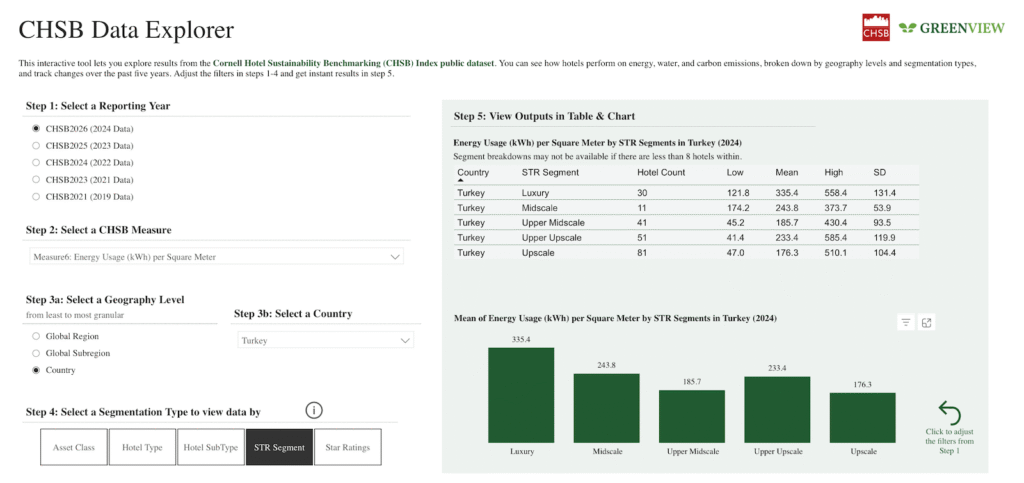
Sample Benchmarking Data from Greenview CHSB Site
Benchmarking is most useful when it leads to a specific question about the property. A hotel that uses more energy than similar properties on both measures might review its overnight base load, plant schedules and major equipment before deciding where to invest. A hotel with typical energy use but higher carbon emissions might investigate its fuel mix, the emissions intensity of its electricity supply and whether the comparison uses the same reporting method. A hotel group can use the same approach to identify which properties warrant an energy audit first, while each hotel can track its own performance over time to see whether the work delivered the expected improvement.
Where the Energy Transition Begins
For a new development, the starting point is to test the hotel concept against the capacity, reliability and cost of the energy supplies available at the site. For an operating hotel, the starting point is to establish where energy is used, which equipment is due for replacement, and what work can be carried out around trading. At portfolio level, the starting point is to establish which decisions can be made centrally and which depend on individual owners or operators. Each route leads to a programme of investment and operating changes that can be reviewed as the hotel’s needs and local energy market evolve.
Success can be assessed through several outcomes, including energy use, emissions, operating costs, and the continuity of guest services. Some benefits can be delivered through changes to controls or operating practices, while others depend on a connection upgrade, major capital works or a new electricity contract. The order matters because earlier decisions can change the capacity, cost and timing of later investments. Including energy in the feasibility study, design brief, and capital plan allows the owner to manage that sequence over the life of the hotel.
Further Resources:
See HDG – Hotel Sustainability
See HDG – Climate Change in Hotel Development
See HDG – Environmental Design in Hotels
See HDG – Hotel Security Consultants | Risk, Certification & Safety Standards
See HDG – Reputation Management
See HDG – Artificial Intelligence – AI in Hospitality
World Hospitality Sustainability Alliance – Climate Action