
by Hotel Development Guide – Darren Blanchard
Last Updated: November 2026
Hotel key money is a financial contribution occasionally offered by a hotel operator to an owner in connection with securing a management contract. It may support a development, renovation or conversion, subject to conditions governing payment and repayment. For the hotel company, the contribution helps secure a property that meets its commercial or strategic objectives. For the owner, its value depends on the obligations accepted in return.
Hotel key money is a selectively negotiated incentive, not a standard component of a hotel contract. Owners should be especially cautious about assuming its availability in emerging markets, where contributions can be difficult to secure, and opportunities vary widely between destinations and projects. A strategically important property may attract an offer, but an otherwise viable hotel may receive none. The development budget should therefore stand independently of an anticipated contribution until an enforceable commitment and its conditions have been assessed.
Deciding whether to accept hotel key money requires more than comparing headline amounts. Payment timing, contract duration, fees, repayment obligations and exit rights can materially affect the benefit. Alternative arrangements may provide more useful support for an owner whose priority is operating cash flow rather than initial funding. The appropriate choice depends on the project’s needs and the quality of the complete contractual relationship.
Hotel Key Money: Contract Terms, Benefits and Alternatives
How Hotel Key Money Works
When applied, hotel key money is commonly structured as a contribution whose repayment obligation reduces over an agreed period. This reduction is often described as forgiveness or burn-off. If the required conditions remain satisfied throughout that period, the owner may ultimately retain the contribution without repayment. If the relationship ends earlier, the outstanding balance may become payable.
The arrangement may appear within the main hotel agreement, a separate contribution agreement or loan documentation. The description used does not establish whether the payment is interest-free, automatically forgivable or subject to security. Those consequences arise from the operative provisions. Owners should read the payment, forgiveness and repayment terms together across the complete document package.
Burn-Off and Repayment
The burn-off period may match the initial contract term or expire before it. Forgiveness may begin at payment, opening or another specified date. The balance may reduce monthly, annually or according to a separately negotiated schedule. Each detail affects the owner’s exposure if the relationship ends before the contribution is fully forgiven.
The contract should explain whether forgiveness continues during closures, disputes or interruptions to operations. It should identify any circumstances that suspend the reduction or reinstate an amount previously forgiven. Repayment calculations should also address termination partway through a contractual period. A clear schedule allows the owner to establish the liability at any proposed exit date.
When Hotel Key Money May Be Offered
A hotel company considers key money when committing capital helps secure an opportunity it particularly wants. Relevant factors can include the property’s location, expected fee income, strategic importance and the strength of competing proposals. The provider will also assess the owner’s credibility and the likelihood of successful delivery. An attractive site may not overcome unresolved funding, approvals or construction risks.
Competition between suitable hotel companies can improve the owner’s negotiating position. However, competition does not guarantee that any participant will offer cash. Some may prefer to compete through fees, services or contractual flexibility. Owners should assess these proposals against the project’s requirements rather than treating a contribution as the defining measure of interest.
Emerging Markets and Selective Availability
In emerging markets, hotel key money should be approached as a potential exception rather than an expected funding source. A brand’s interest in entering a destination does not necessarily mean it will contribute capital. Delivery risk, currency exposure, financing constraints and uncertain operating prospects can weigh against an offer. The position must be tested with relevant operators and current project-specific proposals.
Contributions can nevertheless arise where a property offers a sufficiently compelling opportunity. Strategic importance, a credible owner and a deliverable development programme can strengthen the case. These characteristics support a discussion without establishing an entitlement. Owners should avoid making essential project expenditure dependent on support that has not been committed.
When Key Money Is Not Offered
Receiving no key money offer does not indicate that the hotel is unsuitable or commercially weak. The proposed relationship may simply fall outside the provider’s investment priorities. The operator may have limited capital available or see insufficient incremental benefit from making a payment. Its preferred business model may involve providing management expertise without investing in the property.
The owner should then compare the proposal’s operating and contractual merits. Competitive fees, appropriate performance protections and workable transfer rights can provide substantial value. A contribution attached to restrictive terms may be less attractive over the intended holding period. The assessment should remain focused on the investment as a whole.
Payment Timing and Use of Funds
Hotel key money may contribute towards development costs, fitting out, renovation or improvements required to adopt a brand. Its use may be restricted to specified expenditure and supported by evidence of completed works. Alternatively, the agreement may permit broader application within the project. Owners should establish these conditions before including the contribution in their funding arrangements.
Timing determines whether the money can meet the expenditure for which it is intended. A payment available only after opening requires another source to fund earlier bills. That interim funding may introduce additional costs and conditions. The net benefit should reflect those costs rather than the gross contribution alone.
The payment commitment should also address delays and project changes. A revised opening date, reduced room count or altered development scope may affect entitlement. The contract should distinguish approved changes from failures that allow withholding or cancellation. It should identify the evidence required for payment and the process for resolving disagreement.
Benefits and Trade-Offs for Owners
The main benefit of hotel key money is additional funding for an agreed purpose. It can reduce the amount of other capital required and help meet the cost of development or conversion. Progressive forgiveness can eventually remove the corresponding repayment exposure. These benefits are strongest when the contribution supports an operator relationship the owner would otherwise select.
The trade-offs arise from both the contribution terms and the wider contract. A provider may seek a longer relationship, different fees or more restrictive exit provisions. Repayment can create a significant cash requirement when the owner wants or needs to change direction. Guarantees and security may also extend exposure beyond the hotel-owning entity.
Commitment, Control and Performance
A financial contribution demonstrates that the provider is willing to commit resources to the relationship. It does not mean that the provider bears the same risks as the owner. Fee income, repayment protections and security may support its position even when the owner’s investment performs poorly. Operator capability and contractual performance protections therefore require separate assessment.
Accepting hotel key money does not automatically give the operator additional control. Approval rights over budgets, capital expenditure and other decisions depend on the negotiated agreement. Nevertheless, the cost of repayment can influence the owner’s willingness to enforce rights or terminate. Both formal protections and the practical cost of exercising them matter.
Alternatives to Hotel Key Money
Other incentives can address needs that a cash contribution does not. Some reduce current expenditure, some postpone payment, and others provide funding or protection against a defined shortfall. Their value depends on the timing of the benefit and the provider’s ultimate exposure. They should be compared by function rather than grouped together as equivalent contributions.
The distinction between permanent support and recoverable assistance is particularly important. A waived fee creates a different outcome from a fee that accrues for later payment. A guarantee may provide cash only after specified conditions are met, while equity introduces ownership rights. Each arrangement needs its own assessment of repayment, recovery and termination provisions.
Deferred, Subordinated and Waived Fees
A management fee deferral postpones payment of an amount that would otherwise be due. Depending on the agreement, unpaid fees may accumulate with interest, without interest or subject to a recovery limit. This can ease pressure on hotel cash flow without permanently reducing the owner’s obligations. The accumulated balance must therefore remain visible in the financial assessment.
Fee subordination establishes an order of payment, such as allowing specified debt service or owner distributions to take priority. It does not necessarily determine whether unpaid fees accrue or are forfeited. A permanent waiver provides a different benefit because the specified amount is no longer payable. The contract should distinguish these outcomes and explain their treatment on sale, refinancing and termination.
Owner’s Priority Return
An owner’s priority return places a defined financial threshold ahead of some or all of the operator’s incentive fee. Its effect depends on the calculation method and the cash available for distribution. The priority may relate to an agreed investment base, a fixed amount or another contractual measure. It should not be assumed to guarantee that the owner will actually receive that return.
The agreement should establish whether an unmet priority carries forward into later periods. It should also explain whether an unpaid incentive fee accumulates and when the operator can recover it. These provisions determine whether the arrangement provides a lasting concession or changes the timing of distributions. The owner’s priority and the incentive fee formula should be evaluated together.
Operator Profit Guarantees
An operator profit guarantee requires the operator to fund a defined shortfall under agreed conditions. Its usefulness depends on the performance measure, duration, payment cap and exclusions. The financial standing of the guarantor is also important because a contractual promise must be capable of being honoured. The guarantee should state when payment becomes due and how disputes affect payment.
Some guarantees allow the operator to recover payments from later surplus profits. Such recovery can reduce future distributions to the owner after trading improves. Other arrangements may restrict recovery or provide support without recourse. The owner should assess the complete mechanism, including the calculation of any surplus and the treatment of outstanding recovery rights on exit.
Operator Loans
An operator loan provides funding that is repayable under an agreed schedule or cash-flow mechanism. It may carry interest and may be secured, unsecured or subordinated to senior financing. These characteristics affect both its cost and the operator’s exposure. An unsecured or interest-free loan still carries credit risk and should not be described as risk-free.
For the owner, a loan may offer useful funding without introducing an equity partner. However, interest, fees, repayment priority and acceleration rights can make the overall arrangement expensive or restrictive. Linking repayment to available cash flow may improve short-term affordability while creating a continuing claim on future cash. The loan must be assessed alongside the management agreement and senior financing documents.
Equity and Joint Ventures
An operator may invest directly in the hotel-owning entity or participate through a joint venture. Its return then depends on the ownership structure, distribution arrangements and agreed exit provisions. This creates a different relationship, with a contribution that is forgiven over time. The operator becomes both a service provider and an investor.
That combination can create shared interests while also introducing conflicts over fees, budgets and termination. Replacing the operator may not remove its ownership interest. The documents should therefore coordinate management rights, investor protections and exit mechanisms. Owners should evaluate the combined relationship before assuming that equity participation improves alignment.
Contract Terms That Determine Value
Hotel key money should be negotiated alongside fees, performance provisions, owner approvals and termination rights. A favourable contribution clause can be undermined by inconsistent obligations elsewhere. Separate notes and guarantees may create independent enforcement rights. The complete agreement package should express the same commercial understanding.
The principal review areas are set out below. They apply differently according to the structure of the contribution and the financing arrangements. Each requires a clear answer that can be applied throughout the relationship.
| Contract issue | Points to establish |
|---|---|
| Amount and payment | The committed amount, payment date, conditions and grounds for reduction or withholding. |
| Permitted use | Eligible expenditure, evidence requirements and restrictions on applying funds. |
| Forgiveness | The starting date, reduction schedule and events affecting the outstanding balance. |
| Repayment | Triggering events, calculation method, interest and payment deadlines. |
| Operator failure | Treatment following operator default or termination under a performance test. |
| Sale and financing | Buyer assumption, consent requirements, refinancing and lender enforcement. |
| Guarantees and security | Scope, duration, release and compatibility with senior financing. |
| Other termination liabilities | Interaction with termination fees, buyout payments and damages. |
| Document consistency | Alignment between the main agreement, contribution documents and guarantees. |
| Tax and currency | Obligations affecting receipt, forgiveness and repayment. |
Termination and Repayment
The agreement should distinguish the reasons a relationship may end. Voluntary owner termination, owner default, operator default and failed performance raise different considerations. An owner may seek forgiveness where termination results from the operator’s failure. That protection must appear expressly in the relevant documents.
Repayment should also be considered alongside other termination liabilities. Returning the outstanding contribution may not discharge a separate fee or damages claim. The combined exposure can materially affect the practicality of exit. Any agreed credit, limitation or exclusion should be consistently documented.
Sale, Financing and Release
A sale may require repayment or permit a qualified buyer to assume the arrangement. The contract should explain the approval requirements and any conditions attached to assumption. It should also establish when the seller and existing guarantors are released. Otherwise, liability may continue after ownership has changed.
Financing requires coordination with the contribution documents. Security, repayment priority and enforcement rights must be compatible with lender requirements. Refinancing or lender action may also activate repayment provisions. These matters should be resolved before the owner relies on the contribution.
Evaluating the Overall Proposal
Owners should ask suitable hotel companies to explain their proposals with and without hotel key money where that option is available. This can reveal changes in fees, duration, security and exit rights. Alternatives should be evaluated against the actual need, whether that is construction funding, operating liquidity or protection against weak performance. No single incentive is automatically the cheapest or most appropriate.
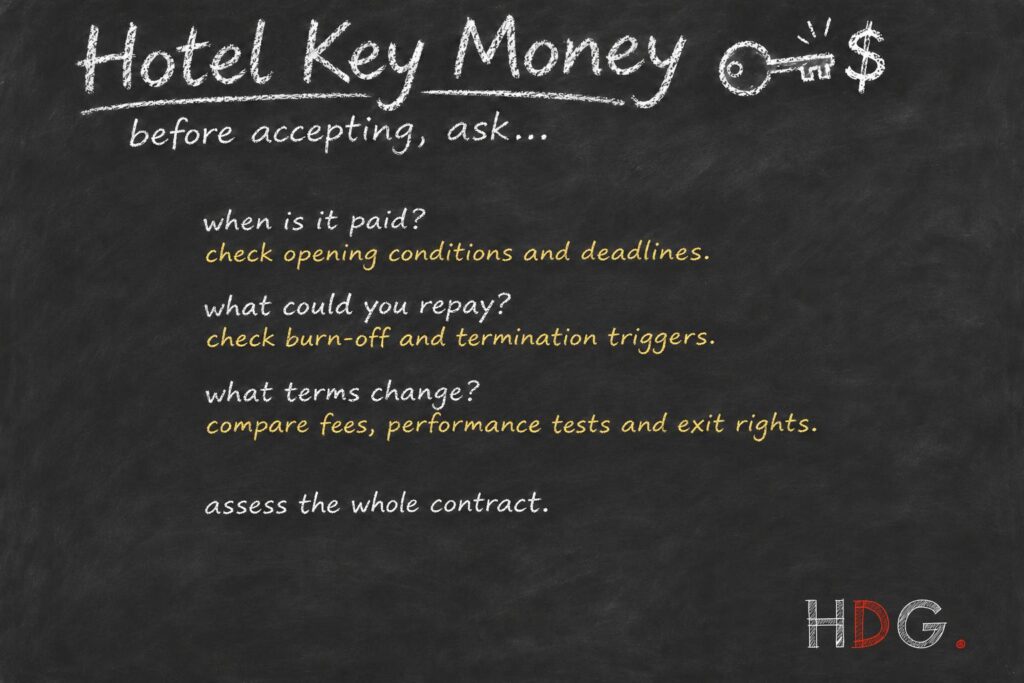
The assessment should consider the intended holding period and less favourable outcomes. Delayed opening, weaker trading or early termination may change both the benefit received and the liability outstanding. The owner needs to understand how those obligations would be funded. Hotel key money is valuable when it strengthens a suitable agreement without creating commitments that outweigh the support provided.
Further resources:
See HDG – Hotel Management Agreement Term
See HDG – Hotel Performance Tests in Hotel Management Agreements
See HDG – Hotel Contract Lawyer Contacts
See HDG – Hotel Operator Links
Hotel Investment Today (June 2023) – “Understanding key money in transactions“
Bird & Bird (February 2026) – “Hotel Management Agreements: A Guide to Key Money”
Disclaimer
This page is provided for general educational and informational purposes only. It does not constitute legal, financial, tax, accounting, investment, valuation or other professional advice, nor does it recommend any particular hotel brand, operator, investment or contractual arrangement. Reading or using this material does not create an advisory, fiduciary or other professional relationship with HotelDevelopmentGuide.com.
Hotel key money, fee concessions, owner’s priority returns, guarantees, loans and equity arrangements vary according to the transaction, contractual wording and applicable jurisdiction. References to commercial practices or potential outcomes are illustrative and should not be interpreted as standard terms, assurances of availability or guarantees of performance. Actual payment, repayment, tax, financing and enforcement consequences depend on the complete agreement package, the parties’ circumstances and applicable law.
Before entering into, amending, financing or terminating any arrangement discussed on this page, obtain independent advice from appropriately qualified legal, financial, tax, accounting and other relevant advisers. Although reasonable care is taken in preparing this material, HotelDevelopmentGuide.com makes no representation or warranty regarding its accuracy, completeness, currency or suitability for a particular purpose. To the extent permitted by applicable law, HotelDevelopmentGuide.com disclaims liability for losses arising from reliance on this material, including errors, omissions and information obtained through external references or links.