
Hotel due diligence is a structured investigation of a proposed investment before an owner, developer, or buyer makes commitments based on its underlying assumptions. It examines whether the property, business, development rights, contractual arrangements and financial expectations are consistent with the opportunity being presented. For hotel projects, this investigation must address both the real estate and the operating business, including the relationship between them. A building may appear suitable for hospitality while carrying restrictions, physical limitations or obligations that materially change the investment case.
The scope of hotel due diligence depends on what is being acquired or developed, how the transaction is structured and what the investor intends to achieve. Purchasing undeveloped land requires a different investigation from acquiring an operating hotel, while converting an office building introduces another set of technical and regulatory questions. The appropriate checks also vary between jurisdictions, property types, ownership structures and financing arrangements. This guide provides a framework for organising those investigations, identifying the evidence required and translating findings into investment decisions.
Hotel Due Diligence: Checklist for Sites, Acquisitions and Conversions
Understanding Hotel Due Diligence
Due Diligence, Site Assessment and Feasibility Studies
Site assessment, feasibility analysis and due diligence are closely connected, but they answer different questions within the investment process. Site location assessment considers whether a location and property appear suitable for the intended hotel, while a hotel feasibility study evaluates the commercial and financial viability of the proposed concept. Due diligence investigates the evidence supporting those conclusions and examines conditions that may prevent the investment from being delivered as assumed. The findings should feed back into the feasibility assessment whenever they affect development capacity, expenditure, timing, operating performance or risk.
A project may therefore be commercially attractive in principle while remaining unacceptable in its current form. Strong demand cannot resolve an absence of enforceable access, and an attractive purchase price may be outweighed by undisclosed capital requirements. Equally, identifying a defect does not automatically mean that an opportunity should be rejected, because some issues can be corrected, priced or allocated through appropriate arrangements. The purpose is to establish what the investor would actually be committing to and whether the revised opportunity remains worthwhile.
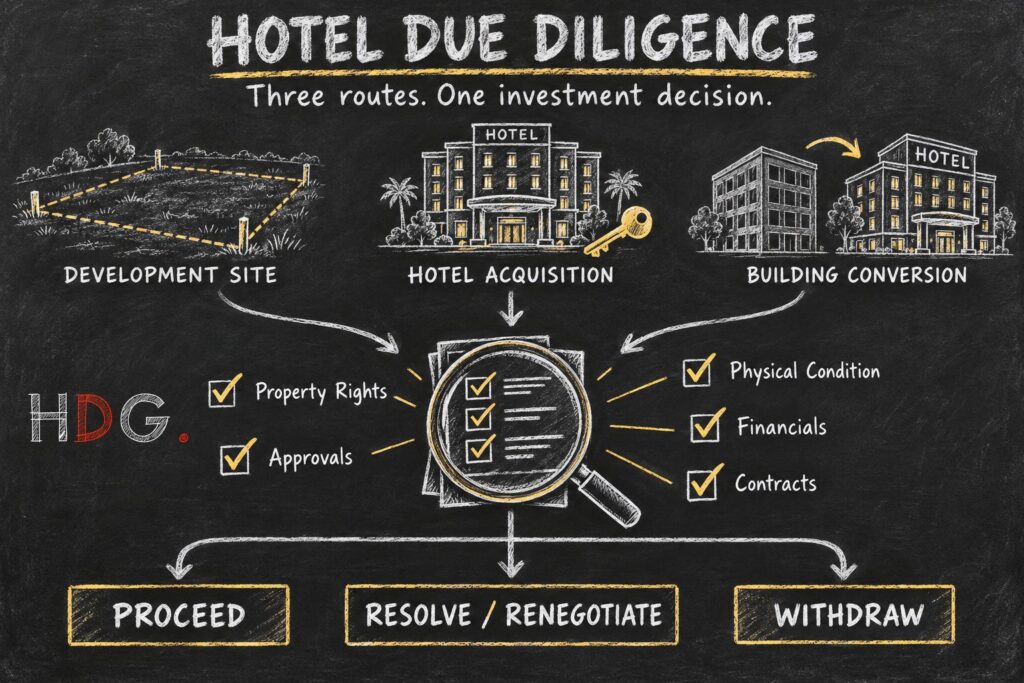
Different Projects Require Different Investigations
The starting point should be a clear definition of the proposed transaction and investment strategy. An investor purchasing shares in a property-owning company may face a different liability profile from a buyer acquiring selected assets, although the consequences depend on local law and transaction terms. A landowner considering development needs to understand both the site’s constraints and the obligations required to make it usable. An owner acquiring an operating hotel must also investigate whether its earnings, contracts, licences and operating arrangements can support the intended ownership strategy.
| Project route | Principal due diligence question | Particular areas of emphasis |
|---|---|---|
| Development site | Can the property accommodate and support the proposed hotel? | Ownership rights, planning, ground conditions, access, infrastructure and development capacity |
| Operating hotel acquisition | What property, business, earnings and obligations are being acquired? | Financial verification, physical condition, contracts, employees, capital expenditure and ownership transition |
| Conversion from another use | Can the building become a viable hotel within the required constraints? | Permitted use, spatial efficiency, structure, building services, compliance and conversion scope |
| Existing hotel rebranding | Can the property transition to the intended brand and operating model? | Existing agreement restrictions, brand acceptance, improvement requirements, systems and business interruption |
When Hotel Due Diligence Should Take Place
Initial Screening Before Major Expenditure
Initial screening should identify issues capable of undermining the investment before substantial expenditure is committed to detailed studies, design or negotiation. The objective is to establish whether further investigation is justified and to define the most important uncertainties. Available information may include ownership records, planning documents, existing drawings, preliminary financial statements and an initial property inspection. At this stage, missing evidence should be recorded explicitly rather than replaced by optimistic assumptions.
The sequence should reflect the seriousness of the potential obstacle and the cost of investigating it. There is limited value in refining interior design assumptions if the proposed hotel use appears fundamentally incompatible with the property’s planning position. Similarly, extensive acquisition modelling may be premature if the buyer cannot obtain the financial information needed to verify operating performance. Early screening should therefore prioritise matters that could stop the transaction, materially reduce the opportunity or require a different development strategy.
Detailed Investigation Before Binding Commitments
Detailed due diligence normally follows once the opportunity has passed initial screening and the investor can obtain sufficient access to documents, people and the property. The investigation should be coordinated with transaction deadlines, funding requirements and the timing of any deposits or other commitments. Where access or information remains restricted, the investor must understand the implications before losing the ability to withdraw or renegotiate. Local legal advisors should establish how investigation rights, conditions and remedies can be reflected in the relevant agreements.
Due diligence is also a continuing process because material circumstances may change between the first investigation and completion. A planning decision, contractual amendment, equipment failure or deterioration in trading may affect conclusions reached earlier. The team should identify which matters require updating and which documents or confirmations must remain current. Completion should therefore include a review of material changes and unresolved conditions, rather than relying entirely on the original reporting date.
| Investigation stage | Main purpose | Expected output |
|---|---|---|
| Initial screening | Identify fundamental obstacles and determine whether further work is justified | Preliminary findings, missing information and investigation priorities |
| Detailed investigation | Test the property, business and transaction assumptions | Specialist reports, verified evidence and quantified implications |
| Resolution and negotiation | Decide how material findings will be addressed | Revised assumptions, corrective actions and negotiated protections |
| Pre-completion review | Confirm that required conditions remain satisfied | Updated confirmations and a clear outstanding-issues record |
| Post-completion follow-through | Implement agreed actions and manage accepted exposure | Assigned responsibilities, funding and monitoring arrangements |
Organising the Hotel Due Diligence Team
Establishing Responsibility and Scope
The investor should appoint someone to coordinate the overall investigation and ensure that specialist findings are considered together. Depending on the project, this role may sit with the owner’s development manager, acquisition lead, project manager or another appropriately experienced advisor. Individual workstreams may involve hotel consultants, lawyers, accountants, tax advisors, architects, surveyors, engineers and environmental specialists. Their appointments should define the questions to be answered, the information available, the reporting requirements and the limits of each investigation.
A specialist report should not be assumed to cover matters outside its agreed scope. A valuation does not necessarily verify title, a building inspection may exclude concealed areas, and an operator’s property assessment may primarily address brand suitability. The investor should understand who may rely on each report and whether additional reliance arrangements are required for lenders or other parties. RICS guidance on technical due diligence emphasises the importance of an appropriate brief, competent specialists and investigation limitations.
Managing Information and Uncertainty
A structured document register helps the team distinguish information requested, information received, information reviewed and information accepted as sufficient. Documents should be dated and linked to the relevant property, legal entity, system or reporting period. Conflicting versions, missing annexes and unexplained gaps should be investigated rather than absorbed into a general statement that documents have been supplied. A populated data room is useful only when its contents answer the questions on which the investment depends.
Evidence also needs to be assessed for reliability and relevance. A seller’s explanation, an old survey and a current independent investigation may each contribute something different to the assessment. Information prepared for another purpose may not address the buyer’s intended use or proposed works. Where uncertainty remains, the report should explain its significance, the additional work required and the consequence of proceeding without resolution.
Core Checks Across Hotel Investment Projects
Ownership, Title and Property Rights
The legal investigation should establish what interest is being acquired and whether the proposed seller or contracting party has authority to grant it. This includes identifying the relevant land, buildings, ownership entities and any interests that affect their use or transfer. Boundaries shown in marketing material should be reconciled with the legal description and appropriate survey information. Ownership restrictions, security interests, disputes and third-party rights should be reviewed by advisors familiar with the jurisdiction.
Rights supporting hotel operations deserve particular attention because they may extend beyond the main property boundary. Access roads, parking, service yards, beach facilities, utility routes and shared amenities may depend on separate ownership or contractual arrangements. An arrangement that functions through goodwill under the current owner may not provide dependable rights for a buyer or lender. The investigation should establish the duration, enforceability, transferability and cost of each material right.
Planning, Permitted Use and Approvals
Planning due diligence should establish the property’s existing position and the approval route for the intended hotel project. A general indication that hospitality is acceptable does not confirm that the proposed scale, room count, facilities or operating arrangements can be approved. Development restrictions may affect height, density, setbacks, parking, heritage features, external appearance or the use of particular spaces. Conditions attached to existing permissions also need review because their fulfilment may require expenditure or third-party action.
Building approval, permission to occupy, tourism classification and permission to operate should be examined as distinct matters where the local system treats them separately. An operating hotel should not be assumed compliant simply because it has been receiving guests for many years. Changes of ownership, use, capacity or configuration may require new applications or additional works, depending on the jurisdiction. The resulting approval schedule should identify the responsible party, supporting documentation, dependencies and uncertainties affecting the programme.
Access, Utilities and Supporting Infrastructure
Infrastructure due diligence should establish whether the property can obtain the services needed for the intended hotel and maintain them at an acceptable level of reliability. The existence of a nearby electricity line, water main or road does not establish connection rights, available capacity or the cost of provision. Written information should be sought from relevant providers, supported by technical assessment where necessary. Include off-site works and third-party contributions in both the development budget and delivery programme.
Hotels may require backup arrangements or additional treatment and storage systems where public services are unreliable or insufficient. The implications extend beyond installation costs to staffing, maintenance, fuel, consumables, space requirements and environmental obligations. Resort projects may face particular challenges where infrastructure must serve a wider development or depends on seasonal demand. Responsibility for operating and replacing shared systems should be clear before their availability is treated as a dependable project assumption.
Environmental, Climate and Community Exposure
Environmental investigation should consider the site’s history, existing conditions and the potential effects of the proposed development, including contamination, hazardous materials, water availability, wastewater, biodiversity and impacts on neighbouring communities. The scope should reflect the property, proposed works and applicable local requirements, supported by appropriately qualified specialists. The EBRD’s 2024 Environmental and Social Requirements, particularly Requirement 1 on assessment and management of environmental and social risks and impacts, provide a recent reference for structuring the investigation, although their mandatory application is tied to EBRD financing. The GSTC Hotel Standard provides complementary hotel-specific sustainability criteria against which the proposed development and operating approach can be reviewed.
Climate-related exposure should be considered over the intended ownership and operating period rather than solely through current conditions. Flooding, coastal hazards, extreme heat, water scarcity and other locally relevant risks may influence design, operating expenditure, insurance and future marketability. Community relationships and existing patterns of land or resource use can also affect whether a project can be delivered and operated successfully. Findings should be assessed alongside the site’s legal position, infrastructure requirements and long-term commercial assumptions.
| Core investigation | Evidence to seek | Investment implication |
|---|---|---|
| Ownership and authority | Relevant title records, entity documentation and legal review | Establishes what can be acquired and who can commit to the transaction |
| Boundaries and access | Surveys, property descriptions and enforceable access arrangements | Tests whether the assumed site and access are legally available |
| Planning and permitted use | Applicable permissions, restrictions, conditions and local advice | Determines whether the proposed use and configuration are achievable |
| Utilities and infrastructure | Capacity information, connection terms and technical assessments | Identifies enabling works, delivery dependencies and operating costs |
| Environmental conditions | Site history, specialist assessments and investigation findings | Identifies remediation, mitigation and development constraints |
| Climate and community exposure | Relevant hazard information and locally informed assessment | Tests resilience, resource availability and wider delivery risks |
Hotel Development Site Due Diligence
Establishing Realistic Development Capacity
A site’s advertised area is not the same as its usable hotel development capacity. Boundaries, setbacks, easements, topography, protected features and infrastructure corridors may reduce the area available for construction. The proposed building must also accommodate circulation, back-of-house functions, plant, servicing and other non-revenue spaces. Early capacity testing should therefore translate the site’s restrictions into a plausible hotel configuration before the room count becomes an established investment assumption.
The relationship between capacity and commercial positioning also requires testing. A layout that achieves the desired number of rooms may leave inadequate space for the facilities or operational support expected by the target market. Conversely, an ambitious public-area programme may consume capital and space without sufficient demand to support it. The architect, hotel consultant and cost advisor should reconcile the physical proposal with the commercial strategy and explain where compromises affect projected performance.
Ground Conditions and Enabling Works
Ground investigations should be appropriate to the proposed development and the known characteristics of the site. Potential issues include bearing conditions, groundwater, slope stability, excavation constraints and interaction with neighbouring structures or infrastructure. Existing buildings, buried services, and previous site uses may require further investigation. Preliminary information should not be treated as equivalent to investigations designed to support the actual project.
Enabling works can materially change the economics of an apparently straightforward land purchase. Demolition, retaining structures, drainage, remediation, road improvements and utility diversions may be necessary before the main construction works can proceed. Their scope may also depend on approvals, neighbouring owners or public infrastructure programmes outside the developer’s control. The investment assessment should identify these dependencies and avoid assigning them to an undefined allowance that conceals the underlying uncertainty.
Testing the Land Commitment
The proposed land terms should be assessed against the confirmed development capacity and the obligations associated with making the site usable. A price supported by an optimistic room count may become unsustainable when design testing reduces the number of saleable rooms. Infrastructure contributions, phased land release or obligations to deliver other facilities may also affect the effective land commitment. These matters should be reflected in the investment assessment before the owner relies on the apparent simplicity of a price-per-area comparison.
Land investigations should also consider the relationship between the property and its wider development context. A hotel within a planned destination may depend on transport connections, attractions or neighbouring projects that are not yet committed. Assumptions about those developments should distinguish contractual commitments from proposals or aspirations. The investor should understand whether the hotel remains viable if the surrounding programme is delayed, reduced or abandoned.
Operating Hotel Acquisition Due Diligence
Verifying Historical Financial Performance
Financial due diligence should establish whether reported results are complete, consistent and supported by underlying records. The review may involve reconciling management accounts, statutory statements, operating-system reports, tax information, and cash movements, depending on the scope agreed with the advisors. Differences in reporting periods, accounting policies and departmental classifications should be understood before performance is compared across years. The investor needs a dependable explanation of how reported revenue becomes operating profit and ultimately owner cash flow.
Historical earnings should also be examined for sustainability under the proposed ownership and operating arrangements. Exceptional income, deferred expenditure, related-party transactions and temporary cost reductions may distort the apparent performance of the business. Changes in management fees, insurance, payroll, property costs or distribution arrangements may alter the future result even without a change in revenue. Adjustments should be supported and explained rather than used to create an increasingly optimistic version of historical profitability.
Examining Demand Quality and Revenue Exposure
Occupancy and average daily rate provide useful information but do not, on their own, establish the strength of a hotel’s revenue base. The buyer should examine seasonality, customer segments, distribution channels, corporate accounts, group demand and dependence on individual sources of business. A strong trading year may reflect a temporary event, unusual market conditions or the absence of competing supply. The investigation should connect historical results with the demand assumptions used in the acquisition case.
Revenue concentration can become particularly significant when ownership, management or branding changes. Corporate customers may have relationships with the existing operator, while distribution performance may depend on systems that will no longer be available after completion. Review forward bookings for cancellation rights, deposits, pricing, and the conditions under which the buyer can fulfil them. The commercial assessment should explain which sources of demand are transferable, which require rebuilding and which remain uncertain.
Reviewing Physical Condition and Capital Expenditure
An operating hotel can report attractive profits while accumulating substantial replacement and refurbishment needs. Technical due diligence should examine the condition of the building, its services, specialist facilities and equipment against the buyer’s intended strategy. The distinction between immediate corrective work, planned replacement and discretionary improvement should be explicit. A buyer should also understand which areas were inspected, which systems were tested and where further investigation is required.
Capital requirements should extend beyond visible guest-facing finishes. Roofs, façades, lifts, cooling systems, plumbing, electrical infrastructure, kitchens and laundry facilities can create significant obligations without being apparent during a standard property tour. Deferred works may also affect guest satisfaction, energy consumption, safety or the hotel’s ability to remain operational. The resulting capital plan should be integrated with trading forecasts, financing assumptions and any intended refurbishment programme.
Investigating Contracts, Employees and Liabilities
Existing management, franchise, lease and other material agreements can determine how much freedom a buyer has to implement its strategy. The review should address duration, transfer conditions, approval requirements, termination provisions, fees and obligations that survive a change in ownership. Supplier agreements, equipment leases, shared-facility arrangements and commercial tenancies may introduce further commitments. The buyer should establish which arrangements continue, which require consent and which must be replaced.
Employment, tax, litigation and other liabilities require transaction-specific review by the appropriate specialists. The allocation of responsibility may depend on the acquisition structure, applicable law and negotiated terms, so assumptions about what remains with the seller should be tested. Accrued employee entitlements, unpaid amounts, guest deposits and disputed obligations can affect both completion arrangements and future cash requirements. These findings should be reconciled with the purchase agreement and funding plan rather than left in separate advisory reports.
| Acquisition workstream | Principal checks | Questions for the buyer |
|---|---|---|
| Financial results | Reconciliation, accounting consistency and supported adjustments | Are the earnings reliable and sustainable? |
| Demand and revenue | Segment mix, seasonality, customer concentration and channel dependence | What business is likely to continue after completion? |
| Physical asset | Condition, maintenance records, testing and replacement requirements | What expenditure is needed to protect or improve performance? |
| Operating agreements | Management, franchise, lease and material supplier obligations | Can the intended ownership strategy be implemented? |
| Employees and liabilities | Employment arrangements, accrued obligations and relevant claims | What responsibilities and exposures accompany the transaction? |
| Transition arrangements | Licences, systems, bookings, deposits, inventories and cash | Can the hotel continue operating through the ownership change? |
Hotel Conversion Due Diligence
Converting a Building from Another Use
An existing building should be tested against hotel requirements before its apparent acquisition discount is treated as a development advantage. Floorplate depth, column positions, façade openings, floor heights and vertical circulation can influence achievable room layouts and operational efficiency. Plant, service routes and back-of-house accommodation may require space that the original use did not provide. The evaluation should establish a credible hotel configuration rather than applying a target room count to the building’s gross area.
A technically achievable conversion may still be commercially unsuitable. Excessive circulation, irregular rooms, inefficient staffing routes or limited public facilities can weaken performance throughout the operating life of the asset. Heritage restrictions or façade limitations may constrain solutions that would otherwise improve the layout. The relevant comparison is therefore the completed hotel’s investment case, including conversion risk, rather than the purchase price of the existing structure alone.
Testing Compliance and Investigation Requirements
Conversion proposals should be reviewed against the requirements applicable to the proposed use and works. Fire strategy, escape arrangements, accessibility, structural performance, acoustics and building services may require specialist assessment and significant alteration. An existing occupancy approval does not establish that the proposed hotel can operate under the same conditions. Advisors should identify where approvals, interpretations or additional investigations remain necessary.
Concealed conditions are particularly important because the building’s original documentation may be incomplete or inaccurate. Opening-up works, material testing, surveys and system assessments may be necessary to establish what can be retained. Restrictions on intrusive investigation before acquisition should be recorded together with their possible cost and programme consequences. The investor should understand how the transaction and delivery strategy address the possibility that further works emerge after possession.
Rebranding an Existing Hotel
Rebranding an existing hotel requires a separate assessment of contractual exit, physical suitability and the commercial value of the proposed affiliation. The owner should confirm the new brand’s acceptance of the property and understand the scope of required improvements. Any Property Improvement Plan should be reviewed alongside technical findings and the owner’s wider investment objectives. A brand-required programme may overlap with, but should not be assumed to replace, a comprehensive assessment of building condition.
The transition may affect revenue, staffing, technology, distribution and guest expectations before the intended benefits are realised. Existing agreements may restrict when a change can occur or impose obligations that influence the timing and cost of the strategy. Proposed fee structures and operating arrangements should be incorporated into the revised feasibility assessment. The owner should evaluate the combined effect of capital expenditure, disruption and future operating performance rather than considering the new brand in isolation.
Testing the Budget, Funding and Delivery Assumptions
Reconciling the Full Capital Requirement
Due diligence should test whether the capital assessment includes the expenditure necessary to deliver and operate the intended hotel. Relevant categories may include acquisition, enabling works, construction, professional services, equipment, brand requirements, financing, pre-opening and working capital. The treatment of taxes, recoverable amounts, contingencies and existing assets should be clear so that comparisons use consistent definitions. The purpose is to establish completeness and evidence quality rather than apply a universal cost allowance.
Each material budget item should have an identifiable basis and an appropriate level of confidence. A contractor quotation, a preliminary consultant allowance and an uninvestigated assumption should not appear equally certain simply because they occupy adjacent spreadsheet cells. Potential overlap between construction, fit-out, FF&E and OS&E should be resolved before totals are relied upon. The hotel construction costs guide provides a framework for understanding these components and their differing cost bases.
Checking Finance and Programme Dependencies
The funding review should distinguish committed capital from indicative interest, conditional offers and funding that remains to be raised. Conditions attached to equity and debt should be compared with the proposed transaction and construction sequence. A financing arrangement may depend on permissions, contracts, guarantees or other matters that have not yet been resolved. The investor should understand how those dependencies affect the ability to acquire, commence works and reach opening.
Programme assumptions require similar scrutiny because delays can increase expenditure and postpone revenue simultaneously. Approvals, utility connections, imported equipment, brand reviews and specialist works may each affect the critical sequence. The team should test the consequences of plausible adverse changes using project-specific assumptions supported by the relevant advisors. Where the funding plan cannot absorb those consequences, the issue belongs in the investment decision rather than being treated solely as a future project-management problem.
Turning Due Diligence Findings into Decisions
Maintaining a Findings and Actions Register
The findings register should connect each material issue with its evidence, responsible party, investment consequence and required resolution. It should distinguish a confirmed problem from a missing document or an investigation not yet completed. Matters described as resolved should include supporting evidence, not a general assurance that someone is addressing them. The register should remain consistent with the transaction documents, revised budget and delivery programme.
| Finding | Evidence or action required | Responsible lead | Decision consequence |
|---|---|---|---|
| Unconfirmed legal access | Establish acceptable rights through local legal review | Legal advisor | Resolve before relying on the property’s assumed accessibility |
| Unverified utility capacity | Obtain provider information and technical assessment | Engineering and development team | Revise enabling works, timing or operating arrangements |
| Unexplained earnings adjustment | Obtain records and an accountant’s assessment | Financial advisor | Reassess sustainable profit and acquisition assumptions |
| Incomplete condition investigation | Secure access, testing or further specialist review | Technical advisor | Reassess capital requirements and remaining uncertainty |
| Outstanding brand requirements | Obtain and assess property-specific obligations | Owner’s hotel and technical advisors | Reconcile works, commercial terms and opening assumptions |
| Conditional funding | Confirm outstanding conditions and achievable sequence | Owner and financing advisors | Establish whether the proposed commitment can be funded |
Proceeding, Renegotiating or Withdrawing
The investment decision should reflect the combined findings, not a collection of isolated approvals from different advisors. An issue that seems manageable on its own may become unacceptable when combined with reduced capacity, additional expenditure, and a delayed opening. The decision-maker should receive a clear account of resolved matters, outstanding conditions and exposure that would remain after completion. This should include the resources and responsibilities required to manage any accepted risk.
Possible responses include revising the design, changing the price, requiring corrective work, adjusting the transaction structure or seeking appropriate contractual protection. The availability and effectiveness of those responses depend on the circumstances and should be assessed by the relevant advisors. Some findings may reveal that the project no longer meets the investor’s objectives even if a transaction remains legally possible. Withdrawal can therefore be a successful outcome of due diligence when it prevents commitment to an unsuitable investment.
Hotel Due Diligence as an Investment Discipline
Effective hotel due diligence links evidence with decisions throughout the investment and development process. It establishes what is known, what remains uncertain and how each material finding affects the proposed hotel. Its value depends on a suitable scope, competent investigation, coordination between advisors and a willingness to revise the original assumptions. A completed checklist becomes meaningful when the owner understands the findings and has decided how they will be addressed.
The depth of investigation should remain proportionate to the property, transaction, and intended strategy, while giving proper attention to matters that could undermine the investment. A development site, an operating hotel and a conversion opportunity each require a different emphasis within the same disciplined approach. Findings should continue into project delivery, asset management and operational planning wherever actions remain outstanding. Due diligence is therefore part of establishing and protecting the hotel’s long-term investment case, rather than simply a procedural step before acquisition.
Further Resources:
See HDG – Homepage
See HDG – Site Location Factors in Hotel Development
See HDG – Hotel Market & Feasibility Studies
See HDG – Hotel Construction Costs: A Practical Guide to Hotel Development Build Costs
See HDG – Property Improvement Plans (PIPs)
RICS (April 2023) – Technical due diligence of commercial property, 1st edition
EBRD – Environmental and Social Policy 2024
The Global Sustainable Tourism Council (December 2025) – GSTC Hotel Standard v.4.0