
A hotel development timeline brings the project’s main activities together in one programme, showing how decisions, commitments, and delivery relate to the proposed opening date. It links the property’s development with the preparation of the business that will operate it. For the owner, its value lies in understanding what needs to happen next, which activities depend on others, and where delays could affect the outcome. A useful timeline therefore explains more than when construction starts and finishes.
In practice, hotel projects begin from different positions and progress in different ways. The owner may already control the site, funding may be available before the concept is settled, or hotel use may be introduced into a building originally intended for another purpose. Design, approvals, financing, procurement, and operational preparation can overlap, with earlier decisions revisited as circumstances change. The programme should reflect those realities rather than impose an ideal sequence on the project.
This page uses a hypothetical 36-month new-build programme to illustrate how the principal activities might fit together. It then explains the milestones, dependencies, and decisions that influence whether an opening date is achievable. The example provides a reference for discussion rather than a forecast for an individual development.
How Long Does Hotel Development Take?
Understand the Range Before Selecting a Target
Hotel development can take less than a year in exceptional rapid-deployment circumstances, several years for a conventional project, or more than five or ten years where interruptions occur. Rapid delivery would need to be supported by prefabricated construction, existing ownership arrangements, a readily available site with hotel use already permitted, readily available funding, and concentrated decision-making. A relatively straightforward mid-market or upscale project may use approximately 18 months to three years as an initial planning reference under favourable conditions. That range needs to be tested against the actual scope, location, starting position, and delivery arrangements before it supports an investment commitment.
Significantly longer development periods can arise from planning difficulties, financing constraints, infrastructure requirements, ownership changes, or external events. Some projects progress intermittently, with periods of suspension between design, approval, and construction activity. Others continue moving but undergo substantial revisions as costs, market conditions, or investor requirements change. The total time elapsed therefore does not necessarily represent a continuous period of productive development.
Define What the Timeline Measures
The starting point must be clear before any development period can be meaningfully assessed. A programme measured from the first discussion of a hotel opportunity is different from one measured from site acquisition, funding close, or the start of construction. A project with developed plans and an established approval route has already completed work that another project may still need to undertake. Comparisons become misleading when those differences are overlooked.
The finishing point also needs a clear definition. Construction completion, handover, permission to operate, first paying guest, and established trading performance are separate milestones. A hotel can reach one without immediately reaching the next, particularly where testing, training, or final permissions remain outstanding. In the illustration below, the endpoint is the intended opening to paying guests, subject to the required physical, regulatory, and operational readiness.
Illustrative Hotel Development Timeline: A 36-Month New-Build Programme
The illustration below shows how the main development activities might overlap within a hypothetical 36-month hotel project. It follows one possible route from initial concept to opening, with several activities running in parallel. The example assumes a new-build project able to proceed without prolonged suspension and with a workable route through site control, approvals, infrastructure, and funding. The timing is illustrative rather than a standard programme, and individual projects will have different dependencies and constraints.
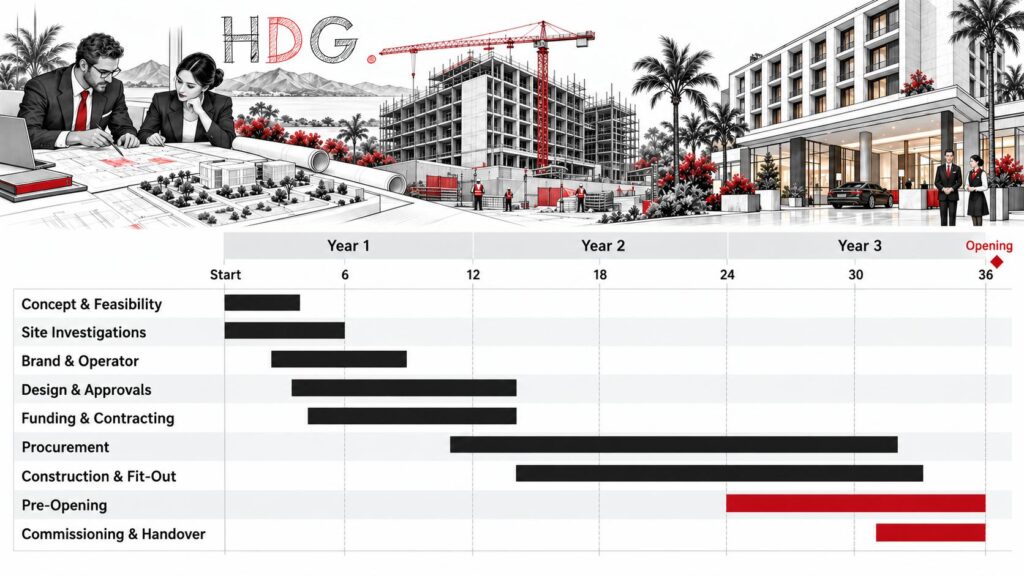
Simplified Illustration Only. Bars show principal activity periods; Planning, reviews, and continuing responsibilities extend beyond them. Actual Timing, duration, and sequencing will vary by project.
The bars show the main period of activity or initial commitment, not the full duration of each party’s involvement. For example, Brand & Operator represents the initial selection, negotiation, and appointment process. Their input may then continue through design, construction, pre-opening, and operation, depending on the agreed arrangements. The end of that bar therefore indicates a transition in the nature of their involvement rather than their departure from the project.
Similarly, Funding & Contracting indicates the principal period for securing funding commitments and establishing delivery arrangements. Drawdowns, contract administration, payments, and subsequent negotiations continue beyond that point. Concept & Feasibility establishes the initial proposition and business case, which should be reviewed as costs, market conditions, and project assumptions change. These continuing responsibilities are not represented as full-length bars because doing so would obscure the main sequence the illustration is intended to explain.
Later activities also require preparation before their bars begin. Procurement planning starts during design, while commissioning requirements should be established well before final testing and handover. The pre-opening bar represents the concentrated preparation for operation, although commercial planning and operational input may begin much earlier. The illustration simplifies a connected process without showing every supporting activity, review, or continuing responsibility.
Actual sequencing may differ considerably where the site, ownership structure, design, or operating arrangements are already established. Approvals, infrastructure, construction methods, supply chains, and external events can shorten or extend the programme. The bars should not be added together because much of the work overlaps. Opening at Month 36 remains subject to the permissions, completed testing, staffing, systems, and other conditions necessary to receive guests.
Reading the Programme Across Three Years
Year 1: Establish the Basis for Delivery
In this example, the first year concentrates on defining the hotel and establishing whether it can be delivered on an acceptable basis. Concept development, feasibility, site investigations, and brand or operator discussions progress in parallel. Design and approval work begin before all commercial arrangements are finalised, while funding discussions develop as the scheme becomes clearer. The intended outcome is a sufficiently coordinated proposition to support the commitments required for construction.
This period is particularly important because decisions can shape expenditure long after they are made. An assumed room count affects revenue forecasts, while layouts and specifications influence construction costs and operating requirements. Approval conditions or site findings may require the team to revise both. Progress should therefore be measured through the quality of resolved decisions as well as the number of activities underway.
Year 2: Commit to Delivery and Manage Interfaces
The example moves into construction during the second year, following the principal period of funding and contracting. Procurement overlaps with delivery, so equipment, furniture, and other packages are available when installation requires them. Design clarification, cost review, and contractual administration continue even though their main preparation periods have passed. The programme becomes increasingly dependent on coordination between information, purchasing, site progress, and payment.
At this point, changes can affect several activities simultaneously. A revised equipment selection may require different connections, alter installation dates, and change testing requirements. A delay in one part of the building may prevent access for another contractor or supplier. The programme needs to capture those relationships so that the team can evaluate consequences before approving changes or accepting revised dates.
Year 3: Bring the Property and Operation Together
The final year combines remaining construction and fit-out with concentrated preparation for opening. Recruitment, training, sales activity, systems setup, operating supplies, and service procedures must progress in coordination with property access. Final testing and handover also require completed work, documentation, and participation from the people who will operate the building. The challenge is to bring these activities together without assuming that physical completion automatically establishes operational readiness.
The final months should allow time to identify and resolve problems. Failed tests, incomplete areas, missing equipment, or insufficient training can affect the opening even when the building appears substantially complete. Recovery may involve additional resources, changed sequencing, or a revised opening scope where that is practical and appropriate. The decision should reflect the hotel’s actual capabilities and obligations, not the visibility of an approaching target date.
| Programme period | Main emphasis in this example | What needs particular attention |
|---|---|---|
| Year 1 | Establish the concept, investigate the site, develop design, and progress approvals and commercial arrangements | Whether the assumptions supporting commitment are sufficiently tested |
| Year 2 | Finalise delivery arrangements, construct the property, and progress procurement | Coordination between information, purchasing, funding, and site activity |
| Year 3 | Complete fit-out, prepare operations, test systems, and establish opening readiness | Access, training, permissions, unresolved work, and the reliability of the opening forecast |
The Milestones That Determine Progress
Distinguish Activity from Achievement
An activity bar shows when work is expected to occur, while a milestone identifies an outcome that enables a decision or transition. Completing several months of design activity does not establish that the information is suitable for construction. Similarly, progressing funding discussions does not mean capital is available for the next payment. Milestones should therefore be defined through evidence rather than the passage of time.
Each important milestone needs an agreed meaning, a responsible party, and a clear method of confirmation. The team should understand what information or approval is required and what depends on achieving it. Where a milestone is only partly satisfied, that limitation should be visible. This helps prevent a broad description such as “ready for handover” from concealing different interpretations among the contractor, owner, and operator.
| Key milestone | What it establishes | Why it matters to the programme |
|---|---|---|
| Site control secured | A sufficient basis for progressing the proposed development | Supports further expenditure and commitments within the agreed terms |
| Development brief agreed | A working basis for scope, positioning, and facilities | Gives design, costing, and commercial discussions a common reference |
| Relevant approvals obtained | Permission to progress the applicable works or use | Releases dependent activities or satisfies agreed conditions |
| Funding available | Capital can be accessed under the required arrangements | Supports orders, contractual commitments, and payments |
| Construction authorised | The owner has accepted the basis for commencing the relevant works | Establishes a major delivery commitment |
| Operational access available | Suitable areas can be used for installation, setup, and training | Connects construction progress with operational preparation |
| Opening readiness confirmed | The necessary physical, regulatory, and operational conditions have been satisfied | Supports the decision to receive paying guests |
Allow for Phased Access and Completion
A single handover date can oversimplify the transition from construction to operation. Guestrooms, public areas, kitchens, offices, and technical spaces may become available at different times. Some activities can proceed with limited access, while others need a completed and suitably controlled environment. The programme should distinguish these requirements rather than assume that one date serves every purpose.
Phased access also requires agreement about responsibility for the spaces concerned. Security, cleaning, protection, insurance arrangements, contractor access, and the treatment of damage need attention. Operational employees should understand where they can work and which restrictions remain in place. Clear arrangements help early access support preparation without creating confusion or disrupting completion.
Working Backwards from the Proposed Opening
Connect the Opening Date to Earlier Decisions
Working backwards from opening helps expose the activities that must happen in advance. Operational rehearsals require trained employees, functioning systems, usable spaces, and essential supplies. Those conditions depend on installation, delivery, purchasing, approved specifications, and earlier decisions. A target becomes more credible when the programme demonstrates that this chain can realistically be completed.
For example, a guestroom equipment package may need to be installed and tested before room inspections and employee training. Delivery must therefore precede those activities, with enough time to receive, check, install, and correct defects. Manufacturing and transport precede delivery, while approved specifications and commercial commitments precede production. The latest acceptable order date follows from those relationships rather than from a general assumption about when purchasing normally occurs.
Distinguish Preferred Dates from Supported Dates
An owner may prefer to open before a peak season, major event, or important commercial commitment. That preference can guide planning, but it does not establish whether the necessary work can fit. The team should identify the resources, access, decisions, and external actions required to support it. Where the target depends on uncertain assumptions, those assumptions need to remain visible.
Announcements and customer commitments should reflect the reliability of the forecast. Sales teams need to understand the basis of the opening date and how changes will be communicated. As the opening date approaches, the assessment should rely more on verified completion and readiness than on broad expectations. Commercial enthusiasm and delivery reporting need a shared view of what the hotel can responsibly promise.
| Working backwards from opening | What must be ready | Earlier dependency |
|---|---|---|
| Receive paying guests | Usable accommodation, essential services, required permissions, and operational capability | Confirmed opening readiness |
| Conduct operational rehearsals | Trained teams, functioning systems, and suitable spaces | Access, installation, setup, and training |
| Install and test equipment | Correct items, connections, access, and installation resources | Coordinated site readiness and delivery |
| Receive deliveries | Completed products, transport arrangements, and receiving capacity | Manufacturing, dispatch, and logistics |
| Commit orders | Approved specifications and agreed commercial terms | Design decisions, budget authority, and funding availability |
What Can Move the Opening Date?
Understand Which Delays Affect the Outcome
A delay matters to opening when it affects a dependency that cannot be recovered or absorbed elsewhere. Some activities have flexibility in their timing, while others sit on the critical path. A short delay to an essential utility connection can therefore have a greater effect than a longer delay to work with available time in the programme. The significance comes from the relationship between activities and the remaining options.
The critical path can also change as work progresses. An activity that initially had flexibility may become critical after repeated slippage or a change in sequence. Procurement, testing, approvals, or operational preparation can become the controlling issue even where the main construction works are progressing well. Programme reviews should identify these changes rather than continue reporting only the constraints recognised at the outset.
| Potential delay | How it can affect opening | Management focus |
|---|---|---|
| Approval changes | Require redesign, revised pricing, or additional submissions | Identify dependent work and assess the consequences of proceeding |
| Unmet funding conditions | Prevent orders, contracts, or payments from progressing | Confirm requirements and realistic dates for capital availability |
| Late design decisions | Delay procurement or disrupt coordinated work | Resolve information needs against purchasing and construction deadlines |
| Supplier delays | Leave essential equipment unavailable for installation or testing | Verify production, transport, alternatives, and recovery options |
| Utility connection delays | Prevent systems from operating under required conditions | Confirm external responsibilities and connection commitments |
| Restricted operational access | Compress setup, training, and trial operations | Agree phased access and the conditions needed for productive use |
| Failed testing or incomplete permissions | Prevent opening despite substantial physical completion | Protect resolution time and verify readiness requirements |
Evaluate Recovery Before Accepting It
A recovery programme should explain how lost time will actually be regained. Additional labour, changed shifts, alternative suppliers, resequencing, or revised access may help in some circumstances. Their effectiveness depends on the work involved, site capacity, supervision, and the availability of information and materials. Simply increasing activity does not guarantee a shorter completion period.
Recovery decisions can also transfer pressure into later stages. Compressing testing or training may preserve an announced date while increasing the likelihood of problems after opening. Ordering substitutes can affect maintenance, compatibility, or the guest experience. The owner should understand those consequences before accepting a proposal that appears to recover time on paper.
Keeping the Timeline Credible
Maintain a Shared and Current Programme
Construction, procurement, funding, approvals, and pre-opening schedules need to connect to one another. Each team may need its own detailed programme, but the key dates and dependencies should align. Differences should be identified and resolved rather than allowed to persist across separate reports. The owner needs a coherent view of the route to opening.
Updates should distinguish the original target, the current forecast, and any recovery proposal. Reporting should explain what changed, why it changed, and which decisions could influence the result. Dates supported by firm commitments should be distinguishable from assumptions awaiting confirmation. This lets management focus on the matters that can still affect the outcome.
Reassess Feasibility When Timing Changes
A change in the opening date can affect more than the programme. Extended finance costs, professional fees, site overheads, recruitment costs, storage, and other commitments may increase the required investment. Missing an intended trading period may also affect the initial revenue profile. These consequences should feed into the financial forecast rather than remain isolated within scheduling reports.
Substantial delays may require a wider reassessment of the development proposition. The competitive market, customer expectations, construction prices, and funding conditions may have changed since the original decision. Continuing expenditure should be supported by the current business case and a realistic view of the work remaining. Earlier investment explains the project’s position, but it does not establish that every further commitment is justified.
From an Illustrative Timeline to a Project Programme
The 36-month illustration provides a way to understand overlap, principal activity periods, and the transition towards opening. Each hotel needs a more detailed programme based on its scope, starting point, contracts, and local conditions. The useful next step is to identify what is already resolved, what remains uncertain, and which commitments depend on obtaining an answer. That assessment establishes the basis for credible dates.
A strong timeline remains understandable while becoming more detailed as the project develops. It should help the owner make decisions, coordinate responsibilities, and recognise changes early enough to respond. Its value comes from accurately representing the route ahead rather than preserving an original target regardless of events.
Further Resources:
HotelDevelopmentGuide.com – Hotel Development Process: From Opportunity to Opening
HotelDevelopmentGuide.com – Determining the Hotel Project Team
HotelDevelopmentGuide.com – Hotel Management
HotelDevelopmentGuide.com – Hotel Development Planning
HotelDevelopmentGuide.com – Asset Management
Hospitality Net (February 2026) – “Hospitality Construction: Trends and Challenges for the Future“
National Institute of Building Sciences – Roles and Responsibilities in the Commissioning Process
Site Overview cluster of HDG webpages: HDG Homepage – The Challenges of Hotel Development – The Advantages of Hotel Investment – Investor Motivation in Hotel Development – Hotels vs Commercial Real Estate Sectors – About the Hotel Development Guide