
A hotel franchise agreement provides brand affiliation, while responsibility for operations remains with the franchisee. Owners who do not wish to operate the hotel themselves can appoint a white-label operator—an independent management company whose identity remains separate from the hotel’s guest-facing brand. This combines the franchise brand’s recognition, systems and services with independently provided operational expertise. Two contracts support the arrangement: the franchise agreement with the brand and a hotel management agreement with the operator.
For ownership, the attraction is the ability to select a brand and an operating partner suited to the property. That flexibility depends on the brand’s acceptance of the management company and the compatibility of the two appointments. Their scope, combined costs and duration shape the owner’s commitment, while changes to either relationship can affect the other. Understanding those connections is essential to assessing whether the model suits the investment.
White-Label Operators in Hotel Franchise Agreements
What Is a White-Label Hotel Operator?
Management Without Its Own Hotel Brand
A white-label operator manages a hotel without requiring the property to adopt the management company’s own consumer-facing identity. The company provides operational expertise, personnel and supporting resources, while the hotel’s identity comes from a separate affiliation or independent positioning. In a franchise arrangement, guests principally recognise the franchise brand rather than the organisation managing the property. The management company can nevertheless be well known to owners, employees and industry partners.
The operator’s responsibilities depend on its appointment but generally cover the organisation and supervision of hotel operations. These can include staffing, guest services, purchasing, revenue management, financial administration and maintenance coordination. Corporate support supplements the property team where included in the agreed services. The operator delivers the hotel’s day-to-day performance within the framework established by ownership, the franchise requirements and its management agreement.
White-Label and Third-Party Management
White-label operator, independent management company and third-party operator are overlapping descriptions rather than separate legal categories. The same organisation may manage franchised hotels, independently positioned properties and hotels operating under other arrangements. Its role can also differ between individual appointments. The label describes the separation between management and the hotel’s outward identity, rather than a uniform contractual package.
That distinction matters when comparing proposals. Two companies describing themselves as white-label operators can offer different levels of corporate support, property involvement and commercial services. Their authority, fees and commitments can also differ substantially. Ownership should assess the proposed role for its hotel rather than assume the description establishes what the company will provide.
International and Regional White-Label Operators
The sector includes large international management platforms alongside regional and domestic specialists. Aimbridge Hospitality is one of the largest third-party hotel management companies, with operations across North America, Europe and Latin America. Highgate has a substantial portfolio spanning North America, Europe, the Caribbean and Latin America, including branded hotels, independent properties and resorts. Valor Hospitality Partners operates across the Americas, the UK and Europe, Africa, the Middle East and parts of Asia. These companies illustrate how independent management can support different franchise brands across several markets without becoming the hotel’s consumer-facing identity.
Alongside these international platforms, smaller operators concentrate on individual countries or neighbouring markets. Their strengths often include local recruitment, supplier relationships and familiarity with the commercial and regulatory environment. Some develop from experienced hotel management teams into companies capable of operating several properties under different franchise brands. For ownership, the relevant distinction is not simply international scale versus local presence, but whether the company has the brand experience, operating resources and market knowledge needed for the proposed hotel.
Why Owners Combine a Franchise with Independent Management
Professional Management Without Direct Brand Management
An owner may want a particular hotel brand without appointing that brand to manage the property. A white-label operator makes this possible by providing the management team and operational support under a separate appointment. Ownership can select the brand for its market positioning and distribution strength, while selecting the operator for its ability to run the hotel. This creates a choice of operating partner beyond the management organisation associated with the brand itself.
The arrangement also makes franchising accessible to owners who do not have their own hotel operating platform. The independent company provides the personnel, supervision and expertise needed to turn the franchise proposition into a functioning business. Its role extends beyond smaller or limited-service properties, with experienced companies also managing full-service, resort and luxury hotels. Suitability depends on the company’s capabilities and the proposed property rather than the white-label description alone.
Combining International Reach with Local Capability
A franchise brand brings recognition and access to demand beyond the hotel’s immediate market. A locally established operator contributes knowledge of recruitment, suppliers, commercial practices and the conditions affecting daily operations. This combination can be particularly valuable in emerging markets, where an international brand has commercial appeal but a limited direct management presence. The operator provides the local organisation needed to deliver the branded product.
Local capability does not necessarily mean a domestically owned white-label management company. An international operator with an established regional team can offer the same practical strengths, plus broader specialist resources. Ownership should consider the personnel and support available to the actual hotel, including access to operational decision-makers. A well-resourced local team and clear accountability matter more than the location of the company’s headquarters.
Managing a Portfolio Across Several Brands
An owner with several hotels can appoint one management company across properties carrying different franchise brands. This provides a common management relationship while allowing each asset to retain the affiliation suited to its market. Reporting, financial administration and communication with ownership can follow a consistent approach across the portfolio. Specialist resources and purchasing arrangements can also be shared where this benefits the individual hotels.
The operator still needs to accommodate the differences between the franchise systems. Each property has its own positioning, standards, technology and service requirements. A common management platform should support those differences rather than impose an identical operating approach on every hotel. The attraction for ownership is coordinated oversight without having to place the entire portfolio under one brand.
A Structure Proposed by the Brand or Operator
The initiative can also come from the franchise brand, particularly where direct management would require resources or market exposure it is reluctant to commit to. Political uncertainty, market instability or a limited regional presence can make a management appointment less attractive, even where the brand sees an opportunity for affiliation. It may prefer to offer a franchise supported by an experienced white-label company already established in the market. Where ownership lacks a proven operating organisation, that trusted management partner can be central to making the proposal workable.
A white-label operator can also identify the opportunity and bring the parties together. It may approach an owner with a proposal combining its management services with a suitable franchise brand. Alternatively, it can work with a brand seeking an operating partner to support expansion without establishing a direct management presence. The arrangement can therefore originate with ownership, the brand or the independent operator, rather than always beginning with an owner’s request.
An Independent View of Brand Requirements
A white-label operator can give ownership an informed operating perspective when assessing proposals from the franchise brand. Experience across different hotels and brand systems helps it distinguish essential requirements from measures whose cost or suitability deserves further discussion. This contribution is particularly useful when considering a property improvement plan, a new programme or changes to operating specifications. The operator can explain the consequences for the hotel and support a request for an acceptable alternative.
This role does not give the operator authority to disregard the franchise agreement. Mandatory requirements remain binding unless the brand agrees otherwise. Its value lies in bringing practical evidence to the discussion, including operating experience, costs and the suitability of alternative solutions. Ownership gains a management partner able to work constructively with the brand while examining the consequences for the individual asset.
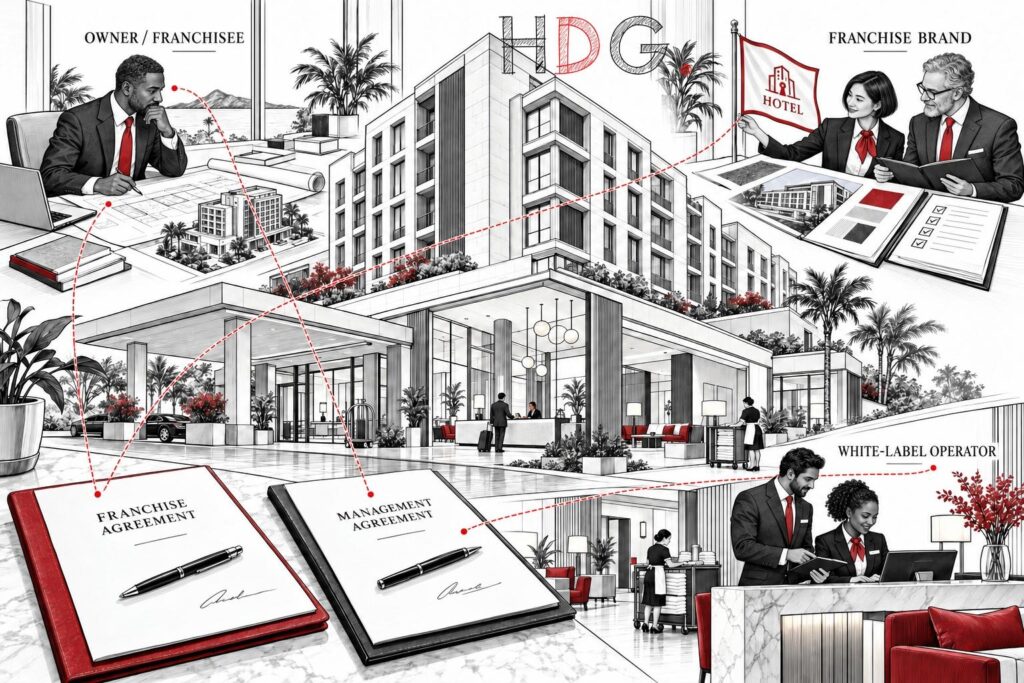
The Owner, the Brand and the Operator
The Owner/Franchisee
The owner/franchisee enters into two separate contracts: a franchise agreement with the brand and a management agreement with the white-label operator. The first provides the right to operate under the brand and access its systems and services. The second appoints the company responsible for daily hotel management. The owner/franchisee funds the business and remains responsible to the brand for meeting its franchise obligations, even where operational tasks are delegated to the manager.
For simplicity, “owner/franchisee” describes the ownership side of this arrangement as one party. In practice, the company owning the building and the company holding the franchise rights may be separate legal entities. The contracts must identify which entity holds each role and carries the associated obligations. This does not change the underlying model: ownership secures the brand affiliation and appoints an independent company to operate the hotel.
The Franchise Brand
The franchisor is the entity granting the right to use the hotel brand and participate in its systems. It has a contractual relationship with the franchisee, which must meet the agreed conditions of affiliation. Those conditions include the applicable standards, fees and other franchise obligations. The brand also has an interest in the management company appointed to deliver the hotel’s operations.
The brand is not the hotel’s day-to-day manager under this arrangement. It provides the rights and services specified in the franchise documents and monitors compliance with their requirements. Its dealings with the white-label operator support that relationship but do not, by themselves, replace the franchisee’s responsibilities. The distinction is between setting and monitoring brand requirements and running the business that must meet them.
The White-Label Operator
The white-label operator is the management company appointed to run the hotel on behalf of the owner or relevant operating entity. Its authority comes from the separate management agreement, rather than from ownership of the franchise brand. It organises daily operations, including the property team, guest services and operational administration, within the scope of that appointment. It must do so in a manner consistent with the hotel’s franchise requirements.
The operator is therefore a service provider within the structure, rather than automatically the property owner or franchisee. It can work directly with the brand on systems, inspections and operational matters while remaining accountable under its management appointment. That direct working relationship does not remove the franchisee’s obligations to the brand. The structure connects three parties through two principal contractual relationships, with ownership linking the brand affiliation and the hotel’s management.
The Contractual Framework
The Franchise Agreement
The franchise agreement establishes the conditions under which the hotel operates within the brand’s system. It defines the rights granted, applicable fees, standards, reporting requirements and conditions for continued affiliation. It also addresses the appointment and replacement of the management company. The franchisee remains accountable under this agreement, even though the white-label operator handles daily management.
The management appointment must therefore support the commitments made to the brand. Operational requirements should be reflected in the manager’s responsibilities, while ownership retains obligations such as funding and agreed guarantees. The documents should distinguish these responsibilities without leaving gaps. A disagreement between owner and manager does not, by itself, suspend an obligation owed to the franchisor.
The White-Label Management Agreement
The management agreement defines the services the operator provides and the authority it receives to run the hotel. It sets out remuneration, reporting to ownership, approval rights and the owner’s funding commitments. Its term and termination provisions govern the management appointment separately from the franchise relationship. Although the operator does not supply the hotel’s brand, this remains a hotel management agreement, or HMA.
White-label management agreements vary considerably, so the operating model alone does not establish a standard duration, fee structure or level of owner control. The essential requirement in this context is that the appointment enables the operator to manage the hotel within its franchise obligations. The agreed scope should identify the relevant brand requirements and distinguish routine management from additional services. This is particularly important where opening, conversion or refurbishment requires support beyond normal hotel operations.
Related Consents and Undertakings
Additional documents connect the management appointment with the franchise relationship. A brand consent records acceptance of the operator, while a separate undertaking can establish commitments made directly by the operator to the brand. These documents commonly address standards compliance, cooperation and notification of management changes. Their effect needs to be understood alongside the two principal agreements because they can create additional obligations or conditions.
Separate agreements also cover particular brand systems and services, including technology licences and required programmes. Where the brand requires the franchisee to sign these agreements, the operator normally administers their day-to-day use on the hotel’s behalf. They form part of the overall commitment even though they sit outside the main franchise contract. A change of management requires attention to which arrangements continue and which access or administrative details need updating.
Brand Acceptance of the Management Company
Brand Approval of the Operator
The brand approves the management company appointed to run its franchised hotel. It assesses the operator’s ability to deliver its standards, use its systems and support the proposed property. Where an established relationship already exists, acceptance is often straightforward; a less familiar company generally needs to demonstrate its experience and resources. Ownership should confirm the approval position before committing to the appointment.
The assessment considers the hotel and market as well as the company’s general reputation. Experience in one segment or region does not automatically establish capability in another. Brand approval confirms acceptability for the franchise arrangement, rather than endorsing the operator’s commercial terms or guaranteeing investment performance. Ownership must separately judge whether the proposed team, services and costs suit the asset.
Continued Acceptance and Corporate Changes
The operator’s standing with the brand remains relevant throughout its appointment. A material loss of capability, persistent standards failures or changes in ownership or control can trigger notification or further approval requirements under the franchise documents. The management company should keep ownership informed of developments affecting its accepted status. An established relationship simplifies communication but does not remove the conditions attached to the appointment.
When the brand requires a change of management, ownership must address both the franchise requirement and its existing management contract. The brand’s decision does not necessarily resolve the owner’s rights or liabilities under that separate agreement. Equally, appointing a successor requires confirmation that the incoming company is acceptable to the brand. The implications for continuity are considered below under operator replacement.
Brand Compliance and Owner Involvement
Inspections, Findings and Corrective Action
The white-label operator handles the hotel’s preparation for brand inspections and the operational response to their findings. This includes coordinating training, correcting service shortcomings and providing the required information. Ownership needs direct visibility of material findings, deadlines and correspondence affecting continued affiliation. The purpose is to identify decisions requiring owner action before an unresolved issue becomes a franchise default.
Inspection findings should distinguish operational corrections from work requiring investment. A training deficiency normally falls within management’s responsibilities, while replacing equipment or altering facilities requires ownership’s involvement. The operator should explain the required response, its cost and the relevant deadline. This gives ownership a clear basis to approve expenditure and monitor completion without taking over daily management.
Required Expenditure and Owner Decisions
Brand requirements can create expenditure outside the hotel’s routine operating plans. Ownership needs to distinguish mandatory commitments from recommendations, optional programmes and improvements proposed by management. When the scope or cost warrants review, the operator can present alternatives and support discussions with the brand. Any change to an existing obligation must nevertheless be agreed through the appropriate franchise arrangements.
A disagreement over the budget does not, by itself, remove the underlying requirement. The operator should identify the consequences of delaying or withholding funds, while ownership should communicate its decision promptly. Where clarification, an alternative solution or an extension is needed, the parties should seek it before the deadline passes. This keeps commercial scrutiny connected to the hotel’s contractual position.
Owner Involvement Within the Franchise Framework
Independent management can give ownership a closer working relationship with the hotel’s management. Regular discussions provide an opportunity to examine operating costs, staffing proposals and the suitability of programmes for the property. The extent of ownership’s decision-making authority follows the management agreement. That authority operates alongside the requirements already accepted under the franchise.
Flexibility is therefore greatest where the proposed decision does not conflict with a binding brand obligation. Ownership and management can examine different ways to deliver the required outcome, including seeking approval for a suitable alternative. Neither party can assume that its preferred approach overrides the franchise requirements. Effective owner involvement combines informed scrutiny with a clear understanding of which decisions remain subject to brand consent.
Fees and the Combined Cost of the Structure
Franchise Charges and Management Fees
The owner pays the franchise brand and the white-label operator for different services. Franchise charges cover the rights, systems and programmes included in the brand arrangement, while management fees compensate the operator for running the hotel. Additional charges depend on the services and commercial terms agreed with each party. Ownership should assess these commitments together to understand the structure’s cost.
Two sets of fees do not automatically make the arrangement more expensive than direct brand management. Similarly, a lower independent management fee does not mean the hotel will cost less to operate. Comparisons need to include equivalent services, central charges and costs borne directly by the property. The relevant question is what the owner receives and retains after paying for the complete operating arrangement.
Services, Central Charges and Purchasing
Marketing, revenue management, training, technology and procurement can appear within both the franchise and management proposals. Similar descriptions do not necessarily mean that the same service is being purchased twice. A brand platform may provide infrastructure or access, while the operator supplies the people who use it for the hotel. The scope of each contribution should be clear enough to identify genuine overlap or an unfilled responsibility.
Corporate support also needs to be distinguished from services charged separately to the property. Central personnel, recruitment, travel and specialist assistance can affect the total cost even where the headline management fee is competitive. Purchasing arrangements deserve similar scrutiny, including the treatment of discounts, rebates and related-party suppliers. Portfolio buying power benefits ownership only where it produces suitable products and commercially favourable terms for the hotel.
Comparing the Total Operating Result
The financial case rests on the expected operating result after all relevant fees and costs. Staffing, purchasing, shared services and commercial execution can outweigh differences in headline remuneration. An arrangement carrying separate franchise charges can still produce a stronger result if operating benefits justify those costs. Those benefits need an identifiable basis rather than an assumption that independent management is inherently more efficient.
Proposals should therefore use consistent assumptions about the property, service level and required resources. Claimed savings should explain what changes, why they are practical and whether they remain compatible with the franchise standards. Revenue improvements deserve the same examination, particularly where they depend on demand, investment or personnel not yet secured. Ownership can then judge whether the proposed combination offers better value for the individual hotel.
The Operator’s Role in PIPs and Capital Investment
Bringing an Operating Perspective to the PIP
A property improvement plan establishes the changes required for the hotel’s proposed or continued brand affiliation. The white-label operator contributes an assessment of how those changes will affect the functioning property. Its input can cover layouts, service routes, equipment, staffing implications and the practical use of facilities. This helps ownership assess the operating consequences alongside the brand’s requirements and the technical advice from its consultants.
The operator can also help examine alternatives where the proposed solution is costly or poorly suited to the building. Experience with comparable properties can support discussions about retention, adaptation or a different specification. Any departure from the agreed requirements still needs the relevant brand approval. The operator’s role is to inform and support that discussion, rather than authorise a waiver on the brand’s behalf.
Refurbishment and Continued Trading
Investment decisions affect more than the construction budget. Room closures, restricted facilities and changes to guest circulation can influence revenue, staffing and service during the works. The operator should explain those consequences so ownership can assess phasing and timing against the hotel’s trading pattern. Where work continues after branded opening, management also needs a clear understanding of the agreed conditions and outstanding obligations.
The extent of the operator’s project involvement should be defined separately from its routine management responsibilities. Operational advice does not automatically include design coordination, procurement management or supervision of construction. Additional services can be valuable, but their scope, fees and relationship with the owner’s professional team need to be clear. Ownership should clearly understand who advises on hotel operations and who is responsible for delivering the works.
Investment Beyond the Initial PIP
Completing the initial PIP does not end the hotel’s capital requirements under the franchise. Maintenance, periodic refurbishment and changes to required systems can create further commitments during the term. The operator should identify foreseeable needs and explain their operating implications through the hotel’s planning and budgeting process. Ownership remains responsible for assessing and funding the agreed investment.
Early identification gives the parties more opportunity to examine scope, timing and acceptable alternatives. It also helps ownership distinguish contractual requirements from discretionary improvements proposed for commercial reasons. These decisions should support both continued affiliation and the asset’s condition over the intended holding period. The detailed treatment of PIP scope, approvals and deadlines is addressed separately under Property Improvement Plans in Hotel Franchise Agreements.
Contract Terms, Operator Replacement and Continued Affiliation
Different Terms for the Brand and Manager
The franchise and management agreements do not need to match in duration. Independent management can offer ownership a shorter appointment than direct brand management, allowing the operating relationship to be reconsidered while the franchise continues. This is an important source of flexibility, but its value depends on the actual term, extension arrangements and rights to end the appointment. A short initial term provides limited flexibility if other provisions make replacement difficult or expensive.
The owner should also distinguish management flexibility from freedom to leave the brand. Expiry or termination of the management agreement does not, by itself, end the franchise commitment. Ownership must continue to provide an acceptable operating organisation for the hotel. The two agreements should therefore support continuity without requiring the owner to retain the same manager throughout the franchise term.
Replacing Management While Keeping the Brand
Ownership can change its operating partner without necessarily changing the hotel’s identity, brand systems or market positioning. This allows a new management approach while preserving the existing affiliation. The incoming company still needs the brand’s acceptance, although an established relationship can make that process straightforward. The owner’s rights and costs under the outgoing management appointment remain a separate consideration.
Franchise obligations continue throughout the change. Responsibility for reporting, inspections, outstanding corrective work and daily service delivery must remain clear until the successor takes over. The parties also need to address access to records, systems and resources used by the outgoing operator. These practical dependencies determine whether replacement can proceed smoothly rather than simply whether the owner can issue a termination notice.
Renewal or Change of Franchise
Renewal of the franchise can introduce revised standards, systems or investment requirements that affect the manager’s work. Ownership should assess whether the existing operating arrangement remains suitable for the renewed commitment. The operator can explain the practical implications and contribute experience of the property. The decision on affiliation and the associated investment remains with the owner/franchisee.
A brand change does not necessarily require a change in independent management. An operator with experience across several franchise systems can provide continuity as the property adopts a new affiliation. Its ability to do so depends on the proposed brand’s acceptance and the terms of the existing arrangements. Rebranding also brings transition costs and operational requirements that should be assessed separately from the decision to retain management.
Sale of the Hotel
The ability to replace or end a management appointment can influence the options available when selling the property. A purchaser may want to retain the brand but appoint its own operating company, or acquire the hotel with the existing management team in place. A structure that accommodates those alternatives can appeal to a wider range of buyers. Its value depends on the consents, continuing commitments and costs attached to the transaction.
Management flexibility should not be presented as a promise that the hotel can be sold free of all operating commitments. The franchise relationship has its own transfer requirements, and ending management does not remove them. Sale planning therefore needs to distinguish the treatment of the operator from the treatment of the brand affiliation. The relevant question is which options the combined agreements make available to ownership and a prospective purchaser.
Further resources:
See HDG – Hotel Franchise Agreement (HFA) / Hotel License Agreement (HLA / ILA)
See HDG – Property Improvement Plans (PIPs) in Hotel Franchise Agreements
See HDG – Area of Protection (AOP) in Hotel Management and Franchise Agreements
See HDG – Hotel Operator Links
eCornell – “Hotel Management & Owner Relations“
Hospitality Net (February 2025) – “The Owner’s Guide to Hotel Brand Selection & Franchise Negotiation“