
Hotel room types are among the most important elements of hotel planning, design, operations, and revenue management. While guests often focus on selecting a room that suits their budget and travel needs, hotel owners, developers and operators view room classifications as a critical component of a property’s commercial strategy. The way hotel room types are designed, categorised and marketed can influence everything from construction costs and staffing requirements to occupancy levels, average daily rate (ADR) and long-term asset value.
Historically, hotel room types were relatively simple. Most properties offered a limited selection of Single Rooms, Double Rooms, Twin Rooms and Suites. Modern hotels, however, have developed increasingly sophisticated room inventories that reflect changing guest expectations and evolving travel patterns. Today’s guests may choose between wellness rooms, family suites, extended-stay apartments, pool villas, accessible accommodation, smart rooms and a growing range of specialised concepts designed to appeal to specific market segments.
For hotel developers, understanding hotel room types is particularly important during the planning and feasibility stages of a project. The room mix selected for a new hotel will have a direct impact on market positioning, operating efficiency and profitability. A city-centre business hotel may require a large proportion of standard king rooms and executive accommodation, while a resort destination may benefit from family rooms, connecting units and premium suites. Similarly, luxury hotels often rely on a relatively small number of high-value suites and villas to generate a disproportionate share of total room revenue.
- Hotel Room Types by Bed Configuration
- Hotel Room Types by Quality and Positioning
- Hotel Suite Types
- Hotel Room Types by View
- Hotel Room Types by Location Within the Hotel
- Apartment and Extended-Stay Accommodation
- Resort and Luxury Accommodation Types
- Guestroom Design Efficiency and Space Planning
- Accessibility and Universal Design
- Development and Operational Implications of Hotel Room Types
- Emerging Hotel Room Concepts
- Revenue Management and Room Type Strategy
- Planning the Right Hotel Room Mix
- Room Type Naming Strategy
- The Future of Hotel Room Types
- Conclusion
This guide explains the most common hotel room types used throughout the hospitality industry, how guestrooms are classified, and how emerging trends are reshaping accommodation design. Whether you are a hotel developer, investor, operator, architect, student or simply interested in understanding the hotel business, a clear understanding of hotel room types provides valuable insight into how hotels create value for both guests and owners.
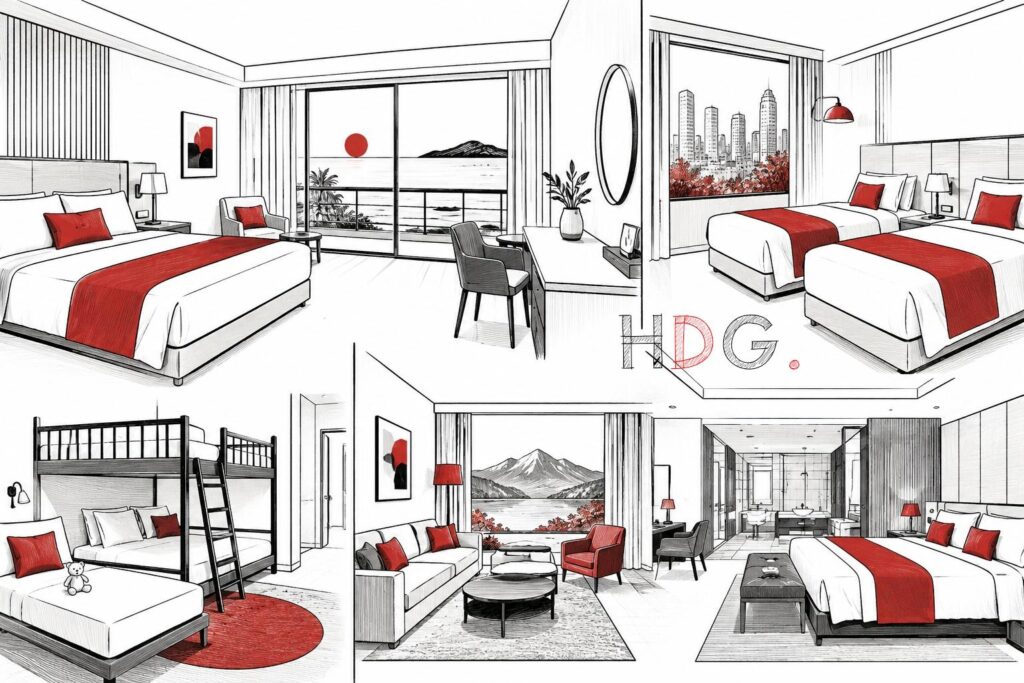
Hotel Room Types by Bed Configuration
The most widely recognised method of classifying hotel room types is by bed configuration. This approach provides guests with an immediate understanding of the sleeping arrangements available and remains the foundation of room categorisation across hotel websites, online travel agencies, global distribution systems and property management platforms.
Although bed configuration appears straightforward, terminology is not always applied consistently throughout the hospitality industry. A room described as a Double Room in one hotel may contain a queen-size bed, while another property may market an almost identical room as a Queen Room. International differences can further complicate matters, as bed dimensions vary between countries and hotel brands. As a result, many hotels now provide both the room category and the specific bed type to avoid confusion and improve booking confidence.
Single Rooms are designed primarily for one guest and usually contain a single bed. They remain common in many European and Asian markets, particularly within budget hotels, city-centre properties and accommodation aimed at solo travellers. However, in North America and some newer hotel developments, single rooms have become less common as larger guestrooms can often accommodate multiple market segments more efficiently.
Double Rooms are intended for two guests sharing a single bed and remain one of the most common hotel room types worldwide. Depending on the hotel’s standards, the room may contain a double, queen or king-size bed. Twin Rooms, by contrast, feature two separate beds and are particularly popular with corporate travellers, conference delegates, tour groups and friends travelling together.
Queen Rooms and King Rooms have become increasingly important as hotels seek to differentiate their accommodation offering. Queen Rooms generally provide comfortable accommodation for couples and individual travellers, while King Rooms are often positioned as a premium category due to the larger sleeping area and enhanced guest comfort. In many hotels, the difference in construction cost between a queen and king room is relatively modest, yet the perceived value to guests allows operators to achieve higher room rates.
Larger occupancy categories include Triple Rooms, Quad Rooms and Family Rooms. These hotel room types are particularly important in leisure destinations, family resorts and extended-stay accommodation. By accommodating three, four or more guests within a single room, hotels can improve occupancy efficiency while providing a more economical solution for families and groups travelling together.
Typical Hotel Room Types by Bed Configuration
The table below summarises the most common hotel room types by bed configuration. While terminology can vary between countries and hotel brands, these categories provide a useful starting point for understanding how guestrooms are typically organised and marketed throughout the hospitality industry.
| Room Type | Typical Occupancy | Typical Bed Arrangement |
|---|---|---|
| Single Room | 1 Guest | Single Bed |
| Double Room | 2 Guests | One Double Bed |
| Twin Room | 2 Guests | Two Single Beds |
| Queen Room | 2 Guests | One Queen Bed |
| King Room | 2 Guests | One King Bed |
| Triple Room | 3 Guests | Various Configurations |
| Quad Room | 4 Guests | Various Configurations |
| Family Room | 3-6 Guests | Mixed Bed Types |
While bed configuration remains the most familiar method of classifying hotel room types, it rarely tells the complete story. Two rooms with identical bed arrangements may command significantly different rates due to their size, location within the building, level of finish or range of amenities. This has led hotels to develop additional classification systems based on quality and positioning.
Hotel Room Types by Quality and Positioning
Beyond sleeping arrangements, many hotel room types are classified according to their quality level, location within the property and the range of facilities provided. These classifications form the foundation of a hotel’s pricing structure and create opportunities for operators to increase revenue through upgrades and upselling.
The Standard Room represents the baseline accommodation category in most hotels. Standard rooms typically offer the property’s core amenities and account for the largest proportion of inventory. Although the term may sound basic, the actual quality of a standard room varies considerably between hotel segments. A standard room in an economy hotel may offer only essential furnishings and services, while a standard room in a luxury hotel may already provide a high level of comfort and sophistication.
Superior Rooms occupy the next tier within the accommodation hierarchy. In many cases, the differences between standard and superior accommodation are subtle rather than dramatic. Superior rooms may provide additional floor space, a more desirable location within the building, improved views or upgraded furnishings. From a development perspective, superior rooms often represent an attractive opportunity because relatively small increases in construction cost can generate meaningful improvements in room revenue.
Deluxe Rooms typically offer a more noticeable enhancement of the guest experience. These hotel room types frequently feature larger bathrooms, higher-quality finishes, premium bedding, upgraded technology and improved views. Deluxe accommodation is particularly common in upscale and luxury hotels, where guests expect greater levels of comfort and differentiation between room categories.
Executive Rooms and Club Rooms are designed primarily for business travellers and higher-spending guests. These categories often include access to executive lounges, private check-in facilities, complimentary refreshments, meeting spaces and enhanced service levels. For hotel owners, executive and club accommodation can be highly attractive because many of the benefits are operational rather than physical, allowing hotels to generate significant rate premiums without substantial increases in construction cost.
Premium Rooms generally represent the highest category of standard accommodation before guests move into suite classifications. These rooms often combine superior locations, larger floor areas, enhanced amenities and the most desirable views available within the hotel’s standard inventory. They serve as an important bridge between traditional guestrooms and suite accommodation, helping hotels maximise revenue opportunities across multiple price points.
| Room Category | Typical Position | Common Characteristics | Typical Rate Index* |
|---|---|---|---|
| Standard Room | Entry Level | Essential amenities, standard location, largest inventory category | 100 |
| Superior Room | Above Standard | Slightly larger guestrooms, improved location or better views | 105-115 |
| Deluxe Room | Upper Mid-Tier | Enhanced finishes, upgraded bathrooms, premium amenities | 115-135 |
| Executive Room | Business-Focused Premium | Enhanced workspace, executive facilities, often includes lounge access | 125-150 |
| Club Room | Upscale Premium | Executive lounge privileges, food and beverage benefits, personalised service | 135-170 |
| Premium Room | Highest Standard Room Category | Prime location, larger floor area, superior furnishings and views | 140-180 |
| Junior Suite | Entry-Level Suite | Larger open-plan accommodation with sleeping and living areas | 160-220 |
| One-Bedroom Suite | Premium Suite | Separate bedroom and living room, greater privacy and flexibility | 220-350+ |
For developers and investors, understanding these quality-based hotel room types is essential when determining a property’s market positioning. A carefully structured room hierarchy enables hotels to appeal to a broader range of guests while creating multiple opportunities for upselling throughout the booking journey.
Hotel Suite Types
Suites represent the highest-value accommodation within most hotels and play a disproportionately important role in overall revenue generation. Although suites typically account for a relatively small percentage of total room inventory, they often contribute a significant share of room revenue and help establish a hotel’s reputation within the marketplace.
The simplest suite category is the Junior Suite. Unlike a standard guestroom, a junior suite provides a larger open-plan layout that incorporates both sleeping and living areas within a single space. The sleeping area may be visually separated through furniture placement, changes in floor level or partial partitions, creating a greater sense of spaciousness without requiring a completely separate room. Junior suites are particularly popular in upscale hotels because they provide guests with a taste of luxury while remaining affordable compared with larger suite categories.
One-Bedroom Suites offer a more substantial upgrade. These accommodations feature a completely separate bedroom and living room, providing greater privacy and functionality. One-bedroom suites are attractive to both leisure and business travellers, particularly those staying for longer periods or requiring space for informal meetings and entertaining guests. From an operational perspective, they often achieve significantly higher room rates than standard guestrooms while maintaining strong occupancy levels.
Executive Suites are specifically designed for senior corporate travellers, diplomats, consultants and other guests who require a combination of luxury and functionality. In addition to separate sleeping and living areas, executive suites frequently include larger workspaces, meeting facilities and upgraded technology. In city-centre business hotels, executive suites often represent one of the most profitable accommodation categories.
At the top of the hierarchy are Presidential Suites and Penthouse Suites. These accommodations are designed not only as guestrooms but also as statements of prestige and exclusivity. Presidential Suites frequently include multiple bedrooms, dining rooms, entertainment spaces, private kitchens and dedicated service areas. Penthouse Suites, usually located on the highest floors of a hotel, often provide panoramic views, private terraces and exceptional levels of privacy.
Many luxury hotels also incorporate speciality suites designed around particular themes, experiences or local cultural influences. These unique accommodations can become powerful marketing tools, generating media attention, supporting premium pricing and strengthening the property’s brand identity. Rather than simply offering larger accommodation, these suites provide guests with a deeper connection to the destination and a more memorable stay experience.
Wine regions often provide good examples of this approach. In Bordeaux, Tuscany and Napa Valley, luxury hotels may create signature suites inspired by local vineyards, wine estates or grape varieties, incorporating regional artwork, wine collections and curated tasting experiences. Similarly, heritage hotels frequently draw upon local history and culture, with suites themed around notable historical figures, artists, writers or architectural traditions associated with the destination.
Typical Hotel Suite Types
| Suite Type | Typical Layout | Typical Guest Profile | Typical Rate Index* |
|---|---|---|---|
| Junior Suite | Open-plan sleeping and living areas within a larger room | Leisure travellers, couples, short stays | 160-220 |
| One-Bedroom Suite | Separate bedroom and living room | Extended-stay guests, families, business travellers | 220-350 |
| Executive Suite | Separate bedroom, living room and enhanced workspace | Senior executives, consultants, VIP corporate travellers | 250-400 |
| Two-Bedroom Suite | Two bedrooms with shared living space | Families, groups, longer stays | 300-500 |
| Presidential Suite | Multiple bedrooms, dining and entertainment areas | VIPs, celebrities, diplomatic guests | 500-1,000+ |
| Penthouse Suite | Premium top-floor accommodation, often with terrace or exceptional views | Luxury leisure travellers, special occasions, high-net-worth guests | 500-1,000+ |
For hotel developers, suite planning requires careful balance. While suites command substantial premiums and enhance a hotel’s image, they also require significantly larger floor areas and higher development costs. Determining the correct suite mix is therefore one of the most important decisions during hotel planning, influencing both project economics and long-term market positioning.
These sections lend themselves quite well to a mixture of explanatory text and one summary table each.
Hotel Room Types by View
For many hotels, particularly resorts and destination properties, the view from a guestroom can be one of the most important factors influencing room rates and guest satisfaction. Two guestrooms with identical layouts, furnishings and amenities may command significantly different prices simply because of what guests see when they look out of the window or step onto a balcony.
Hotels have long recognised the value of desirable views and frequently structure their room categories around them. Sea views, oceanfront locations, mountain vistas and iconic city skylines often justify substantial rate premiums, particularly during peak travel periods. In some destinations, the view itself may be the primary reason a guest chooses a particular hotel.
From a hotel development perspective, view classifications can have significant implications during the design stage. Architects and planners often seek to maximise the number of guestrooms benefiting from premium views, as relatively minor adjustments to building orientation or floorplate design can have a major impact on long-term revenue performance. Revenue managers subsequently use these classifications to create pricing differentials that reflect market demand.
While terminology is widely used throughout the industry, the precise definitions are not always standardised. For example, a Sea View Room may only offer a partial glimpse of the water, whereas an Oceanfront Room generally implies an unobstructed outlook directly facing the sea. Understanding these distinctions is important for both guests and hotel operators.
Typical Hotel Room Types by View
| View Type | Typical Description | Typical Guest Appeal | Typical Rate Index* |
|---|---|---|---|
| No Specific View | Internal, courtyard or urban outlook | Budget-conscious travellers | 100 |
| City View | Urban skyline, streetscape or landmark views | Business and city-break travellers | 105-120 |
| Garden View | Landscaped gardens and green spaces | Leisure travellers seeking a quieter setting | 105-125 |
| Pool View | Direct outlook over swimming pools and recreation areas | Families and resort guests | 110-130 |
| Mountain View | Scenic mountain or countryside vistas | Resort and nature-based tourism | 115-140 |
| Sea View | Partial or direct sea views | Leisure and resort travellers | 120-160 |
| Oceanfront | Unobstructed seafront location | Premium leisure travellers | 140-200 |
| Beachfront | Direct access and views of the beach | Resort guests and families | 150-220 |
Not all views generate equal value. In city-centre hotels, iconic landmarks such as the Eiffel Tower in Paris, the Bosphorus in Istanbul or Central Park in New York can command exceptionally high premiums. Similarly, resort properties often find that sea-facing accommodation significantly outperforms inland-facing rooms, particularly during peak holiday seasons.
As competition increases, many hotels have developed increasingly sophisticated view categories, including Harbour View, Marina View, Sunset View, Lagoon View and Golf Course View rooms. These classifications allow operators to capture additional value from desirable locations while giving guests greater choice during the booking process.
Hotel Room Types by Location Within the Hotel
In addition to bed configuration, quality level and view, many hotels classify guestrooms according to their physical location within the property. While these distinctions may appear subtle, room location can significantly influence guest satisfaction, operational efficiency and revenue potential.
Certain locations are naturally more desirable than others. Higher floors often provide improved views, reduced noise and a greater sense of privacy. Corner rooms may benefit from additional windows, more natural light and larger floor areas. Conversely, some guests may specifically request ground-floor accommodation for ease of access or proximity to hotel facilities.
Hotels frequently use location-based room categories to create additional pricing tiers without substantially increasing development costs. A high-floor room, for example, may command a premium despite being physically identical to the same room type located several floors below. This approach has become increasingly common as hotels adopt more sophisticated revenue management strategies.
Location-based classifications are also important for meeting the needs of specific market segments. Families may prefer connecting rooms, while guests with mobility requirements depend upon accessible accommodation designed in accordance with local regulations and universal design principles. In resort developments, entirely separate accommodation forms such as villas, bungalows and pavilions may be distinguished primarily by their location and relationship to the surrounding environment.
Typical Hotel Room Types by Location
| Room Type | Typical Location | Key Characteristics | Typical Rate Index* |
|---|---|---|---|
| Ground Floor Room | Lower levels of the hotel | Easy access, often near public facilities | 95-110 |
| High Floor Room | Upper floors | Better views, greater privacy, reduced noise | 105-130 |
| Corner Room | Building corners | Additional windows, more natural light, often larger | 110-140 |
| Connecting Room | Adjacent guestrooms with internal connecting door | Popular with families and groups | 100-120 |
| Adjoining Room | Adjacent rooms without connecting door | Convenient for groups travelling together | 100-115 |
| Accessible Room | Various locations throughout the hotel | Enhanced accessibility and universal design features | 100 |
| Villa | Separate structure within resort grounds | Greater privacy, larger living areas | 200-500+ |
| Bungalow | Detached or semi-detached low-rise accommodation | Resort-style experience, often garden setting | 150-350 |
| Pavilion | Standalone luxury accommodation | Strong connection to landscape and privacy | 250-600+ |
For developers, location-based room classifications often represent one of the most effective ways to maximise the value of a hotel’s physical layout. By carefully considering building orientation, circulation patterns and guest preferences during the design stage, operators can create multiple accommodation categories from otherwise similar guestrooms.
This principle is particularly evident in luxury resorts, where villas, pavilions and bungalows may command several times the room rate of standard guestrooms despite sharing many of the same operational services. In these cases, privacy, exclusivity and connection to the surrounding environment become key drivers of value, often outweighing differences in room size or amenities.
Apartment and Extended-Stay Accommodation
While traditional hotel room types are generally designed for short-term stays, a growing segment of the hospitality industry focuses on guests who require accommodation for weeks, months or even years. This demand has driven the expansion of apartment-style guestrooms, serviced residences and extended-stay hotel concepts that combine the flexibility of a hotel with many of the practical features of a private home.
Extended-stay accommodation has become increasingly popular among corporate travellers, project teams, relocating employees, digital nomads and guests undertaking long-term medical treatment or education programmes. Unlike conventional hotel rooms, these units are designed to support daily living rather than simply overnight accommodation. Features such as kitchenettes, dining areas, larger wardrobes, laundry facilities and dedicated workspaces become increasingly important as the length of stay increases.
For hotel developers, apartment-style accommodation can offer several advantages. Guests staying for extended periods typically generate lower housekeeping and front-office costs per occupied room night while often providing more stable occupancy throughout the year. Extended-stay properties may also be less vulnerable to seasonal fluctuations than traditional leisure-focused hotels.
The boundaries between hotels, serviced apartments and residential accommodation have become increasingly blurred. Many modern developments combine several accommodation formats within a single project, allowing operators to serve a wider range of market segments while maximising asset flexibility.
Typical Apartment and Extended-Stay Accommodation Types
| Accommodation Type | Typical Length of Stay | Key Characteristics | Typical Guest Profile |
|---|---|---|---|
| Studio Room | Short to Medium Stay | Open-plan living and sleeping area, often with kitchenette | Solo travellers, business guests |
| Studio Apartment | Medium to Long Stay | Larger living space with cooking facilities | Corporate travellers, relocations |
| Serviced Apartment | Medium to Long Stay | Fully equipped apartment with hotel-style services | Extended-stay business travellers |
| One-Bedroom Apartment | Medium to Long Stay | Separate bedroom and living area | Couples, project teams |
| Residence Unit | Long Stay | Residential-style accommodation with hotel services | Relocations, expatriates |
| Extended-Stay Suite | Medium to Long Stay | Hotel suite adapted for longer occupancy | Corporate and leisure guests |
| Aparthotel Unit | Flexible | Hybrid hotel-apartment model | Business and leisure travellers |
The growth of remote working and flexible lifestyles has further strengthened demand for these accommodation types. Many guests now combine business and leisure travel, resulting in longer average stays and increased demand for units that offer greater comfort and functionality than traditional hotel rooms.
From a development perspective, the rise of extended-stay accommodation has created opportunities for mixed-use projects that combine hotel rooms, serviced apartments and residential units within a single development. This approach can diversify revenue streams, reduce operating risk and improve overall asset utilisation throughout changing market cycles.
Resort and Luxury Accommodation Types
Resort and luxury developments frequently extend beyond the traditional guestroom model to offer a wider range of accommodation styles. In these properties, the accommodation itself often becomes a central component of the guest experience rather than simply a place to sleep. Privacy, exclusivity, space and connection to the surrounding environment frequently become more important than conventional room classifications.
Many luxury resorts have developed specialised accommodation categories that allow guests to enjoy unique experiences while enabling operators to command substantial rate premiums. In some cases, these accommodation types become iconic features of the destination and major drivers of marketing exposure.
The growth of experiential travel has accelerated demand for distinctive accommodation concepts. Guests increasingly seek memorable environments that reflect local culture, natural surroundings or unique architectural design. As a result, many luxury hotels have shifted away from standardised room products towards accommodation that offers a stronger sense of place and individuality.
For developers, these accommodation types often require higher construction costs and larger land allocations. However, they can also generate significantly higher room rates and strengthen a property’s competitive positioning within the luxury market.
Typical Resort and Luxury Accommodation Types
| Accommodation Type | Typical Setting | Key Characteristics | Typical Rate Index* |
|---|---|---|---|
| Villa | Resort Grounds | Detached accommodation with enhanced privacy and space | 200-500+ |
| Pool Villa | Resort Grounds | Private swimming pool and outdoor living areas | 300-700+ |
| Beach Villa | Coastal Resorts | Direct beach access and sea views | 300-800+ |
| Overwater Villa | Tropical Destinations | Accommodation constructed over water | 500-1,500+ |
| Pavilion | Luxury Resorts | Standalone structure integrated with landscape | 250-600+ |
| Bungalow | Resort Developments | Detached or semi-detached low-rise accommodation | 150-350+ |
| Chalet | Mountain Resorts | Traditional alpine-style accommodation | 200-600+ |
| Safari Tent | Safari Lodges | Permanent luxury tented accommodation | 250-700+ |
| Treehouse Suite | Nature Resorts | Elevated accommodation within natural surroundings | 300-800+ |
| Cave Room | Heritage and Unique Hotels | Accommodation integrated into natural rock formations | 250-700+ |
Several of these accommodation types have become synonymous with particular destinations. Overwater villas are strongly associated with the Maldives and French Polynesia, while luxury safari tents have become a defining feature of many African safari lodges. Cave hotels in Cappadocia, Türkiye, treehouse resorts in tropical destinations and alpine chalets in mountain regions all demonstrate how accommodation can become an integral part of the destination experience itself.
Luxury hotel brands increasingly focus on creating accommodation that reflects local culture and geography rather than replicating a standardised global design. Aman, Six Senses, Soneva and other leading luxury operators have demonstrated that guests are often willing to pay significant premiums for accommodation that delivers authenticity, privacy and a strong connection to the surrounding environment.
For hotel developers, these specialised accommodation types offer opportunities to create genuine points of differentiation. While construction costs may be higher than traditional guestrooms, the ability to command premium rates and generate stronger marketing appeal can often justify the additional investment, particularly in resort and leisure destinations where the guest experience plays a central role in purchase decisions.
Guestroom Design Efficiency and Space Planning
Room Economics and Building Efficiency
Guestrooms typically represent between 65% of the total built area in luxury hotels and up to 85% in budget hotels. As guestrooms also generate the largest share of hotel revenue and operating profit, their design has a disproportionate influence on both project economics and operational performance. Decisions relating to room dimensions, layouts and building efficiency therefore have a far greater impact on a hotel’s financial performance than their modest size might initially suggest.
Room dimensions are particularly important because any increase or decrease is multiplied across the entire room inventory. A reduction of only a few square metres per room can significantly reduce overall development costs when applied across hundreds of guestrooms. Conversely, rooms that are too small may feel restrictive or overcrowded, offer limited flexibility in furniture layouts, create operational challenges for housekeeping staff and increase wear and tear on finishes, fixtures and furniture.
Circulation and Planning Efficiency
Developers must also consider the efficiency of circulation space. Corridors, lift lobbies, stairwells, service rooms, vertical shafts and building services infrastructure typically account for between 25% and 35% of a hotel’s gross built area. The relationship between guestroom dimensions and circulation efficiency is therefore one of the most important aspects of hotel planning. A wider room may improve guest comfort and marketability, but it can also reduce the number of guestrooms accommodated on each floor, increase corridor lengths and require greater external wall areas, all of which can increase development costs.
The challenge for hotel designers is to balance guest comfort, operational efficiency and development economics. Achieving this balance requires careful consideration of room proportions, structural modules, service distribution, circulation patterns and furniture layouts. Even small design adjustments can have significant consequences when repeated across an entire hotel.
Standardisation and Structural Planning
The hotel industry has traditionally favoured standardisation because it creates efficiencies throughout both construction and operations. Repetitive room modules simplify structural design, facilitate prefabrication, improve construction productivity and support consistent quality standards. Standardisation also benefits operations through simplified housekeeping procedures, bulk purchasing of furniture and equipment, streamlined maintenance programmes and more efficient replacement of fixtures and fittings.
In multi-storey hotels, guestrooms are frequently designed around repetitive structural grids and service modules. This allows vertical risers, plumbing stacks and ductwork to align throughout the building, reducing construction complexity and improving long-term maintainability. Variations in room size are often concentrated at corners, building junctions and premium locations where suites and speciality accommodation can be introduced without disrupting the overall building module.
Functional Zones
Guestrooms are typically organised into several functional zones. These include sleeping, lounging, working, dressing, luggage storage, bathroom and circulation areas. Effective design seeks to maximise overlap between these zones, allowing a relatively compact space to support multiple functions while maintaining comfort and ease of use.
The sleeping area should ideally be positioned away from the entrance and circulation routes, while workspaces benefit from natural daylight and views where possible. Luggage storage is usually located near the entrance for convenience, while bathrooms are generally positioned internally to facilitate servicing and reduce noise transmission. Successful guestroom design balances these different functions while maintaining flexibility for both guests and housekeeping staff.
Typical Guestroom Functional Zones
| Zone | Typical Design Considerations |
|---|---|
| Sleeping Area | Quiet location, privacy, bedside access |
| Lounge / Day-Use Area | Natural light, views, flexible furniture |
| Work Area | Desk space, power outlets, daylight |
| Dressing Area | Good lighting, mirrors, storage |
| Luggage Storage | Convenient access near entrance |
| Bathroom | Efficient servicing, noise separation |
| Circulation Space | Comfortable movement and housekeeping access |
Room Widths and Proportions
As a general rule, hotel guestrooms should maximise the benefit obtained from external walls, natural daylight and views. The width of a guestroom is therefore often considered the most critical planning dimension.
A minimum practical room width is approximately 3.0 metres, although this can result in long, narrow rooms that are difficult to furnish efficiently. Standard hotel guestrooms are typically based on widths of around 3.5 to 3.75 metres, allowing comfortable furniture layouts and adequate circulation space. Luxury guestrooms frequently exceed 4.0 metres in width, creating a more spacious feel and greater flexibility in furniture arrangements. Suites generally require substantially greater widths, often exceeding 6.0 metres, to accommodate separate sleeping and living areas.
Indicative Guestroom Widths
| Accommodation Type | Typical Width |
|---|---|
| Minimum Practical Guestroom | 3.0 m |
| Standard Guestroom | 3.5 – 3.75 m |
| Luxury Guestroom | 4.0 – 4.2 m |
| Suite | 6.0 m + |
Room Lengths and Areas
Room depth and overall floor area are generally more flexible than room width and are often influenced by site constraints, structural grids and market positioning. The layout must accommodate sleeping, working and day-use functions while maintaining sufficient circulation space and access to natural light.
Budget hotels may operate successfully with guestrooms of around 20 m², while midscale hotels typically offer approximately 25 m². Upscale and luxury hotels frequently exceed 30 m², while suites can range from 50 m² to several hundred square metres depending on market positioning.
Indicative Guestroom Dimensions
| Hotel Segment | Overall Area (m²) | Typical Width (m) |
|---|---|---|
| Budget Hotel | 20 | 3.5 |
| Midscale Hotel | 25 | 3.6 |
| Upscale Hotel | 34 | 3.9 |
| Suite | 50+ | 6.0+ |
Ceiling Heights and Spatial Perception
Ceiling heights are closely related to room proportions and have a significant influence on guest perception. While floor area is often the primary focus during hotel planning, ceiling height can greatly affect the sense of openness and quality within a room.
Typical ceiling heights over sleeping and living areas are around 2.5 metres, with an absolute minimum of approximately 2.3 metres. In warmer climates, ceiling heights of around 3.0 metres are often preferred to improve air circulation and create a greater sense of space. Bathrooms and entrance lobbies are frequently lowered to accommodate air-conditioning ductwork, extraction systems and other building services.
Indicative Ceiling Heights
| Area | Typical Height |
|---|---|
| Guestroom Sleeping and Living Area (Minimum) | 2.3 m |
| Guestroom Sleeping and Living Area (Typical) | 2.5 m |
| Guestroom Sleeping and Living Area (Preferred in Hot Climates) | 3.0 m |
| Bathroom and Entrance Lobby (Minimum) | 2.2 m |
Accessibility and Universal Design
Accessible guestrooms have become an essential component of modern hotel design and are increasingly viewed as a fundamental aspect of hospitality rather than a specialist accommodation category. While accessibility requirements are often driven by building regulations and brand standards, well-designed accessible accommodation also expands a hotel’s potential customer base and improves the guest experience for a wide range of travellers.
Historically, accessible rooms were developed primarily to accommodate wheelchair users and guests with mobility impairments. Today, the concept has broadened significantly through the adoption of universal design principles, which aim to create environments that can be used comfortably and independently by as many people as possible, regardless of age or ability.
Accessible guestrooms typically incorporate wider doorways, barrier-free circulation routes, roll-in showers, grab rails, lowered controls and accessible furniture layouts. Many hotels also provide visual alarms, hearing assistance systems and other features designed to support guests with sensory impairments. Increasingly, accessibility considerations are being integrated throughout the guest journey, from online booking systems and public areas to guestrooms and recreational facilities.
From a development perspective, accessible rooms require careful planning during the design stage. Retrofitting accessibility features can be costly and operationally disruptive, whereas incorporating universal design principles from the outset often results in more efficient and flexible accommodation. Many modern hotel brands have moved beyond minimum regulatory compliance and now view accessibility as an important component of guest satisfaction and corporate responsibility.
Importantly, accessible rooms should not be viewed solely as a compliance requirement. Older travellers, multi-generational families, guests recovering from injury and travellers with temporary mobility limitations may all benefit from accessible design features. As populations continue to age in many markets, demand for accessible accommodation is expected to increase steadily.
Typical Accessibility and Universal Design Features
| Feature | Purpose | Typical Benefit |
|---|---|---|
| Step-Free Access | Eliminates level changes and barriers | Improved accessibility for wheelchair users, luggage and strollers |
| Wider Doorways | Allows wheelchair and mobility aid access | Greater ease of movement |
| Roll-In Shower | Barrier-free shower access | Improved safety and independence |
| Grab Rails | Additional support in bathrooms | Enhanced stability and safety |
| Accessible Controls | Lowered switches and controls | Easier operation for all guests |
| Visual Alarm Systems | Visual alerts for emergencies | Support for guests with hearing impairments |
| Hearing Assistance Systems | Enhanced communication technologies | Improved accessibility for hearing-impaired guests |
| Universal Design Features | Flexible layouts benefiting all users | Greater comfort and usability for a wider range of travellers |
As guest expectations evolve, accessibility is increasingly becoming a component of overall quality rather than a separate category of accommodation. Hotels that successfully embrace universal design principles often improve usability, comfort, and inclusivity for all guests while strengthening their market appeal and long-term resilience.
Development and Operational Implications of Hotel Room Types
Selecting hotel room types is not simply a marketing decision. Every room category has implications for development costs, operating efficiency, staffing requirements, maintenance programmes and long-term asset value. During the planning stage of a hotel project, developers must therefore consider not only guest preferences and revenue opportunities, but also the financial and operational consequences of different accommodation formats.
One of the most immediate considerations is room size. Larger guestrooms, suites and villas require more construction materials, larger structural footprints and increased mechanical and electrical infrastructure. Although premium accommodation categories can command higher room rates, they also reduce the total number of keys that can be accommodated within a given building envelope. Developers must therefore carefully evaluate whether additional revenue potential justifies the loss of overall room inventory.
The impact of room type extends beyond the guestrooms themselves. Certain accommodation categories can significantly influence the overall efficiency of a hotel’s floorplate and circulation design. For example, hotels seeking to maximise the number of sea view rooms may adopt single-loaded corridor layouts, where guestrooms are positioned on only one side of a corridor. While this can increase the proportion of rooms benefiting from premium views, it also increases circulation space requirements and can substantially reduce net-to-gross efficiency. In many cases, achieving a higher percentage of premium-view accommodation requires a larger building footprint and higher capital expenditure.
Similarly, villas, pavilions and bungalow-style accommodation typically require significantly more land area per key than conventional guestrooms. Although these units often command substantial rate premiums, infrastructure costs for roads, pathways, landscaping, utilities and maintenance access can increase considerably compared with more compact hotel configurations.
Typical Development Implications of Different Room Types
| Room Type | Development Implications | Potential Impact on Capital Cost |
|---|---|---|
| Standard Guestroom | Efficient floorplates and circulation | Low |
| Deluxe Room | Larger room sizes and upgraded finishes | Low to Moderate |
| Suite | Increased floor area and reduced keys per floor | Moderate to High |
| Executive / Club Room | Limited physical impact, enhanced service requirements | Low to Moderate |
| Sea View Accommodation | Building orientation and premium frontage requirements | Moderate |
| Single-Loaded Corridor Layout | Reduced efficiency and increased circulation area | Moderate to High |
| Villa / Pavilion | Larger site requirements and infrastructure needs | High |
| Overwater Villa | Complex engineering and specialised construction | Very High |
Operational considerations are equally important. Larger rooms and suites generally require longer housekeeping times, increasing labour costs and potentially reducing the number of guestrooms that can be serviced by each room attendant during a shift. While a standard guestroom may be cleaned relatively quickly due to its consistent layout and furnishings, luxury suites often contain multiple rooms, additional bathrooms, dining areas and larger quantities of furniture and decorative items.
Specialised accommodation concepts can introduce further operational complexity. Wellness rooms may incorporate advanced air purification systems, specialist mattresses or fitness equipment that require additional maintenance and periodic replacement. Family rooms often contain bunk beds, games equipment or child-focused amenities that increase wear and tear. Smart rooms introduce additional technology infrastructure that must be maintained, updated and occasionally replaced.
Luxury villas and premium suites frequently contain high-value furniture, bespoke fittings, artwork and specialist finishes. These features may require dedicated cleaning procedures, specialist contractors or more frequent maintenance interventions. In some cases, replacement costs for custom-designed furnishings can be significantly higher than for standardised guestroom furniture.
Typical Operational Implications of Different Room Types
| Room Type | Operational Considerations | Relative Operating Cost |
|---|---|---|
| Standard Guestroom | Standardised cleaning and maintenance procedures | Low |
| Deluxe Room | Larger area and upgraded furnishings | Low to Moderate |
| Suite | Longer cleaning times and increased maintenance requirements | Moderate |
| Family Room | Higher wear and tear, additional furniture and equipment | Moderate |
| Wellness Room | Specialist equipment and maintenance regimes | Moderate to High |
| Smart Room | Technology maintenance and software updates | Moderate |
| Villa / Pavilion | Separate servicing requirements and infrastructure maintenance | High |
| Presidential Suite | Extensive cleaning, maintenance and replacement costs | Very High |
The standardisation of guestrooms can also have a significant impact on operational efficiency. Hotels that minimise variation between room layouts often achieve faster housekeeping times, simpler maintenance procedures and more efficient staff training. Conversely, highly customised accommodation may enhance the guest experience but can increase operational complexity throughout the life of the asset.
Successful hotel development therefore requires balancing revenue opportunities against both capital and operating costs. The most profitable room category is not necessarily the one that commands the highest room rate, but rather the one that delivers the strongest long-term return on investment after considering development expenditure, operating costs, maintenance requirements and market demand. Understanding these trade-offs is one of the most important aspects of hotel planning and asset management.
Emerging Hotel Room Concepts
Guest expectations continue to evolve, and many hotels are responding by creating specialised room categories designed around specific lifestyles, interests and travel behaviours. While traditional hotel room types remain important, modern travellers increasingly seek accommodation that supports wellness, remote working, family experiences, sustainability and personal interests. As a result, innovative room concepts have become an important source of differentiation and revenue growth.
Unlike traditional classifications based on bed configuration, size or view, these emerging room types focus on the experience delivered to the guest. In many cases, the physical differences between these rooms and standard accommodation may be relatively modest. However, specialised amenities, technology, design features and curated services allow hotels to target specific market segments while commanding premium rates.
The growth of wellness tourism provides a good example. Wellness-focused guestrooms may incorporate enhanced air filtration, circadian lighting systems, premium mattresses, yoga equipment and sleep-enhancing technologies. Rather than simply providing accommodation, these rooms are designed to support physical and mental wellbeing throughout the stay.
Similarly, the rapid growth of remote and hybrid working has created demand for guestrooms that function as productive workspaces. Workcation rooms often feature larger desks, ergonomic seating, enhanced connectivity, video conferencing facilities and flexible layouts that accommodate both work and leisure activities.
Technology is also playing an increasingly important role. Smart Rooms allow guests to control lighting, temperature, entertainment systems and window coverings through mobile applications or voice commands. These technologies not only improve the guest experience but can also contribute to energy efficiency and operational savings.
Typical Emerging Hotel Room Concepts
| Room Concept | Key Features | Typical Guest Profile | Typical Rate Index* |
|---|---|---|---|
| Wellness Room | Enhanced air quality, sleep systems, fitness and wellness amenities | Wellness-focused travellers | 120-180 |
| Sleep Tourism Room | Advanced sleep technology, soundproofing, circadian lighting | Health-conscious guests | 130-220 |
| Smart Room | Integrated technology and automated controls | Tech-savvy travellers | 110-160 |
| Workcation Room | Enhanced workspace and connectivity | Remote workers and business travellers | 115-170 |
| Pet-Friendly Room | Pet amenities and specialised cleaning standards | Travellers with pets | 105-150 |
| Family Experience Room | Child-friendly layouts and themed features | Families | 110-180 |
| Eco Room | Sustainable materials and energy-efficient systems | Environmentally conscious travellers | 105-150 |
| Gaming Room | High-performance gaming equipment and entertainment systems | Younger leisure travellers | 120-180 |
Many of these concepts remain niche products today, but they illustrate an important shift within the hospitality industry. Hotels are increasingly moving away from selling rooms solely on size or location and towards selling experiences tailored to specific guest needs. This trend is expected to accelerate as operators adopt more personalised approaches to accommodation design and revenue management.
For developers, the challenge is determining which concepts genuinely support long-term demand and which represent short-term trends. Successful room concepts are usually those that address a clearly identifiable guest need while generating measurable revenue premiums that justify the additional investment required.
Revenue Management and Room Type Strategy
Creating Revenue Opportunities Through Room Segmentation
Hotel room types play a central role in revenue management. While guests often view room categories simply as different accommodation options, revenue managers see them as inventory segments that can be priced, packaged and sold to different customer groups. The number, variety and structure of room types within a hotel can therefore have a significant influence on revenue performance.
A well-designed room hierarchy allows hotels to target multiple market segments simultaneously. Standard rooms may appeal to price-sensitive travellers, while upgraded rooms, suites and specialty accommodation can be marketed to higher-spending guests seeking additional space, privacy or exclusive amenities. This layered approach enables hotels to capture a broader range of demand without necessarily changing the physical product.
Room type variety can also provide flexibility when managing group business. Corporate groups, conferences, government delegations, sports teams and diplomatic visitors often require accommodation across several price levels and room categories. A hotel with a balanced range of room types can more easily accommodate these requirements while maintaining pricing integrity. For example, senior executives may occupy suites or executive rooms, while support staff and delegates are accommodated in standard guestrooms.
The Risks of Excessive Room Type Variation
However, increasing the number of room categories is not always beneficial. Excessive room type variation can create operational complexity and make inventory management more difficult. This is particularly true in smaller hotels where only a limited number of guestrooms exist within each category. If a hotel creates too many room types, individual categories may contain only a handful of rooms, reducing the revenue manager’s ability to optimise pricing and inventory allocation.
From the guest perspective, too many room types can also create confusion. Travellers may struggle to understand the differences between Standard, Superior, Deluxe, Premium, Executive and Club categories if the distinctions are not immediately obvious. Rather than increasing conversion rates, an overly complicated room structure can lead to uncertainty and booking abandonment. In these situations, hotels effectively find themselves educating guests about room categories before they can complete the sale.
Demand Patterns and Upgrade Challenges
Revenue managers must also consider booking patterns across the room hierarchy. In many markets, demand naturally builds from the bottom up, with lower-priced room categories selling first. Standard guestrooms often achieve the highest occupancy levels because they appeal to the broadest range of customers. Premium suites and specialty accommodation, while important for profitability and brand positioning, frequently represent a much smaller share of total demand.
This creates a common challenge. Hotels with excessive premium inventory may find themselves upgrading guests into larger or higher-category accommodation simply to maximise occupancy. While upgrades can enhance guest satisfaction, they may also increase operating costs and create unrealistic expectations for future stays. Larger rooms generally cost more to clean, maintain and furnish, meaning that the revenue benefit of filling an otherwise empty suite may be lower than it first appears.
For this reason, the most profitable room mix is not necessarily the one with the highest proportion of premium accommodation. Revenue managers must carefully balance occupancy, average daily rate (ADR), operating costs and long-term demand patterns when determining the most appropriate room hierarchy.
The Impact of Attribute-Based Selling (ABS)
The growth of Attribute-Based Selling (ABS) may gradually change how hotels approach room categories. Rather than relying on an extensive hierarchy of fixed room types, ABS allows hotels to sell individual attributes such as views, balconies, high floors, enhanced workspaces or wellness features. This approach can reduce the need for numerous room categories while still providing guests with meaningful choice and enabling hotels to monetise desirable features.
Nevertheless, room types are likely to remain an important component of hotel revenue management for the foreseeable future. The challenge for owners, operators and revenue managers is to strike an appropriate balance between simplicity and flexibility. Too few room categories may limit pricing opportunities, while too many can create complexity, confuse guests and dilute demand across the inventory.
Advantages and Challenges of Multiple Room Types
| Aspect | Potential Benefits | Potential Challenges |
|---|---|---|
| Revenue Management | More pricing flexibility and upselling opportunities | More complex inventory management |
| Market Segmentation | Ability to target multiple customer groups | Demand spread across too many categories |
| Group Business | Supports accommodation hierarchies within groups | Greater allocation complexity |
| Guest Choice | More options for different preferences and budgets | Potential confusion during booking |
| Premium Categories | Higher ADR opportunities | Lower occupancy and risk of unsold inventory |
| Operational Efficiency | Ability to differentiate product offering | More complex housekeeping and maintenance |
| Attribute-Based Selling | Greater personalisation and monetisation of features | Requires advanced systems and technology |
Ultimately, successful room type strategy is not about maximising the number of categories available. Rather, it is about creating a room hierarchy that is easy for guests to understand, operationally efficient to manage and capable of supporting the hotel’s revenue objectives across changing market conditions.
Planning the Right Hotel Room Mix
While understanding hotel room types is important, one of the most critical decisions in hotel development is determining the appropriate room mix for a project. Room mix refers to the proportion of different room categories within a hotel’s inventory and has a direct impact on development costs, operating performance, guest satisfaction and profitability.
There is no universal formula for determining the ideal room mix. The optimal combination depends on numerous factors including location, market demand, target customer segments, brand standards, competitive positioning and development constraints. A business hotel located in a financial district will typically require a very different room mix to a beachfront resort, mountain retreat or extended-stay property.
The majority of hotels rely upon a substantial base of standard guestrooms to maximise operational efficiency and occupancy. However, a carefully selected proportion of upgraded rooms and suites allows operators to capture higher spending segments and create opportunities for upselling. The objective is to balance the efficiency of standardised accommodation with the revenue potential of premium room categories.
The relationship between room mix and profitability is often misunderstood. Developers are sometimes tempted to maximise the number of suites and premium accommodation units because of their higher room rates. However, larger units require more space and higher construction costs, while demand for premium accommodation may be limited in certain markets. Excessive suite inventory can therefore reduce overall profitability despite higher average room rates.
Conversely, an inventory consisting almost entirely of standard rooms may achieve strong occupancy but fail to capture sufficient revenue from higher-spending guests. Successful hotels typically provide a range of accommodation categories that reflect the needs of their target market while supporting a broad pricing strategy.
Illustrative Hotel Room Mix Comparison
| Room Type | Typical Business Hotel | Typical Resort Hotel |
|---|---|---|
| Standard Rooms | 65-75% | 30-40% |
| Superior / Deluxe Rooms | 15-20% | 25-35% |
| Executive / Club Rooms | 5-10% | 0-10% |
| Family Rooms | 0-5% | 10-20% |
| Junior Suites | 3-8% | 5-10% |
| Suites | 2-5% | 5-10% |
| Villas / Specialty Accommodation | Rare | 5-15% |
Room mix decisions should be informed by detailed feasibility studies and market analysis rather than industry averages alone. Factors such as seasonality, length of stay, group demand, family travel patterns, competitive supply and future market trends all influence the most appropriate room composition.
As the hospitality industry continues to evolve, room mix planning is becoming increasingly dynamic. Modern revenue management systems allow operators to extract greater value from room attributes and guest preferences, reducing the need for rigid room hierarchies. This trend is leading many developers to reconsider how guestrooms are designed, classified and sold, paving the way for more flexible inventory strategies in the future.
These final two sections should bring the article away from simple categorisation and back towards revenue generation, marketing and future development trends. That gives the page a strong conclusion and reinforces the Hotel Development Guide perspective.
Room Type Naming Strategy
While room design and classification are important, the way accommodation is named and described can have a significant impact on guest perception, booking conversion rates and revenue performance. Many hotels invest heavily in developing distinctive room products but fail to communicate their value effectively through room names and descriptions.
Historically, hotels relied upon generic names such as Standard Room, Deluxe Room or Executive Suite. While these terms remain widely understood within the hospitality industry, they often provide little information about the actual guest experience. Furthermore, because many competing hotels use similar terminology, generic room names can make it difficult for properties to differentiate themselves within increasingly crowded marketplaces.
Modern revenue management increasingly recognises that room naming should communicate benefits rather than simply describe physical characteristics. A room described as a “Deluxe Sea View King Room” immediately conveys more value than a generic “Deluxe Room.” Similarly, a “Garden Family Suite” or “Executive Harbour View Room” helps guests visualise the experience they are purchasing before they arrive.
Descriptive naming can also improve search engine visibility and support direct booking strategies. Many travellers search for specific features rather than room categories, using phrases such as “hotel room with sea view,” “family suite,” “private pool villa” or “accessible hotel room.” By incorporating meaningful descriptors into room names and descriptions, hotels can improve visibility for these highly targeted searches.
Luxury and boutique hotels frequently take this concept further by creating distinctive room identities. Some properties name suites after historical figures, local landmarks, artists, vineyards or cultural themes associated with the destination. A wine hotel in Bordeaux may offer suites inspired by famous wine estates, while a heritage hotel in Scotland might create accommodation themed around local castles, clans or whisky distilleries. These naming strategies help create a stronger sense of place and contribute to the property’s overall storytelling and brand identity.
Examples of Hotel Room Naming Strategies
| Naming Approach | Example | Typical Objective |
|---|---|---|
| Generic Classification | Standard Room | Simplicity and consistency |
| Feature-Based | Deluxe Sea View Room | Highlight key selling point |
| Occupancy-Based | Family Suite | Target specific market segment |
| Location-Based | Harbour View King Room | Monetise desirable views |
| Experience-Based | Wellness Suite | Promote specialist room concept |
| Destination-Themed | Château Margaux Suite | Create local identity and storytelling |
| Luxury Positioning | Presidential Suite | Reinforce exclusivity and prestige |
Effective room descriptions should complement room names by focusing on guest benefits rather than simply listing amenities. Guests are generally more interested in the experience created by a feature than the feature itself. A “sunlit workspace overlooking the marina” is often more compelling than simply stating that a room contains a desk. Likewise, a “deep soaking bathtub designed for relaxation” creates a stronger emotional connection than merely listing a bath among the room amenities.
Ultimately, room naming should be viewed as a commercial tool rather than an administrative exercise. Well-designed room names and descriptions can increase perceived value, support higher room rates and encourage guests to select higher categories during the booking process.
The Future of Hotel Room Types
The hospitality industry is entering a period of significant change in the way guestrooms are classified, marketed and sold. Traditional room categories such as Standard, Superior and Deluxe remain important, but emerging technologies and evolving guest expectations are creating opportunities for far more flexible approaches to inventory management.
One of the most significant developments is the growth of Attribute-Based Selling (ABS). Rather than requiring guests to choose from a fixed selection of room categories, ABS allows hotels to sell specific room attributes individually. Guests may select a base room and then choose additional features such as a high floor, balcony, corner location, premium view, enhanced workspace or specialised wellness amenities. This approach allows travellers to customise their stay while enabling hotels to monetise attributes that were previously offered as complimentary upgrades.
Advances in technology are also transforming the guestroom itself. Smart rooms equipped with connected devices, voice controls and personalised settings are becoming increasingly common. Future guestrooms may automatically adjust lighting, temperature, entertainment preferences and workspace configurations based on individual guest profiles, creating highly personalised experiences while improving operational efficiency.
Artificial intelligence is expected to play an increasingly important role in room classification and pricing. Rather than relying on broad room categories, future revenue management systems may evaluate hundreds of individual room attributes simultaneously, generating pricing strategies based on real-time demand patterns and guest preferences. This could reduce the importance of traditional room classifications and allow hotels to create more flexible inventory structures.
Sustainability considerations are likely to influence room design as well. Future accommodation may place greater emphasis on energy efficiency, resource conservation and environmentally responsible materials. Guests are increasingly evaluating hotels based on sustainability credentials, creating opportunities for operators to develop room concepts that combine comfort with environmental responsibility.
The continued growth of wellness tourism, remote working and experiential travel is also expected to drive further innovation. Accommodation will increasingly be designed around specific guest needs rather than traditional room categories. Wellness rooms, workcation suites, family experience rooms and other specialised concepts may become more common as hotels seek to differentiate themselves within competitive markets.
Key Trends Shaping Future Hotel Room Types
| Trend | Potential Impact on Hotel Room Classification |
|---|---|
| Attribute-Based Selling (ABS) | Greater focus on individual room features rather than fixed categories |
| Artificial Intelligence | More personalised pricing and inventory management |
| Smart Room Technology | Increased guest control and customisation |
| Wellness Tourism | Growth of health and wellbeing-focused accommodation |
| Remote Working | Expansion of work-friendly room concepts |
| Sustainability | Greater emphasis on environmentally responsible design |
| Experiential Travel | More destination-specific and themed accommodation |
| Data-Driven Personalisation | Accommodation tailored to individual guest preferences |
Hotel room types will undoubtedly continue to evolve, but the underlying objective will remain unchanged: matching the right accommodation to the right guest at the right price. Developers, owners and operators who understand how room classifications influence both guest satisfaction and commercial performance will be better positioned to create successful hospitality assets in an increasingly competitive marketplace.
Conclusion
Hotel room types form the foundation of hotel planning, design, operations and revenue management. From simple bed configurations and traditional room categories to luxury villas, wellness suites and future-facing smart rooms, accommodation classifications help hotels organise inventory, target specific market segments and maximise revenue opportunities.
For hotel developers, investors and operators, understanding hotel room types extends far beyond knowing the difference between a Double Room and a Suite. The composition of a hotel’s room inventory influences development costs, market positioning, operational efficiency and long-term asset value. Decisions regarding room mix, room naming, accessibility, suite allocation and specialised accommodation concepts can all have a significant impact on financial performance.
As guest expectations continue to evolve, hotel room classifications are becoming increasingly flexible, personalised and experience-driven. While traditional categories will remain relevant, future success is likely to depend upon a hotel’s ability to adapt its accommodation offering to changing traveller preferences while leveraging technology and data to unlock additional value from its inventory.
Whether planning a new hotel development, repositioning an existing property or simply seeking a better understanding of the hospitality industry, a clear appreciation of hotel room types remains essential to creating accommodation that meets both guest expectations and commercial objectives.
Further resources:
See HDG – Environmental Design in Hotels
See HDG – Hotel Classification: A Strategic Framework for Owners and Developers
EHL Insights (April 2026) – “Different Types of Hotel Room: Classifications Explained“