
The Area of Protection (AOP) is one of the most commercially sensitive clauses within a hotel management agreement (HMA) or hotel franchise agreement (HFA/ILA). It is often negotiated late, emotionally, and under pressure, yet its implications extend across the entire investment horizon of a hotel asset. While the clause appears territorial and technical on the surface, it is fundamentally about growth rights, fee generation, competition control, and long-term asset value.
An AOP defines the geographic or market area within which the operator or franchisor agrees not to develop, manage, or franchise another hotel under the same brand, and in some cases under certain competing brands within its portfolio. It is typically framed as protection for the owner against internal brand cannibalisation. However, territorial protection is rarely absolute and never commercially neutral. In practice, an AOP represents a negotiated allocation of future opportunity, and the value of that protection must be weighed against the economic concessions often required to secure it.
- What an Area of Protection in Hotel Contracts Actually Means
- How a Hotel AOP Is Defined: The Methodologies
- Exceptions and Structural Limitations of AOP
- Why Owners Want an AOP
- Why Hotel Operators Resist Strong AOPs
- The Illusion of Absolute Protection
- Disadvantages for the Owner
- Disadvantages for the Operator
- Strategic Considerations in Negotiating an AOP
- Area of Protection (Sample Clauses)
- Conclusion: AOP as Commercial Strategy
What an Area of Protection in Hotel Contracts Actually Means
At its core, an AOP is an exclusivity mechanism. The owner is seeking assurance that the operator will not dilute the subject hotel’s market position by placing an identical or closely competing branded property nearby. The operator, meanwhile, is seeking to preserve its freedom to expand its network and maximise system-wide fee income.
The clause will normally specify whether protection applies only to the same brand or extends to other brands within the same segment. In some negotiations, owners attempt to widen protection across the operator’s entire brand family within a defined territory, though operators rarely accept such broad restrictions without significant commercial concessions.
In management contracts, the AOP is typically customised and heavily negotiated, especially in urban or gateway markets. In franchise agreements, the protection is often much narrower and more standardised, particularly where global franchisors manage extensive portfolios and rely on density to strengthen distribution.
The AOP clause usually includes remedies if breached. These remedies can range from fee reductions to termination rights or even (rarely) monetary compensation. However, the true value of the clause lies not in enforcement, but in how it shapes strategic behaviour over the long term.
How a Hotel AOP Is Defined: The Methodologies
The strength of an AOP depends entirely on how it is defined. A loosely drafted clause can create more ambiguity than protection.
The most common approach is a radius-based definition, under which the operator agrees not to develop another hotel of the same brand within a specified distance of the subject property. This is simple and easy to map, but it often misaligns with how hotel demand actually works. In dense urban environments, a two-kilometre radius may include several distinct demand submarkets. In a resort location, even a larger radius may not reflect competitive reality.
Another approach relies on administrative or municipal boundaries. The AOP might cover a defined district, borough, or municipality. While politically neat, such boundaries rarely align perfectly with commercial demand flows. Hotels compete within micro-markets shaped by transport nodes, office clusters, retail concentration, or leisure districts, not by lines on a planning map.
More sophisticated agreements adopt a market-based definition. Instead of a simple circle, the AOP follows a recognised hotel submarket or competitive set logic. This approach requires careful drafting but better reflects commercial dynamics. It recognises that competition is driven by guest segmentation and demand drivers, not purely by geography.
Segment-specific protection is also common. Rather than prohibiting any additional branded hotel, the restriction applies only to properties positioned within the same segment or rate band. This acknowledges that cross-segment brand presence may not materially dilute performance. An upscale hotel, for example, may coexist with an economy or luxury sibling brand without direct cannibalisation.
Finally, some AOP clauses are performance-linked. If the subject hotel fails to meet agreed-upon performance thresholds, often measured by the RevPAR index, the operator may be released from the territorial restriction. This structure subtly shifts leverage back toward the operator and ties protection to demonstrated market strength.
Each methodology carries implications not only for competition control but for future flexibility.
Exceptions and Structural Limitations of AOP
No Area of Protection clause operates without exceptions. In practice, most agreements carve out hotels that were already operating or under a binding agreement prior to the effective date, as well as renovations, rebrandings or conversions of existing properties within the protected area. These exclusions recognise that an operator cannot unwind pre-existing commitments simply because a new agreement is signed.
Temporary operations for emergency, force majeure or disaster-recovery purposes are also typically excluded. Such provisions reflect operational necessity rather than competitive intent.
The chain acquisition exception is particularly significant. Global operators regularly acquire portfolios or merge with other brand companies, and it would be commercially impractical for an AOP to prevent corporate transactions where properties fall within the protected territory. From the operator’s perspective, acquisition flexibility is essential to long-term brand strategy and system growth. From the owner’s perspective, the relevant issue is not whether consolidation should be blocked, but whether the agreement sensibly allocates any resulting competitive overlap.
Taken together, these exceptions illustrate an important principle: an AOP is not an absolute perimeter. It is a negotiated allocation of competitive risk within a dynamic market and evolving corporate structure.
Why Owners Want an AOP
From the owner’s perspective, the instinctive logic is straightforward. A branded hotel depends heavily on system distribution, loyalty platforms, and brand positioning. If the same operator introduces a competing property nearby, the owner fears internal cannibalisation and diluted rate integrity.
In underwriting models, projected revenues often assume a certain degree of territorial exclusivity. Investors and lenders may take comfort in the existence of an AOP clause, viewing it as a safeguard against fee-driven expansion decisions by the operator.
There is also a valuation dimension. When marketing a hotel asset for sale, the presence of a defined AOP may be presented as a risk mitigation measure. Buyers often ask whether the operator has unrestricted rights to introduce competing properties within the micro-market.
At a psychological level, the AOP provides comfort. It signals that the operator’s interests are aligned with the asset’s success.
Why Hotel Operators Resist Strong AOPs
For operators, growth is the business model. Their revenue is primarily derived from management and franchise fees across a network of properties. Restricting geographic expansion directly limits potential fee income and network scale.
Operators often argue that density strengthens brand performance. Clusters allow shared sales teams, operational efficiencies, stronger corporate account negotiation, and greater loyalty penetration. In many urban markets, multiple properties under one brand family increase visibility and distribution power.
From the operator’s perspective, a strong AOP can create opportunity costs. A prime development site may emerge within the restricted zone years later. If the operator is contractually barred from pursuing it, the site may instead go to a competing global brand. The operator not only loses fee income but potentially strengthens a rival’s market position.
Thus, while AOP is not typically categorised as a “commercial term” in fee schedules, it is very much viewed internally as one. Territorial restriction has a direct economic impact.
The Illusion of Absolute Protection
A key challenge to the traditional pro-owner narrative is this: hotel development is market-driven. If demand in a micro-market justifies additional supply, capital will pursue it. An AOP does not prevent new hotels from being built. It only determines whether the hotels are affiliated with the same operator.
If the operator is restricted, another brand family will likely enter. The question then becomes strategic rather than emotional: would the subject hotel be better positioned competing with a sister property under the same distribution system, or with a fully independent global competitor?
In some cases, internal clustering may actually enhance performance. Shared sales infrastructure, consolidated corporate contracts, loyalty cross-selling, and operational synergies can outweigh cannibalisation effects. Excluding the operator might inadvertently create space for a stronger external competitor.
The AOP therefore protects against internal competition, but not against market competition.
Disadvantages for the Owner
Owners may inadvertently overvalue AOP protection. A wide territorial clause can limit flexibility if future repositioning opportunities arise within the operator’s system. It may also weaken negotiating leverage if the operator demands commercial concessions in exchange for accepting territorial limits.
There is also a strategic risk of misalignment. If the operator perceives the AOP as commercially restrictive, it may prioritise other markets for development focus and resource allocation. While subtle, this can influence long-term attention and brand investment in the city where the subject asset is located.
Most importantly, the owner may be sacrificing commercial value. Operators frequently view territorial exclusivity as a concession that must be offset elsewhere, often through higher fees, longer contract terms, or reduced termination rights.
Disadvantages for the Operator
For operators, overly broad AOPs constrain growth and reduce portfolio optimisation. They limit the ability to respond dynamically to emerging submarkets. In markets characterised by mixed-use development, infrastructure expansion, or new demand generators, the rigidity of a territorial restriction can become strategically problematic.
Operators also face internal allocation issues. Portfolio strategy often involves deploying multiple brands across different micro-markets. A poorly considered legacy AOP may prevent rational brand deployment years after the original agreement was signed.
Strategic Considerations in Negotiating an AOP
When negotiating an AOP, both parties must move beyond reflexive positions and examine commercial substance.
Is the market supply-constrained, or are barriers to entry low? Does clustering enhance distribution dominance? How segmented is demand within the city? Over a ten- or fifteen-year horizon, how likely is adjacent development?
Critically, owners should ask a harder question: Are you sacrificing fees or other commercial terms in exchange for protection that may not materially protect you? Operators rarely accept strong AOP clauses without commercial compensation. While the AOP is not explicitly priced like a base fee or incentive fee, it is treated internally as a commercial concession.
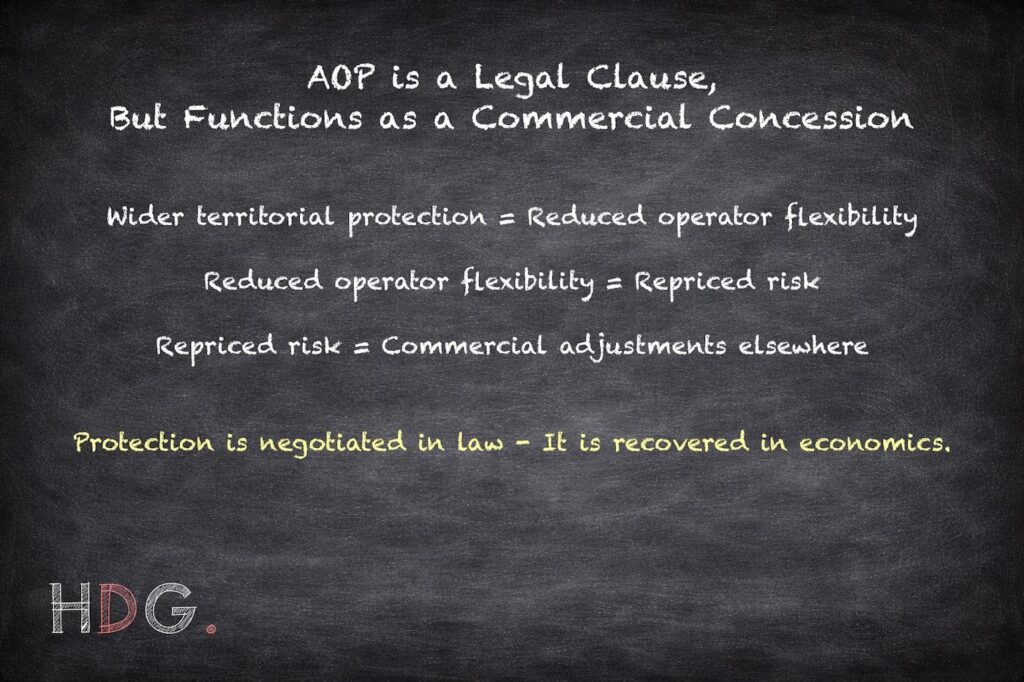
If an owner negotiates aggressive territorial protection but concedes on management fees, term length, or termination rights, the economic trade-off must be assessed. The real issue is whether the AOP meaningfully alters competitive reality or merely creates contractual comfort.
In some cases, a narrower AOP combined with structured remedies, such as fee adjustments if cannibalisation is demonstrably occurring, may yield a more balanced outcome than a blanket prohibition.
Area of Protection (Sample Clauses)
Below are illustrative sample Area of Protection (AOP) clauses showing how territorial protection may be structured within a hotel management agreement. These examples are generic and for guidance only; in practice, AOP provisions are heavily negotiated and tailored to the specific market, brand portfolio, asset positioning, and the commercial trade-offs agreed between the owner and the operator.
In reality, detailed AOP drafting would not normally appear in an operator’s initial form agreement unless the issue had been discussed and commercially aligned in advance. The drafting language, scope of restriction, remedies, and performance conditions can materially alter the economic balance of the contract, so each clause should be reviewed within the broader context of fees, term length, termination rights, and overall risk allocation.
1. Grant of Protection
This clause establishes the core territorial restriction: it defines the operator’s agreement not to introduce another hotel of the same brand within a specified geographic area during the term of the contract. In management agreements, the scope and geography are often more heavily negotiated and customised, whereas in franchise agreements, the protection may be narrower and more standardised, particularly within large global franchise systems.
Subject to the terms and conditions set forth herein, Operator agrees that, during the Term of this Agreement, it shall not own, operate, manage, lease, license, or franchise any hotel operating under the [Brand Name] brand within the Area of Protection, except as expressly permitted under this Section.
For purposes of this Agreement, the “Area of Protection” shall mean the geographic area defined as [insert description – e.g., a radius of ___ kilometers from the main entrance of the Hotel / the administrative boundaries of ___ District / the defined ___ submarket as illustrated in Schedule __].
2. Scope of Restriction
This clause clarifies the scope of protection, whether it applies only to the exact same brand or also to other brands within the operator’s portfolio that are considered materially similar. In management agreements, owners sometimes negotiate broader protection across segments, while in franchise agreements, protection is typically limited to the specific franchised brand unless expressly expanded.
The restriction set forth above shall apply solely to hotels operating under the [Brand Name] brand. The Operator shall retain the right to develop, operate, manage, franchise, or license hotels under other brands within its portfolio within the Area of Protection, provided that such hotels are positioned in a materially different market segment and are not substantially similar in concept, pricing tier, target market, or positioning to the Hotel.
For the avoidance of doubt, extended-stay, serviced apartment, branded residence, or alternative accommodation concepts shall not be deemed a breach of this Section unless such concept is substantially similar in market positioning to the Hotel.
3. Exceptions
This provision identifies circumstances where the operator is not restricted, such as existing hotels, previously signed agreements, conversions, or corporate acquisitions. There is generally no material structural difference between management and franchise agreements here, although franchise systems may include broader system-wide carve-outs due to portfolio scale.
Notwithstanding the foregoing, the Area of Protection shall not apply to:
(a) Hotels in operation or under binding agreement as of the Effective Date of this Agreement;
(b) Renovations, rebrandings, or conversions of properties existing within the Area of Protection prior to the Effective Date;
(c) Temporary operation of a hotel for emergency, force majeure, or disaster recovery purposes;
(d) Acquisition by Operator of a hotel within the Area of Protection as part of a broader corporate transaction, provided that Operator uses commercially reasonable efforts to avoid material competitive overlap.
4. Performance Condition
This clause makes the Area of Protection conditional upon the hotel achieving certain performance benchmarks, often measured by RevPAR index against an agreed competitive set. Performance-linked AOP structures are more common in management agreements, where the operator has direct operational control, and less common in franchise agreements, where performance is largely driven by the franchisee.
The Area of Protection shall remain in effect only so long as the Hotel achieves a RevPAR Index of not less than [___]% of the defined Competitive Set for two consecutive Fiscal Years following the Opening Date. In the event the Hotel fails to achieve such threshold, Operator may, upon written notice to Owner, be released from the restrictions set forth in this Section.
5. Remedies
This section defines what happens if the operator breaches the AOP, typically limiting the owner’s remedies to fee reductions, liquidated damages, or termination rights. In management agreements, remedies often focus on management fee adjustments, whereas in franchise agreements, they may focus on royalty fee reductions or contractual termination options.
In the event Operator develops or operates a hotel in material breach of this Section, Owner’s sole remedies shall be as follows:
(a) A reduction in the Base Management Fee by ___% for the period during which such competing hotel operates within the Area of Protection; or
(b) Payment of liquidated damages calculated in accordance with Schedule ___; or
(c) The right to terminate this Agreement without payment of a termination fee, provided that such termination occurs within ___ months of the breach.
The parties agree that the foregoing remedies constitute Owner’s exclusive remedies with respect to a breach of this Section.
6. Acknowledgement of Market Competition
This clause clarifies that the operator does not guarantee protection from third-party competition and that the AOP applies only to the operator’s own branded expansion. It underlines that it is not the operator driving new hotel development, but the market.
Owner acknowledges that the Area of Protection does not restrict the development, operation, or franchising of hotels by third parties within the Area of Protection, and that Operator makes no representation or warranty regarding future market supply or competitive conditions.
7. Expiration
This provision defines when the Area of Protection ends, typically upon termination or expiration of the agreement, or after a specified period. In both management and franchise agreements, protection is usually coterminous with the contract term unless otherwise negotiated.
Unless otherwise agreed in writing, the Area of Protection shall expire upon the earlier of:
(a) The expiration or termination of this Agreement;
(b) The sale of the Hotel to an unaffiliated third party without assumption of this Agreement; or
(c) The lapse of ___ years following the Opening Date.
Conclusion: AOP as Commercial Strategy
The Area of Protection clause is neither inherently pro-owner nor anti-operator. It is a strategic allocation of future opportunity and risk. It shapes how brand growth intersects with asset value over decades.
Used thoughtfully, an AOP can align incentives, protect underwriting assumptions, and support long-term positioning. Used simplistically, it can create illusory protection while sacrificing commercial flexibility and fee economics.
In sophisticated hotel development, the AOP should not be treated as a symbolic territorial boundary. It should be negotiated as what it truly is: a commercial lever embedded within the broader structure of hotel contract strategy, brand growth dynamics, and long-term asset management discipline.
Further resources:
See HDG – Hotel Contract Lawyers Contacts
Hotels Magazine – “Crowded House: Examining AOPs in the age of brand proliferation”, March 2025
Disclaimer: This page provides general information and does not constitute legal, tax or financial advice. Contract terms and applicable laws vary by agreement and jurisdiction. Owners and developers should obtain independent professional advice before entering into an agreement or proceeding with a transaction.