
Google Travel and hotel distribution have become increasingly intertwined over the past decade. As digital discovery, price comparison, and booking behaviour have evolved, Google’s role within the hospitality ecosystem has expanded beyond search into a structural layer of demand generation. In this context, “Google Travel” refers to Google’s integrated hotel search and visibility environment, including hotel listings within search results, Google Maps, review aggregation, and Google Hotel Ads.
This page explores how Google Travel and hotel distribution interact, how that relationship has evolved, and what it means for hotel owners, operators, and investors navigating an increasingly platform-driven marketplace.
- What You Need to Know about Google Travel and Hotel Distribution
- From Perceived Disruptor to Structural Gatekeeper
- The Modern Booking Journey and Google’s Embedded Role
- The Infrastructure Behind Google Travel
- Distribution Economics and Customer Acquisition Cost
- Platform Dependency and Exposure Risk
- Artificial Intelligence and the Compression of Discovery
- Implications for Hotel Owners and Investors
- Implications for Operators and Management Strategy
- Strategic Oversight in a Platform-Driven Distribution Environment
- Q&A Google Travel and Hotel Distribution
What You Need to Know about Google Travel and Hotel Distribution
Google Travel is no longer simply a search feature; it is embedded in the infrastructure of modern hotel distribution. Most digital booking journeys now begin within Google’s ecosystem, meaning visibility, pricing comparison, and review sentiment are processed through its interface before a traveller ever reaches a brand website or online travel agency. For hotels, this makes Google less of a channel choice and more of a structural layer of demand generation.
The financial implication is that customer acquisition costs have become increasingly influenced by Google’s advertising and metasearch environments. Direct bookings often depend on paid visibility, and distribution performance is shaped by algorithmic ranking, structured data accuracy, and bidding strategy. As a result, marketing expenditure and the quality of digital infrastructure directly affect operating margins.
For owners and investors, Google Travel should therefore be viewed not as a technology trend but as a risk and performance variable. Platform dependency, cost-of-sale inflation, and AI-driven search evolution all intersect with asset value. Effective oversight of Google-driven distribution is now part of disciplined hotel asset management.
From Perceived Disruptor to Structural Gatekeeper
In the mid-2010s, industry commentary often framed Google Travel as a potential existential threat to established intermediaries. As Google expanded its hotel search functionality and integrated real-time pricing feeds, speculation intensified that it would evolve into a fully transactional online travel agency competing directly with Booking.com and Expedia Group. The concern was that Google could leverage its dominance in search to control both discovery and transaction, fundamentally altering the balance of power within hotel distribution..
The anticipated disruption centred on disintermediation. If Google controlled both discovery and transaction, existing OTAs and hotel brand websites could have lost substantial leverage. However, Google Travel did not fully replicate the commission-based OTA model. Instead, Google positioned itself above the booking ecosystem, strengthening its control over visibility rather than inventory. This shift marked a structural evolution in Google Travel and hotel distribution. Rather than replacing intermediaries, Google became the gateway through which demand flows.
The Modern Booking Journey and Google’s Embedded Role
Today, the majority of digital hotel booking journeys begin with a search query. Before a traveller engages with Booking.com, Expedia Group, or even platforms such as Airbnb, they frequently interact first with Google.
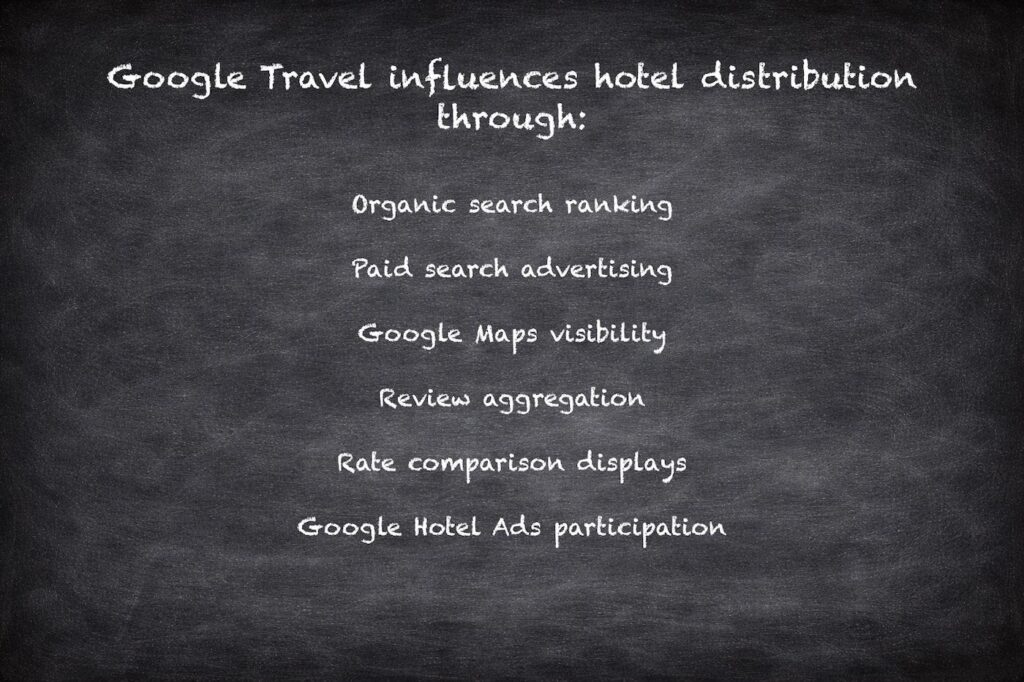
Google Travel influences hotel distribution through organic ranking logic, paid search visibility, Google Maps integration, aggregated review signals, rate comparison displays, and participation in Google Hotel Ads. These elements operate simultaneously within a single interface, meaning that pricing, reputation, bidding strategy, and structured data quality all contribute to a hotel’s competitive position.
Whether a hotel prioritises direct booking or intermediary distribution, it must compete for visibility within Google’s environment. Google monetises this visibility through advertising and metasearch bidding, capturing revenue from both OTAs and hotel brands.
The result is a distribution ecosystem in which Google Travel and hotel distribution are structurally linked. Visibility, rather than transaction ownership alone, has become the central battleground.
The Infrastructure Behind Google Travel
Beneath the visible interface of Google Travel lies a structured commercial data infrastructure that powers hotel visibility across search results, maps, and price-comparison displays. Google does not manually curate hotel listings; instead, it relies on standardised data feeds submitted through platforms such as Google Hotel Center and approved connectivity partners. Pricing, availability, room types, policies, and images are synchronised in near real time, enabling Google to display multiple booking options and comparative rates within a single search environment.
This data architecture underpins the relationship between Google Travel and hotel distribution. Visibility within search results is influenced not only by advertising spend, but also by feed accuracy, pricing competitiveness, review sentiment, and technical implementation. If a hotel’s structured data is incomplete, misaligned, or inconsistently updated, its competitive positioning can weaken regardless of brand strength. Conversely, disciplined integration supports more efficient participation in metasearch and paid placement environments.
For hotel owners, the implication is clear: Google Travel operates on data governance as much as it does on marketing strategy. Distribution performance increasingly depends on the quality of commercial data infrastructure and the alignment between revenue management, digital marketing, and connectivity systems. Understanding this infrastructure reinforces a broader reality explored throughout this page: Google’s role in hotel distribution is structural, embedded in the architecture of demand, rather than simply a channel decision.
Distribution Economics and Customer Acquisition Cost
The financial implications of Google Travel and hotel distribution are most visible in customer acquisition cost. Over the past decade, competition for search visibility has intensified, contributing to rising cost-per-click rates and increasing reliance on paid search to secure bookings.
Direct bookings, traditionally positioned as lower-cost alternatives to OTA commissions, increasingly depend on paid visibility within Google’s ecosystem. When advertising expenditure is fully allocated, the effective cost of acquiring a direct booking can approach intermediary commission levels. This alters the economics of distribution.
For asset managers, this has tangible implications. Gross Operating Profit margins become sensitive to digital marketing inflation. Stabilised EBITDA projections must incorporate sustained acquisition costs as structural, recurring expenses. In underwriting scenarios, assumptions regarding the cost of sale require careful validation. Google Travel and hotel distribution, therefore, intersect directly with profitability. What may appear to be a marketing dynamic is, in practice, a margin management issue.
Platform Dependency and Exposure Risk
As Google Travel becomes embedded within hotel distribution strategy, platform dependency increases. Organic ranking algorithms, paid placement mechanics, and review visibility influence performance outcomes. These variables operate outside direct owner control.
Changes in algorithm prioritisation can affect organic reach. Adjustments to advertising formats can alter competitive positioning. Increased prominence of sponsored placements may shift the balance between paid and organic traffic. As a result, exposure to Google-driven demand becomes a measurable risk factor.
In evaluating Google Travel and hotel distribution, owners should consider the proportion of bookings reliant on Google-originated traffic. Heavy dependence on paid search for “direct” bookings may conceal underlying exposure. Scenario modelling of cost-per-click inflation or organic ranking shifts becomes a prudent exercise within asset management frameworks.
The objective is not to characterise Google as adversarial, but to recognise that distribution infrastructure now resides within a third-party technology ecosystem.
Artificial Intelligence and the Compression of Discovery
Artificial intelligence introduces an additional dimension to Google Travel and hotel distribution. AI-generated summaries, personalised hotel recommendations, and generative search outputs have the potential to compress the booking funnel. Instead of navigating multiple websites and comparison pages, travellers may increasingly rely on algorithmic curation within Google’s interface.
If discovery becomes more automated, brand differentiation may depend heavily on the accuracy of structured data, review sentiment, pricing competitiveness, and technical optimisation. The traditional browsing phase may shorten, reducing opportunities for direct brand engagement.
From a strategic perspective, Google Travel and hotel distribution could become even more integrated under AI-enhanced search. Visibility within algorithmically generated results may intensify competition and reinforce the importance of disciplined digital strategy.
Implications for Hotel Owners and Investors
For hotel owners and investors, Google Travel and hotel distribution dynamics affect both operating performance and asset valuation. Rising acquisition costs can erode net operating income, particularly in competitive urban markets where bidding intensity is high.
Due diligence increasingly examines channel mix stability, direct booking sustainability, and exposure to metasearch-driven traffic. Assets with balanced distribution profiles and controlled acquisition costs may be viewed more favourably in underwriting models. Conversely, properties heavily reliant on paid search may warrant sensitivity adjustments in forecast assumptions.
Capital planning must also reflect this environment. Investment in booking engine optimisation, analytics infrastructure, and distribution strategy is no longer optional. It is integral to sustaining competitive positioning within Google Travel and hotel distribution ecosystems.
Implications for Operators and Management Strategy
Operators navigating Google Travel and hotel distribution must integrate revenue management and digital marketing more closely than ever before. Pricing strategy influences visibility within metasearch results. Performance marketing affects occupancy and ADR outcomes.
Operator sophistication in managing Google Hotel Ads, controlling cost per acquisition, and optimising conversion rates increasingly differentiates performance. Owners evaluating management agreements may consider digital distribution capability a critical competency.
Google Travel and hotel distribution, therefore, elevate digital expertise to executive-level importance. Distribution strategy is no longer confined to marketing departments; it is central to operational performance.
Strategic Oversight in a Platform-Driven Distribution Environment
The structural integration of Google Travel and hotel distribution requires disciplined oversight. Hotels must treat distribution strategy as a capital allocation issue rather than a purely promotional activity.
Regular distribution audits, transparent cost-of-sale reporting, and scenario analysis of acquisition cost trends strengthen resilience. Diversifying demand sources, maintaining disciplined bidding strategies, and continuously monitoring algorithmic performance help mitigate exposure.
Google Travel has become part of the architecture of hotel distribution. Owners and operators who incorporate Google Travel and hotel distribution analysis into asset management, underwriting, and valuation frameworks will be better positioned to protect margins and sustain long-term value.
Q&A Google Travel and Hotel Distribution
Is Google Travel an online travel agency (OTA)?
No. Google Travel does not operate as a traditional commission-based OTA. Instead, it functions as a visibility and comparison platform within Google Search and Maps. Bookings are typically completed either on a hotel’s website or through an intermediary such as Booking.com or Expedia Group. Google monetises the ecosystem primarily through advertising and metasearch participation rather than through direct inventory commission control.
Does Google Travel reduce hotel reliance on OTAs?
Not automatically. While Google Travel can support direct bookings, visibility often depends on paid search and metasearch bidding. In many cases, both OTAs and hotel brands compete within the same Google interface. As a result, Google Travel may reduce intermediary dominance in some markets, but it can also introduce a new form of platform dependency if acquisition costs are not carefully managed.
Does Google charge commission on hotel bookings?
Google does not typically charge a standardised OTA-style commission. Instead, hotels and intermediaries participate through advertising models such as cost-per-click or commission-based bidding within Google Hotel Ads. The effective acquisition cost, therefore, depends on bidding strategy, competitiveness, and conversion performance rather than on a fixed commission structure.
How does Google Travel affect hotel profitability?
Google Travel influences profitability through customer acquisition cost. Increased competition for search visibility can drive up advertising spend, and direct bookings often require paid support to maintain prominence. For hotel owners, this means distribution cost should be treated as a structural component of operating expense, directly affecting gross operating profit, EBITDA, and long-term asset valuation.
Should hotel owners be concerned about dependency on Google?
Concern is less productive than oversight. Google’s role in hotel distribution is structural and unlikely to diminish. The key issue for owners is concentration risk: understanding the extent to which demand originates from Google-driven channels and modelling the impact of cost-per-click inflation or algorithm changes. Hotels with diversified distribution strategies and disciplined digital governance are better positioned to manage platform exposure.
Does Google Travel change the case for appointing a hotel operator versus self-management?
Google Travel does not inherently favour branded operators or self-managed hotels; it favours digital competence. As hotel discovery becomes increasingly embedded in Google’s ecosystem, performance depends on disciplined management of structured data feeds, participation in metasearch, pricing alignment, and acquisition cost control. A digitally sophisticated operator can add significant value in this environment, particularly for owners without in-house expertise in performance marketing and distribution analytics. Conversely, self-managed hotels with strong digital capability may achieve greater efficiency by retaining control over bidding strategy and avoiding brand-level fees. The decisive factor is therefore not branding alone, but who is best positioned to manage Google-driven distribution economics effectively.
Further resources:
See Hospitality Net (February 2026) – “Will Google’s new Universal Commerce Protocol (UCP) turn hotel distribution upside down?“