
Hotel operator oversight is a core function of hotel asset management. It ensures that management agreements, performance metrics and capital decisions align with owner objectives and long-term asset value. In managed and franchised hotel structures, the operator controls daily performance, but the owner retains financial risk.
A hotel is not simply a service business. It is an income-producing real estate asset. Without disciplined supervision, the priorities of the operator, brand and owner can gradually diverge. Hotel operator oversight provides a structured review of performance, budgets, contracts and capital plans to ensure that the asset works in service of the owner’s investment thesis.
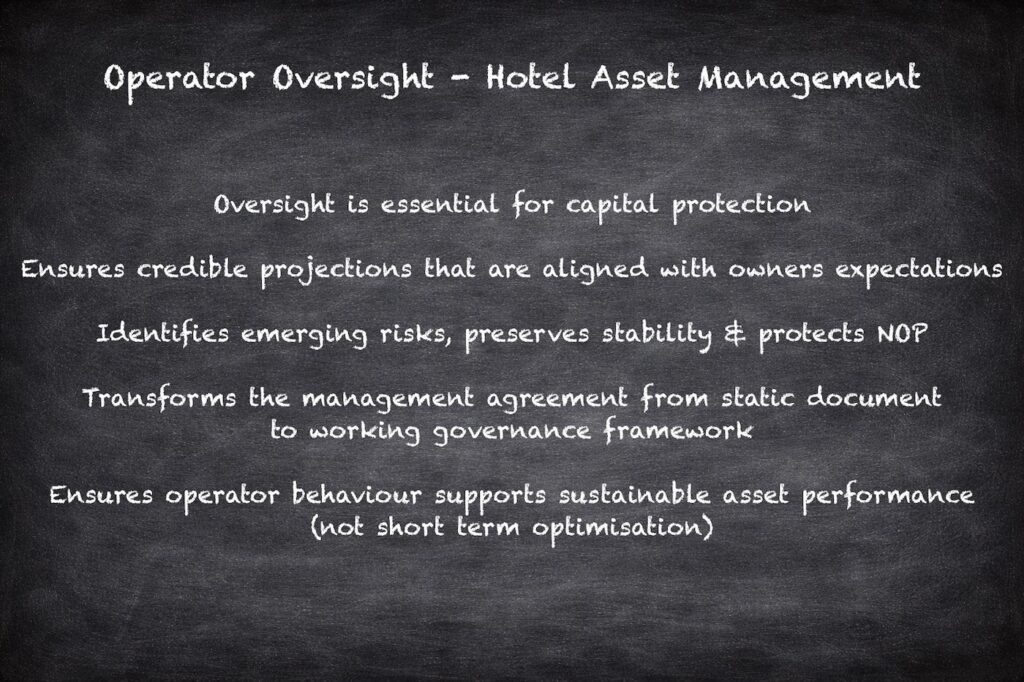
In markets characterised by volatility, leverage, or long-term management agreements, hotel operator oversight is essential for capital protection.
- What Is Hotel Operator Oversight?
- Budget Review and Business Plan Challenge
- Monthly Performance Monitoring and Variance Analysis
- Management Agreement Compliance
- Incentive Fee Alignment
- Capital Expenditure and Property Improvement Plan (PIP) Oversight
- Strategic Positioning and Market Review
- Risk Management and Covenant Monitoring
- Hotel Operator Oversight in Different Structures
- How Hotel Operator Oversight Creates Value
- The Strategic Role of Hotel Oversight in Asset Management
What Is Hotel Operator Oversight?
Hotel operator oversight is the structured monitoring of a hotel operator’s performance under a management agreement or franchise. It does not involve micromanaging day-to-day operations. Instead, it focuses on evaluating outcomes, reviewing assumptions and ensuring contractual compliance.
The distinction is important. A hotel general manager focuses on occupancy, ADR, RevPAR and cost control. An asset manager evaluates how those metrics translate into net operating income, cash flow stability and asset value.
Oversight operates at the intersection of operations and capital. It translates trading results into investment implications.
Budget Review and Business Plan Challenge
The annual operating budget is one of the most powerful oversight tools available to ownership. It establishes revenue expectations, departmental cost structures, capital expenditure timing and cash flow projections for the year ahead.
Effective operator oversight requires critical examination of:
- Revenue assumptions relative to market growth
- Payroll ratios and departmental margins
- GOP forecasts versus historical trends
- Capital expenditure proposals
- Working capital requirements
Approval of the budget should not be procedural. It should involve structured dialogue around assumptions, risk factors and contingency planning.
An overly conservative budget can distort the alignment of incentive fees. An overly optimistic budget can weaken performance test mechanisms. Oversight ensures that projections are credible and aligned with ownership expectations before the financial year begins.
Monthly Performance Monitoring and Variance Analysis
While budgets establish direction, monthly reporting provides operational transparency. However, reviewing reports is not the same as analysing them.
Hotel operator oversight involves structured variance analysis against:
- Approved budget
- Prior year performance
- Competitive set benchmarks
- Management agreement performance thresholds
When deviations occur, oversight requires investigation of root causes. For example:
- Is ADR erosion driven by market weakness or positioning strategy?
- Are payroll increases structural or temporary?
- Is margin decline cyclical or indicative of operational inefficiency?
Disciplined analysis allows ownership to identify emerging risks early, preserving stability and protecting net operating income.
Management Agreement Compliance
Hotel management agreements define fee structures, performance tests, approval rights and termination provisions. These contracts are often complex and long-term in nature.
Hotel operator oversight ensures that the agreement functions as intended. This includes reviewing:
- Base fee and incentive fee calculations
- Owner priority returns
- Performance test triggers
- Termination rights
- Capital expenditure approval mechanisms
Without active oversight, contractual protections can lose practical impact. Fee calculations may drift, performance thresholds may be interpreted flexibly, and approval rights may be overlooked.
Oversight transforms the management agreement from a static document into a working governance framework.
Incentive Fee Alignment
Incentive fee structures are designed to align operator motivation with owner returns. However, the mechanics of alignment vary significantly across agreements.
Some structures reward revenue growth. Others reward gross operating profit. Some incorporate owner priority return thresholds before incentive fees are paid.
Hotel operator oversight evaluates whether the fee structure genuinely promotes long-term value creation. For example:
- Does the operator have incentive to defer necessary capital expenditure to protect short-term GOP?
- Does the fee structure encourage revenue growth at the expense of cost discipline?
- Are owner priority thresholds realistically achievable?
Periodic review of incentive alignment ensures that operator behaviour supports sustainable asset performance rather than short-term optimisation.
Capital Expenditure and Property Improvement Plan (PIP) Oversight
Hotels are capital-intensive assets. Brands may require Property Improvement Plans (PIPs), and operators may recommend strategic upgrades to maintain competitiveness.
Hotel operator oversight evaluates capital proposals through an investment lens:
- What is the expected return on investment?
- Is the timing appropriate relative to market cycle?
- How will the expenditure be funded?
- What is the impact on asset valuation?
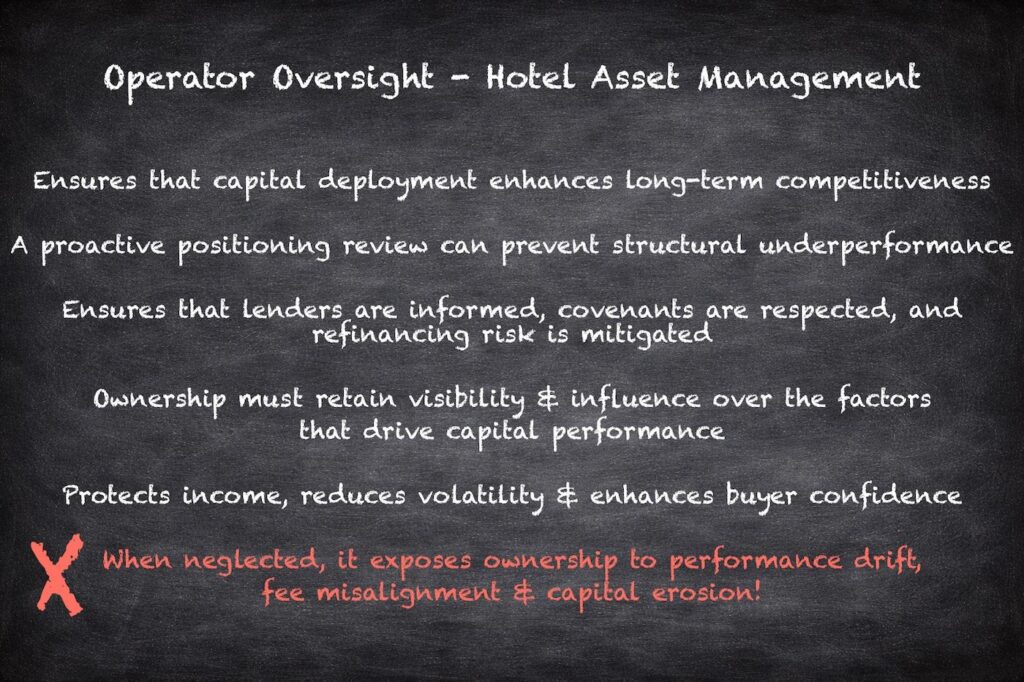
CapEx decisions directly influence net operating income, yield perception and buyer appetite. Oversight ensures that capital deployment enhances long-term competitiveness without unnecessarily eroding returns.
Strategic timing of renovation can materially affect exit pricing.
Strategic Positioning and Market Review
Oversight extends beyond financial metrics. Market positioning, brand alignment and distribution strategy all influence asset value.
If a hotel underperforms relative to its competitive set, oversight may require reassessment of positioning rather than simple cost reduction. This may involve reviewing:
- Segment focus
- Brand suitability
- Distribution channel mix
- Pricing strategy
In evolving or emerging markets, a proactive positioning review can prevent structural underperformance.
Risk Management and Covenant Monitoring
In leveraged hotel investments, operational performance affects debt service capacity and covenant compliance. Hotel operator oversight, therefore includes monitoring:
- Debt service coverage ratios
- Loan covenant thresholds
- Cash sweep triggers
- Refinancing timelines
Operational volatility can quickly translate into capital risk. Structured oversight ensures that lenders are informed, covenants are respected, and refinancing risk is mitigated.
This connection between operations and capital resilience underscores the strategic importance of oversight.
Hotel Operator Oversight in Different Structures
The nature of oversight varies depending on the operating model.
- In management agreements, oversight focuses on fee alignment, performance tests and approval rights.
- In franchise structures, where the owner assumes operational risk, oversight emphasises cost discipline, brand compliance and margin protection.
- In lease structures, attention shifts toward tenant covenant strength and lease compliance rather than operational detail.
Regardless of structure, the principle remains consistent: ownership must retain visibility and influence over the factors that drive capital performance.
How Hotel Operator Oversight Creates Value
Hotel operator oversight enhances asset value through disciplined intervention rather than operational interference.
Value is created through:
- Early identification of performance drift
- Credible budget setting
- Fee structure alignment
- Disciplined capital timing
- Transparent reporting
Because hotel value is typically derived from net operating income capitalised at market yield, even modest improvements in margin can produce disproportionate increases in asset value.
Oversight protects income, reduces volatility and enhances buyer confidence. In competitive markets, stability and predictability are often rewarded with stronger valuation multiples.
The Strategic Role of Hotel Oversight in Asset Management
Operator oversight is not about control for its own sake. It is about ensuring alignment between operations and capital.
Hotels operate daily, but they are owned for years. Oversight bridges the gap between short-term trading and long-term investment performance.
When implemented effectively, it strengthens operator relationships, clarifies expectations and reinforces contractual governance. When neglected, it exposes ownership to performance drift, fee misalignment and capital erosion.
In disciplined hotel asset management, operator oversight is not optional. It is central to protecting value and sustaining investment returns.
Further resources:
See HDG – Hotel Asset Management
See Hospitality Net (December 2025) – “The Future of Hotel Asset Management in Europe“