
The consolidation of hotel operators has reshaped the global hospitality landscape over the past decade. Through mergers, acquisitions, and brand platform integration, major hotel groups have expanded portfolios, strengthened loyalty ecosystems, and increased geographic reach. This page provides a structured analysis of hotel operator mergers and acquisitions, examining how industry consolidation is influencing development strategy, brand positioning, and investment decision-making.
Since 2015, global hotel operators have completed more than 40 major brand and platform acquisitions across luxury, lifestyle, midscale, and all-inclusive segments. The Consolidation of hotel operators has been driven by loyalty scale expansion, asset-light growth models, and cross-border capital flows between North America, Europe, and Asia.
Driven by evolving consumer preferences, digital disruption, and strategic consolidation, major players in the hospitality industry are streamlining their portfolios and scaling through mergers and acquisitions. Whether you’re a developer, investor, or operator, understanding these dynamics is essential to navigating competitive alliances, identifying growth opportunities, and benchmarking against industry leaders.
- Major Hotel Operator Mergers and Acquisitions
- Marriott International M&A Activity
- Hilton Hotels & Resorts Growth Strategy and Acquisitions
- IHG Brand Consolidation
- Wyndham Hotels and Resorts Portfolio Expansion
- Jin Jiang International Holdings Cross-Border Acquisitions
- Accor Hotels Group Brand Platform Strategy
- Hyatt Hotels Corporation Lifestyle and All-Inclusive Expansion
- Choice Hotels International Domestic Consolidation
- H World Group (formerly Huazhu) International Expansion
- Minor Hotels European Integration
- Geographic Consolidation Patterns
- Loyalty Ecosystem Consolidation
- What Consolidation Means for Developers and Investors
- Methodology and Sources
Major Hotel Operator Mergers and Acquisitions
Marriott International M&A Activity
Website: Marriott International Investor Relations
In recent years, Marriott International has expanded primarily through large-scale acquisitions combined with selective brand and platform purchases. The company has used mergers and acquisitions to increase global room supply, broaden its segment coverage, and incorporate established brand systems into its portfolio. This approach has resulted in significant consolidation of upper-upscale, luxury, lifestyle, and, more recently, midscale brands under a single corporate structure.
| Date | Transaction | Notes |
|---|---|---|
| Jul 2025 | citizenM | Acquisition (brand & platform) · ~36 hotels · ~8,500+ rooms · Lifestyle / tech-driven micro-luxury · Strong urban Europe & US footprint |
| May 2023 | City Express | Acquisition (brand portfolio) · ~150 hotels · ~17,000 rooms · Midscale / affordable · Primarily Mexico & Latin America |
| Dec 2019 | Elegant Hotels Group | Acquisition · 7 resorts · ~588 rooms · Luxury all-inclusive · Barbados / Caribbean |
| Sep 2016 | Starwood Hotels & Resorts | Acquisition (mega-merger) · ~1,300 hotels · ~370,000+ rooms · Luxury, upper upscale, lifestyle · Global · Created world’s largest hotel company at the time |
| Oct 2015 | Design Hotels AG | Majority stake acquisition · ~300 member hotels (soft brand network) · Boutique / design-led · Global collection model |
| Apr 2015 | Delta Hotels & Resorts | Acquisition · ~38 hotels at acquisition · Primarily Canada · Upscale full-service · Strengthened North American footprint |
The acquisition of Starwood Hotels & Resorts in 2016 materially increased Marriott’s global footprint and brand portfolio, adding multiple established flags across luxury, premium, and lifestyle categories. Subsequent transactions, including Elegant Hotels Group (2019), City Express (2023), and citizenM (2025), reflect expansion into all-inclusive resorts, affordable midscale, and urban lifestyle segments. In parallel, earlier acquisitions such as Delta Hotels and a majority stake in Design Hotels strengthened Marriott’s presence in Canada and within the soft-brand model.
Hilton Hotels & Resorts Growth Strategy and Acquisitions
Website: Hilton Hotels & Resorts Investor Relations
Unlike several of its global competitors, Hilton has largely avoided transformational mergers over the past decade, instead pursuing a disciplined, asset-light growth strategy focused on organic brand creation and selective lifestyle acquisitions. The company has prioritised launching and scaling its own brands, particularly in the lifestyle, soft-brand, and focused-service segments, rather than buying large competitors.
| Date | Transaction | Notes |
|---|---|---|
| Mar 2024 | Graduate Hotels | Acquisition (brand platform) · ~35 hotels · ~7,500+ rooms · University-anchored lifestyle · US & UK focus |
| Apr 2024 | NoMad (Sydell Group majority stake) | Majority stake acquisition · Ultra-luxury lifestyle brand · Small but high-ADR footprint · Urban gateway cities |
| Feb 2022 | Citadel (Graduate JV stake increase)* | Strategic investment · Increased control of Graduate prior to full acquisition · Lifestyle segment |
Hilton’s expansion has been driven primarily by internally developed brands such as Curio Collection, Canopy, Motto, Tempo, and Spark, as well as targeted acquisitions, including Graduate Hotels and a majority stake in NoMad in 2024. Rather than pursuing scale through mega-mergers, Hilton has focused on segment diversification, growth of its loyalty platform (Hilton Honours), and strengthening its asset-light management and franchise model. The result is a portfolio that has grown significantly in size and geographic reach without relying heavily on large-scale corporate consolidation.
IHG Brand Consolidation
Website: IHG Investor Relations
IHG has expanded through a combination of targeted brand acquisitions and continued organic brand development. Rather than pursuing large-scale operator mergers, IHG has focused on acquiring specific brands that add capability in defined segments, particularly luxury and lifestyle, while maintaining its asset-light management and franchise model.
| Date | Transaction | Notes |
|---|---|---|
| Feb 2025 | Ruby | Acquisition (brand platform) · ~20 hotels at acquisition · Urban lifestyle · Strong German & Central European footprint |
| Feb 2019 | Six Senses Hotels Resorts Spas | Acquisition · 18 operating hotels & resorts · 6 standalone spas · ~37 pipeline · Luxury wellness · Asia / Middle East / Europe focus |
| Jul 2018 | Regent Hotels & Resorts | Majority stake acquisition (51%) · Luxury brand relaunch platform · Global pipeline repositioning |
| Jan 2015 | Kimpton Hotels & Restaurants | Acquisition · ~60 hotels · Boutique lifestyle · Predominantly US urban markets |
Major transactions include the acquisition of Kimpton Hotels & Restaurants in 2015, Regent Hotels & Resorts in 2018 (initial majority stake), and Six Senses Hotels Resorts Spas in 2019. More recently, IHG acquired the Ruby brand in 2025 to strengthen its urban lifestyle positioning in Europe. These acquisitions expanded IHG’s presence in the luxury, upper-upscale lifestyle, and experiential segments, complementing its existing core brands, including InterContinental, Crowne Plaza, and Holiday Inn. Overall, IHG’s strategy reflects selective portfolio enhancement through brand acquisition rather than operator-scale mergers.
Wyndham Hotels and Resorts Portfolio Expansion
Website: Wyndham Hotels & Resorts Investor Relations
Wyndham Hotels & Resorts has expanded primarily through brand and portfolio acquisitions focused on the midscale, upper-midscale, and economy segments. The company has used acquisitions to increase scale in core franchised markets, strengthen its presence in North America, and expand into selected international regions. Following its 2018 spin-off from Wyndham Worldwide, the company has operated as a standalone, asset-light hotel franchisor focused on system growth and brand consolidation.
| Date | Transaction | Notes |
|---|---|---|
| Sep 2022 | Vienna House | Acquisition (brand portfolio) · ~40+ hotels at acquisition · Upper-midscale / upscale · Central & Eastern Europe focus |
| May 2018 | La Quinta Holdings | Acquisition · ~900 hotels · ~89,000 rooms · Upper-midscale · Predominantly US market |
| Oct 2017 | AmericInn | Acquisition · ~200 hotels · Midscale · US regional / Midwest concentration |
| Dec 2016 | Fën Hotels | Acquisition · ~26 managed/franchised hotels · Latin America presence · Introduced Dazzler & Esplendor brands |
| Feb 2015 | Dolce Hotels & Resorts | Acquisition · ~24 properties · Meetings & conference-focused upscale segment · US & Europe |
Major transactions include the acquisition of Dolce Hotels & Resorts (2015), Fën Hotels (2016), AmericInn (2017), and La Quinta Holdings (2018). More recently, Wyndham acquired the Vienna House brand in 2022 to expand its European footprint. In contrast to luxury-focused consolidation seen elsewhere in the sector, Wyndham’s acquisitions have largely concentrated on franchised midscale and economy brands, reinforcing distribution scale and regional density rather than entering new ultra-luxury or lifestyle segments.
Jin Jiang International Holdings Cross-Border Acquisitions
Website: Jin Jiang Investor Relations (Chinese Only)
Jin Jiang International Holdings has expanded primarily through cross-border acquisitions and strategic stakes in established European and international hotel groups. The company’s approach has centred on increasing global room supply, gaining access to international distribution platforms, and integrating overseas brands into a broader portfolio headquartered in China. Unlike asset-light Western operators focused mainly on franchise growth, Jin Jiang’s expansion has included acquiring controlling stakes in publicly listed hotel companies.
| Date | Transaction | Notes |
|---|---|---|
| Nov 2018 | Radisson Hospitality AB (RHG) | Acquisition (controlling stake; later delisted) · ~1,400+ hotels & pipeline at announcement · Upper-upscale & upscale · Global footprint (Europe strong) |
| Apr 2016 | Vienna House Group | Acquisition (majority stake) · ~30 hotels at acquisition · Upscale / Central Europe focus |
| Sep 2015 | Plateno Hotels Group | Acquisition (majority stake) · ~3,000+ hotels (primarily China) · Midscale & economy brands · Domestic China scale |
| Mar 2015 | Louvre Hotels Group | Acquisition (majority stake) · ~1,100 hotels · Economy & midscale · Strong European presence (Campanile, Kyriad, etc.) |
Major transactions include the acquisition of Louvre Hotels Group (2015), Plateno Hotels Group (2015), Vienna House Group (2016), and Radisson Hospitality AB (2018). These transactions significantly expanded Jin Jiang’s presence in Europe and strengthened its position in the midscale and upper-midscale segments globally. The Radisson transaction, in particular, marked a major step in consolidating an international upscale platform under Chinese ownership. Collectively, these acquisitions reflect a strategy focused on geographic diversification and portfolio scale through corporate-level consolidation.
Accor Hotels Group Brand Platform Strategy
Website: Accor Hotels Group – Finance
Accor has expanded through a combination of brand acquisitions, strategic investments, and platform consolidation, with a particular focus on lifestyle, luxury, and management-led growth. Rather than pursuing a single transformational merger, the group has executed multiple transactions across different segments to broaden its brand architecture and strengthen its position in Europe, North America, and Asia-Pacific. Accor has also restructured internally, separating asset ownership from operating platforms and building dedicated lifestyle divisions.
| Date | Transaction | Notes |
|---|---|---|
| Oct 2021 | Ennismore (lifestyle JV completion) | Platform consolidation / joint venture · Combined 100+ lifestyle hotels & pipeline · Created dedicated lifestyle operating platform |
| Oct 2018 | sbe Entertainment Group | Majority stake acquisition · Added Delano, Mondrian, SLS brands · Luxury lifestyle focus · US & global gateway cities |
| Sep 2018 | Mövenpick Hotels & Resorts | Acquisition · ~80+ hotels · Upscale · Strong Middle East & Europe presence |
| Sep 2018 | 21c Museum Hotels | Acquisition (majority stake) · Boutique lifestyle brand · US urban markets |
| May 2018 | Mantra Group Limited | Acquisition · ~130 properties · APAC-focused · Strengthened Australia & New Zealand presence |
| May 2018 | Atton Hoteles | Acquisition (majority stake) · ~11 hotels · Latin America footprint |
| Oct 2017 | Orient Express (brand acquisition) | Brand acquisition · Luxury brand relaunch platform · Limited operating footprint at time of acquisition |
| Jul 2016 | FRHI Hotels & Resorts | Acquisition · ~155 hotels · Added Fairmont, Raffles, Swissôtel · Luxury & upper-upscale global expansion |
| Dec 2016 | Morgans Hotel Group | Acquisition · Lifestyle boutique portfolio · Added Delano & Mondrian assets (later integrated into sbe structure) |
| Oct 2014 | Mama Shelter (37% initial stake) | Minority stake (later full ownership) · Lifestyle / urban boutique · Europe-focused |
Major transactions include the acquisition of FRHI Hotels & Resorts in 2016 (bringing Fairmont, Raffles, and Swissôtel), majority stakes in lifestyle platforms such as sbe Entertainment Group (2018) and Mama Shelter (initial minority stake in 2014, later full control), and the acquisitions of Mövenpick Hotels & Resorts, Mantra Group, Atton Hoteles, and 21c Museum Hotels in 2018. In 2021, Accor consolidated its lifestyle brands into a joint venture structure under Ennismore, creating a distinct operating platform for brands such as The Hoxton, Mondrian, and Delano. Collectively, these moves reflect a strategy centred on segment diversification and platform integration rather than a single large-scale corporate merger.
Hyatt Hotels Corporation Lifestyle and All-Inclusive Expansion
Website: Hyatt Hotels Corporation Investor Relations
Hyatt Hotels Corporation has expanded through a combination of targeted acquisitions and organic brand development, with increasing emphasis on lifestyle and all-inclusive segments. Compared to larger-scale mergers seen elsewhere in the industry, Hyatt’s transactions have focused on acquiring brand platforms and management companies that expand segment coverage and distribution capabilities. The company has continued to operate under an asset-light model, prioritising management and franchise growth over real estate ownership.
| Date | Transaction | Notes |
|---|---|---|
| Oct 2024 | Standard International | Acquisition (asset-light lifestyle platform) · The Standard & Bunkhouse brands · Lifestyle / urban luxury · Global gateway cities |
| Nov 2021 | Apple Leisure Group (ALG) | Acquisition · ~100+ all-inclusive resorts at acquisition · Caribbean, Mexico, Europe focus · Added AMR Collection brands |
| Oct 2018 | Two Roads Hospitality | Acquisition · ~85 properties · Added Alila, Thompson, Joie de Vivre, Destination Hotels · Luxury & lifestyle expansion |
Major transactions include the 2018 acquisition of Two Roads Hospitality, adding lifestyle brands such as Alila, Thompson Hotels, Destination Hotels, and Joie de Vivre. In 2021, Hyatt acquired Apple Leisure Group, significantly expanding its presence in the all-inclusive resort segment across the Caribbean, Mexico, and Europe. More recently, Hyatt has continued to strengthen its lifestyle positioning through acquisitions, including Standard International in 2024. Collectively, these moves reflect a strategy centred on segment diversification, particularly in experiential, luxury, and resort categories, rather than large-scale operator consolidation.
Choice Hotels International Domestic Consolidation
Website: Choice Hotels International Investor Relations
Choice Hotels International has expanded primarily through franchised midscale and economy brands in North America. The company has generally pursued incremental acquisitions that strengthen regional density and franchise distribution rather than large-scale global mergers. Its strategy has remained focused on asset-light franchising within the upper-economy and midscale segments.
| Date | Transaction | Notes |
|---|---|---|
| Aug 2022 | Radisson Hotels Americas | Acquisition · ~600 hotels · Upper-midscale & upscale · US, Caribbean, Latin America |
| 2023–2024 | Proposed Wyndham acquisition | Unsolicited acquisition proposal (not completed) · Targeted large-scale consolidation in US midscale |
A significant transaction occurred in 2022 with the acquisition of Radisson Hotels Americas, adding a substantial upscale and upper-midscale presence in the United States, Caribbean, and Latin America. In 2023–2024, Choice made an unsolicited proposal to acquire Wyndham Hotels & Resorts, which was not completed. Overall, Choice’s consolidation activity has focused on strengthening domestic US scale rather than international corporate expansion.
H World Group (formerly Huazhu) International Expansion
Website: H World Group Limited Investor Relations
H World Group has expanded through domestic scale growth in China, combined with selective international acquisitions. The company’s strategy has focused on building a large multi-brand portfolio in the economy and midscale segments, supported by a centralised operating platform. International expansion has been achieved primarily through the acquisition of established European management platforms rather than incremental greenfield brand launches.
| Date | Transaction | Notes |
|---|---|---|
| Jan 2020 | Deutsche Hospitality (Steigenberger brands) | Acquisition (majority stake) · ~160 hotels · Upscale & upper-upscale · Germany & Central Europe focus |
A significant milestone was the acquisition of Deutsche Hospitality in 2019–2020, bringing brands such as Steigenberger, IntercityHotel, and Jaz into the group. This transaction established a European management structure and repositioned H World as an operator with a dual China–Europe footprint. Since then, the group has continued to expand primarily through organic development within China while integrating international operations under a unified corporate structure.
Minor Hotels European Integration
Website: Minor Hotels Shareholders & Investors
Minor Hotels has expanded through cross-border acquisitions, complemented by the continued development of its existing resort and urban brands. The group has pursued controlling stakes in established European hotel operators to broaden its geographic footprint while maintaining strong resort exposure in Asia-Pacific and the Middle East.
| Date | Transaction | Notes |
|---|---|---|
| 2019–2020 | Increased stake in NH Hotel Group | Ownership consolidation · Further increased control following 2018 acquisition · Full operational integration into Minor platform |
| Oct 2018 | NH Hotel Group (initial majority stake) | Acquisition (controlling stake) · ~380 hotels at acquisition · Upscale urban · Strong Spain & wider European footprint |
The most significant transaction was the acquisition of a majority stake in NH Hotel Group in 2018, which increased control and integrated the platform into Minor’s global structure. This transaction substantially expanded Minor’s European presence and strengthened its position in the upscale urban segment. The group now operates brands including Anantara, Avani, NH Collection, Tivoli, and Oaks across Europe, Asia-Pacific, and the Americas, reflecting a strategy centred on geographic diversification through acquisition.
Geographic Consolidation Patterns
The consolidation of hotel operators has followed distinct geographic patterns over recent decades, often reflecting capital flows and regional growth dynamics rather than purely brand strategy.
One clear trend has been Chinese cross-border acquisition into Europe. Chinese groups such as Jin Jiang International and H World Group have acquired established European platforms to gain international distribution, brand recognition, and operational expertise. These transactions have effectively linked large domestic Chinese room supply with European management systems.
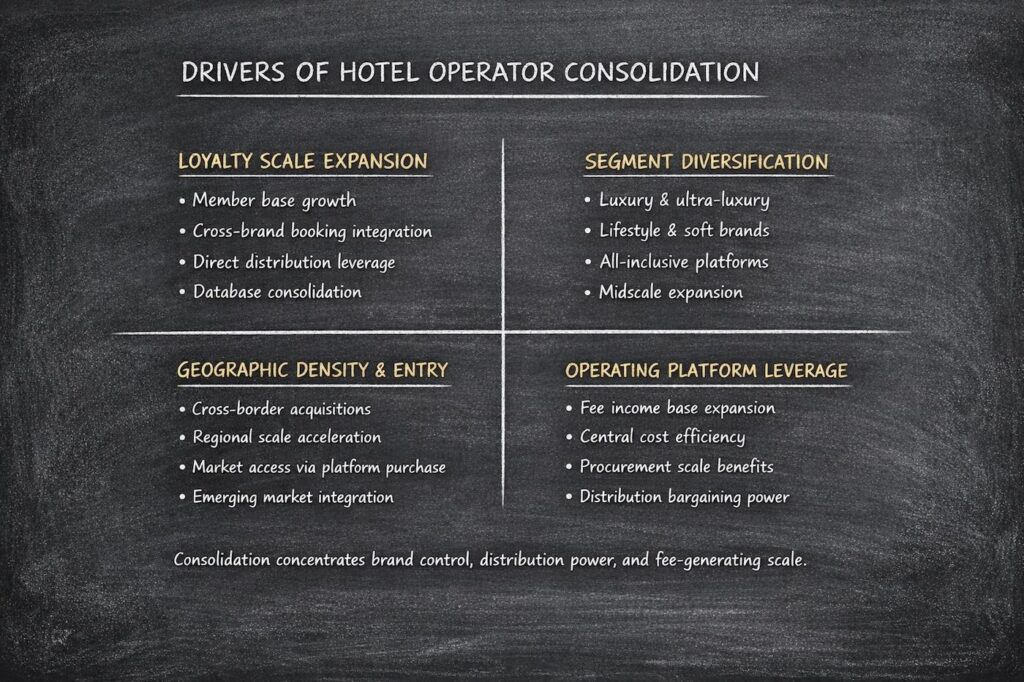
In parallel, North American operators have expanded into the Caribbean and Latin America, particularly through acquisitions in the all-inclusive and resort segments. Hyatt’s acquisition of Apple Leisure Group and Marriott’s acquisition of Elegant Hotels illustrate this pattern, strengthening resort portfolios in markets with high leisure demand.
European operators have also pursued regional expansion through acquisition. Accor’s transactions in Australia, Latin America, and the lifestyle sector demonstrate a strategy of geographic diversification combined with brand platform development. Minor Hotels’ acquisition of NH Hotel Group represents another example of cross-border European consolidation driven by a non-European parent.
By contrast, some US-focused operators, such as Choice Hotels and Wyndham, have prioritised domestic scale consolidation, particularly in the midscale and upper-midscale segments. These transactions reinforce regional density rather than global footprint.
For developers, understanding geographic consolidation patterns helps clarify where new brands are likely to expand, where internal competition may increase, and how global capital alignment may influence brand deployment decisions in emerging markets.
Loyalty Ecosystem Consolidation
Beyond brand portfolios, one of the most significant effects of operator consolidation has been the expansion and integration of loyalty ecosystems. As operators acquire new brands, those properties are typically incorporated into centralised loyalty programmes, increasing member scale and cross-brand booking potential.
Programmes such as Marriott Bonvoy, Hilton Honors, IHG One Rewards, World of Hyatt, and Accor Live Limitless have expanded materially following acquisitions. The integration of acquired brands into these systems enhances direct booking capability, strengthens data collection, and increases repeat demand across segments.
For developers and investors, loyalty scale directly affects distribution economics. Larger loyalty programmes can reduce reliance on third-party online travel agencies, improve repeat guest capture, and support rate integrity in competitive markets. At the same time, integration into a global loyalty platform requires alignment with brand standards, technology systems, and marketing contributions, all of which should be factored into financial modelling.
The consolidation of hotel operators, therefore, extends beyond the brand level to the database level. The ability of a global operator to move guests across multiple brands and regions through a unified loyalty structure has become a central component of competitive advantage. When selecting an operator, developers should evaluate not only brand positioning but also the strength and geographic relevance of the loyalty ecosystem associated with it.
What Consolidation Means for Developers and Investors
Hotel operator consolidation has direct implications for site selection, brand choice, deal structuring, and exit strategy. As global hotel groups expand through acquisition, the competitive landscape changes not only in terms of brand count but also in negotiating leverage, distribution reach, and capital market perception.
From a development perspective, the consolidation of hotel operators increases the number of brands under the control of fewer corporate parents. This can create efficiencies in negotiations, as a single operator may offer multiple brand options across segments. However, it may also reduce competitive tension in certain markets where only two or three major global operators dominate. Developers evaluating management or franchise agreements should recognise that internal portfolio priorities within large groups can influence brand allocation decisions, performance support, and pipeline approvals.
The consolidation of hotel operators also affects conversion opportunities. When a global group acquires a new brand platform, it often seeks rapid expansion through conversions rather than ground-up development. This can create short-term competitive pressure in specific segments, particularly lifestyle and upper-midscale. Developers considering repositioning or reflagging strategies must therefore understand how newly acquired brands are being deployed regionally.
From an investment standpoint, operator scale influences liquidity and exit pricing. Institutional investors and REITs frequently favour globally recognised flags supported by large loyalty platforms. A property branded under a consolidated global operator may benefit from stronger buyer familiarity, perceived operational stability, and integration into international distribution systems. At the same time, brand proliferation within large groups can blur differentiation between adjacent segments, requiring careful positioning analysis during underwriting.
Ultimately, the consolidation of hotel operators shifts bargaining power toward operators with large brand portfolios and loyalty ecosystems, while also offering developers broader access to segment diversification under a single corporate umbrella. Understanding where each operator sits within the consolidation cycle is, therefore, central to long-term asset strategy.
Further resources:
See HDG – Hotel Operator Links
See HDG – Hotel Asset Management
See HDG – Hotel Operator Oversight
See HDG – Home Page
See Lodging Magazine (May 2025) – “Inside the Merger Boom: What’s Fueling the Consolidation of Hotel Management Companies“
Methodology and Sources
This page analysing the consolidation of hotel operators is based on publicly available information, including company announcements, investor presentations, regulatory filings, and industry reporting. The content reflects a structured interpretation of hotel operator mergers, acquisitions, and strategic positioning as understood at the time of publication. Hotel counts, room numbers, ownership structures, and loyalty programme data may change over time as additional transactions, restructurings, or integrations occur.
While reasonable efforts have been made to ensure accuracy, the information presented is provided for general informational purposes only and does not constitute investment, legal, or professional advice. Readers undertaking hotel development, asset management, or investment decisions should independently verify current corporate structures and transaction details directly with the relevant operators or through official filings, as consolidation trends and ownership arrangements may evolve after publication.