
Hotel development does not operate in a vacuum. In modern urban and resort environments, hotels are increasingly embedded within multifunctional schemes that combine residential, office, retail, leisure, healthcare, or serviced living. In many urban markets, land economics and planning frameworks make mixed-use development unavoidable rather than optional.
The question is no longer whether mixed-use exists; it is whether that mixed-use is strategically aligned. This is where the concept of compatible CRE becomes critical. Commercial real estate uses that actively support, strengthen, and multiply hotel performance rather than dilute positioning, complicate operations, or suppress long-term value.
For developers, investors, and asset managers, compatible CRE is not an architectural question. It is a demand, operational, and valuation question. When properly aligned, compatible CRE enhances occupancy resilience, pricing power, and exit liquidity. When misaligned, it creates friction, governance conflict, and long-term underperformance.
- What Is Compatible CRE?
- Mixed-Use Development as a Demand Multiplier
- Classes of Compatible Commercial Real Estate
- The Live-Work-Play Model as a Structural Trend
- Vertical and Horizontal Mixed-Use Structures
- Operational and Governance Risk in Mixed-Use Development
- Compatible CRE and Hotel Classification
- Valuation and Exit Implications
- Should You Integrate or Stand Alone?
- Final Position
What Is Compatible CRE?
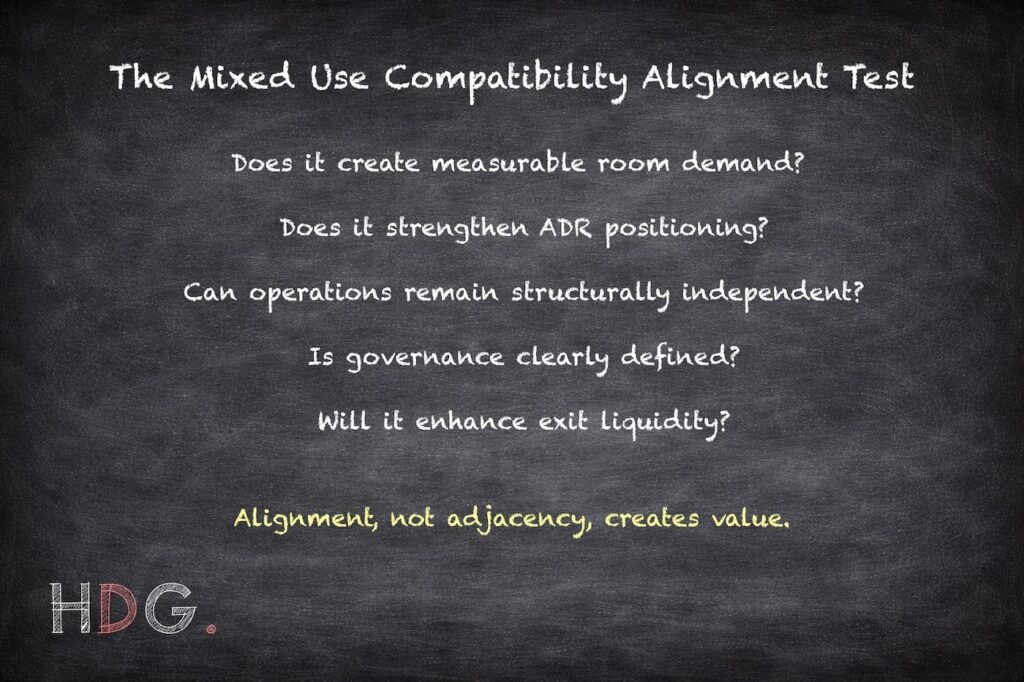
Compatible CRE describes the integration of hotel real estate with adjacent commercial uses that are demand-generative, brand-supportive, and operationally manageable. Compatibility is not automatic simply because two functions can share a podium or a structure. It must be tested against five strategic criteria:
- whether the adjacent use generates incremental room-night demand
- whether it strengthens ADR positioning
- whether it aligns with hotel classification
- whether operational systems can remain fully efficient, and
- whether the integration enhances rather than complicates the exit value.
In this sense, compatible CRE is contextual. A luxury urban hotel may integrate successfully with branded residences but struggle with mass retail below its guestrooms. A limited-service airport hotel may benefit from adjacent logistics or business park activity but gain little from lifestyle retail. Compatibility is therefore market-specific and classification-sensitive.
Mixed-Use Development as a Demand Multiplier
When structured correctly, mixed-use hotel development can create a self-reinforcing ecosystem. Office components generate weekday occupancy, corporate rate agreements, and meeting demand. Residential units provide built-in F&B customers and activate the immediate environment. Retail and curated dining enhance street presence and guest vibrancy. Leisure and cultural anchors create compression nights and event-driven revenue spikes.
In these circumstances, compatible CRE multiplies demand through proximity. It reduces reliance on a single segment and improves RevPAR stability across economic cycles. This effect is particularly powerful in urban CBDs, airport corridors, waterfront districts, and large-scale regeneration zones where land values justify vertical integration.
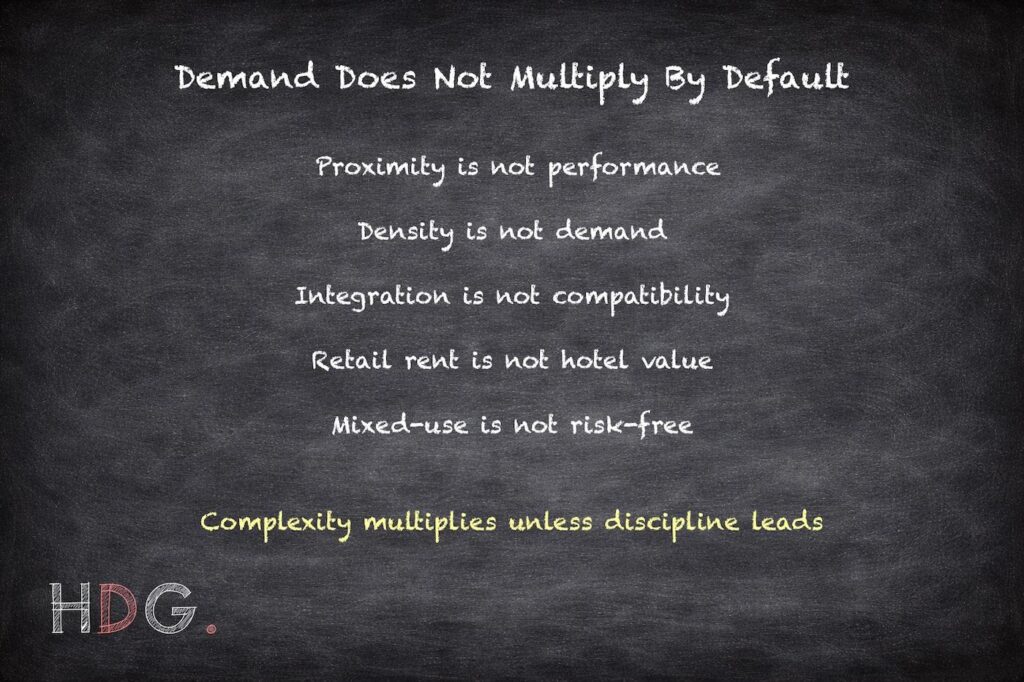
However, demand multiplication only occurs when integration is strategic. Simply co-locating uses does not guarantee synergy. Demand must be measurable, sustainable, and aligned with the hotel’s positioning.
Classes of Compatible Commercial Real Estate
Not all commercial real estate supports hotel performance equally. Different classes of real estate generate different demand patterns, operational implications, and brand impacts. When assessing compatible CRE within a multifunctional development, the developer must evaluate each adjacent use independently rather than assuming that mixed use automatically creates synergy.
Office, residential, retail, and leisure or cultural anchors each interact with hotel performance in distinct ways. Some primarily generate weekday occupancy, others activate food and beverage revenue, and others influence long-term positioning and perception. The degree to which each class qualifies as compatible CRE depends on measurable demand contribution, operational separation, governance clarity, and alignment with hotel classification.
The following sections examine the principal commercial real estate classes most frequently integrated into mixed-use hotel development, assessing where compatibility strengthens performance and where it introduces structural risk.
Office Integration: Stability with Structural Risk
Office space is traditionally viewed as highly compatible CRE for business-oriented hotels. The commercial logic is clear: offices generate weekday occupancy, corporate-negotiated rates, meeting room demand, and food-and-beverage crossover. In established CBDs and business districts, this relationship can strengthen base demand and smooth performance volatility, particularly for upscale and upper-midscale properties that rely on corporate transient segments.
However, office compatibility must now be tested against structural shifts in workplace behaviour. Hybrid and remote working models have reduced peak occupancy in many office markets. A hotel overly dependent on adjacent office demand may experience compression if that office base weakens. True compatible CRE in this context requires a diversified submarket where office demand complements, rather than defines, the hotel’s business mix.
Beyond the demand case, physical integration also matters. When hotels and offices share a tower or podium, vertical transport, lobby separation, and security zoning must be carefully planned to avoid dilution of the guest experience. Peak office traffic can conflict with hotel arrival flows if lift systems are undersized or poorly zoned. Shared loading areas, plant systems, or back-of-house facilities can introduce operational friction if not designed with full lifecycle capacity in mind.
In well-planned schemes, office integration provides demand stability without operational compromise. But compatibility exists only where commercial contribution and structural independence are both protected. Without both, the perceived stability of office demand can mask long-term operational and market risk.
Residential Integration: Value Multiplier or Operational Friction?
Residential integration is one of the most complex compatible CRE decisions in mixed-use hotel development because it affects demand, capital structure, and long-term control.
From a market and financing perspective, high-end branded residences paired with a luxury hotel can significantly enhance project viability. Residential sales often generate early capital returns, strengthen the funding structure, and reduce development risk. Shared amenities and brand positioning can create a mutually reinforcing lifestyle proposition, with residents supporting food and beverage, spa, and ancillary revenues. In prime urban or resort markets, this combination can materially enhance valuation.
However, the same capital logic can create structural tension. Developers frequently position residential units on the highest floors to maximise sales value. While commercially rational, this can compress the hotel vertically and complicate service logistics. Branded residences typically require separate entrances, dedicated lift zoning, and independent security protocols. Without clear vertical and operational separation, guest experience and brand integrity can be diluted.
Operational patterns also differ. Hotels function continuously with high service intensity; residential occupancy is private and long-term. Shared lobbies, loading docks, or mechanical systems can introduce friction if not designed with full separation and lifecycle capacity in mind. Once units are sold, governance becomes more complex, with homeowner associations influencing façade control, capital expenditure, and future repositioning decisions.
At the midscale level, residential integration often produces more tension than synergy. True compatible CRE in residential development requires alignment between capital strategy, vertical infrastructure design, and long-term operational control. Without that alignment, short-term financing gains may come at the expense of long-term hotel flexibility.
Extended-Stay Properties & Student Housing in Mixed-Use Development
Extended-stay products and purpose-built student accommodation (PBSA) are increasingly integrated into mixed-use schemes alongside traditional hotels. Although residential in form, their operational profile is closer to hospitality, making them distinct within a compatible CRE framework.
Extended-stay hotels and serviced apartments can complement traditional hotels by capturing longer-stay corporate, relocation, and project-based demand. Because these units are typically held under single ownership, they avoid the governance complexity of individually sold residential units and preserve operational control. In many markets, extended-stay strengthens demand diversification without diluting asset flexibility.
Student housing presents a more location-specific case. In strong university cities, it can provide predictable occupancy patterns and support retail activation in surrounding areas. However, seasonal cycles and demographic concentration must align with the hotel’s positioning to avoid perceptual mismatch.
The key compatibility factor is ownership and control. Uses that remain institutionally owned and operationally coherent are generally easier to integrate without constraining long-term strategy.
Retail and Ground Floor Strategy
Ground-floor retail is attractive to owners seeking secure lease income. A strong covenant tenant can provide predictable cash flow, which supports financing and reduces perceived risk. However, not all retail qualifies as compatible CRE. Retail must strengthen the hotel’s arrival experience, brand positioning, and long-term demand profile, not simply generate rent.
In high-footfall urban locations, curated retail and destination dining can enhance vibrancy and reinforce positioning. Carefully aligned operators may complement the hotel’s identity and activate the street frontage. In these cases, retail supports perception and pricing power.
The tension arises when prime ground-floor frontage is prioritised for leased retail income at the expense of the hotel’s visibility and spatial hierarchy. Compressing or relocating the hotel entrance to accommodate retail may appear commercially rational in the short term, but it can weaken brand presence and dilute arrival impact. The effect is gradual and difficult to quantify, yet over time it may suppress ADR potential and reduce asset positioning strength.
There are also operational and contractual implications. If hotel infrastructure is constrained to fit around retail, lobby scale, back-of-house efficiency, and vertical circulation may be compromised. Management contracts are structured to maximise total hotel revenue; independently leased retail that competes with in-house outlets can create alignment tension. Governance over servicing, loading, and shared space management must be clearly defined from inception.
Retail becomes compatible CRE only when it enhances the hotel’s long-term value rather than prioritising short-term rental certainty. If ground-floor leasing erodes brand clarity or operational efficiency, the security of retail income may ultimately come at the expense of sustained hotel performance.
Leisure, Culture, and Entertainment Anchors
Hotels located adjacent to convention centers, stadiums, cultural institutions, waterfront promenades, or major entertainment venues often benefit from periodic compression and strong event-driven occupancy. In such cases, compatible CRE exists through proximity to demand drivers rather than structural integration.
However, event-driven compatibility must be assessed carefully. Volatile demand patterns, security concerns, and noise impacts require mitigation. Compatible CRE in this context is strongest when event demand supplements a stable base rather than replacing it entirely.
The Live-Work-Play Model as a Structural Trend
The live-work-play model has become a defining feature of contemporary mixed-use development. Rather than separating residential, office, retail, and hospitality uses, developers increasingly cluster them within integrated urban schemes designed to create continuous activation and embedded demand.
For hotels, the model is attractive because it promises proximity-driven occupancy: residents generate lifestyle spend, offices drive weekday business, retail and leisure enhance vibrancy, and hotels capture transient demand across all segments. In high-density cities and regeneration districts, this structure can improve land efficiency and financing viability.
However, live-work-play only strengthens performance when the integration qualifies as compatible CRE. Density without structural separation, governance clarity, and measurable demand contribution can increase complexity without enhancing value. The strategic question is not whether to participate in the trend, but whether the ecosystem genuinely supports long-term hotel positioning and exit liquidity.
Vertical and Horizontal Mixed-Use Structures
Not all mixed-use development is configured in the same way. The distinction between vertical and horizontal integration is fundamental when assessing compatible CRE, because the physical structure directly influences operational control, governance complexity, and long-term flexibility.
Vertical Mixed-use
Vertical mixed-use typically involves stacking uses within a single building or tower, for example, retail at ground level, office in mid-floors, residential above, and a hotel occupying defined floors within the same structure. While this configuration can maximise land efficiency and urban density, it also concentrates complexity. Vertical circulation, lift zoning, fire strategy, security separation, and mechanical infrastructure must be precisely engineered. Shared cores or plant systems increase long-term interdependence between uses. The more vertically integrated the scheme, the greater the importance of structural independence within the design.
Horizontal Mixed-use
Horizontal mixed-use, by contrast, distributes uses across separate but adjacent buildings within a master-planned site. A hotel may sit alongside office, residential, or retail blocks rather than above or below them. This arrangement often reduces operational friction because each asset can retain its own entrances, back-of-house systems, plant, and vertical infrastructure. Compatibility in horizontal schemes is driven more by proximity and demand synergy than by structural integration.
From a compatible CRE perspective, vertical integration offers density and potential capital efficiency but increases governance and infrastructure risk. Horizontal integration generally preserves asset clarity and exit flexibility but may reduce development intensity.
Operational and Governance Risk in Mixed-Use Development
Mixed-use integration is often assessed through demand generation and valuation uplift. However, compatible CRE is equally dependent on operational coherence and governance clarity. Multifunctional schemes introduce structural and managerial complexity that does not exist in standalone hotel assets. Without disciplined planning and robust legal frameworks, friction can gradually erode performance.
Governance and Management Alignment
Operating a mixed-use development requires coordination across hospitality, retail, office, and sometimes residential components, each with distinct commercial priorities. Hotel operators focus on guest experience and revenue optimisation; retail leasing prioritises rental stability; office management emphasises tenant efficiency; residential oversight centres on privacy and long-term asset protection.
Aligning these objectives demands strong asset management oversight and a clearly defined governance architecture. Service charge allocation, capital expenditure responsibilities, façade control, signage rights, and shared-area maintenance must be clearly defined in the contract. In multi-owner structures, diverging interests can create tension over time. Compatible CRE at opening can become incompatible if long-term decision-making authority is unclear.
Infrastructure, Parking, and Peak-Load Pressure
Hotels depend on precise logistics, controlled access, and a predictable arrival experience. When loading docks, lift systems, plant infrastructure, or parking facilities are shared across uses, peak stacking becomes a structural risk.
Morning office arrivals may conflict with hotel checkouts; evening retail and restaurant traffic may compete with returning guests; event surges can overwhelm shared parking capacity. If parking ratios, drop-off sequencing, and entrance hierarchy are designed for average demand rather than cumulative peak usage, congestion becomes systemic rather than occasional.
Infrastructure planning must therefore anticipate differentiated user behaviour and peak overlap across all components. Cost efficiencies achieved through shared systems during development should not compromise long-term operational reliability or guest experience.
Compatible CRE and Hotel Classification
Compatibility must align with classification. Luxury hotels demand higher control over environment, access, and experiential integrity. Upper-upscale properties have limited tolerance for uncontrolled uses in adjacent properties. Midscale and limited-service properties may operate successfully within more multi-functional environments.
The higher the ADR ambition, the lower the tolerance for uncontrolled adjacency. The higher the classification, the stricter the compatibility threshold. Integration that weakens exclusivity, arrival sequence, or experiential control can directly suppress ADR potential.
Valuation and Exit Implications
From a valuation perspective, compatible CRE must convert into sustainable NOI uplift. Mixed-use integration only enhances value if it strengthens stabilised occupancy, supports ADR growth, or reduces earnings volatility. If synergy does not translate into measurable income resilience, it does not translate into asset value.
Well-structured, compatible CRE can improve demand diversification, enhance institutional appeal, and smooth performance across cycles. Large institutional investors may favour multifunctional environments where demand drivers are embedded within a broader ecosystem. In such cases, mixed-use integration can support pricing strength and exit liquidity.
However, not all buyers view mixed-use positively. Many hotel-focused investors prefer pure-play hospitality assets and may avoid structures that include office, retail, or residential complexity. Where asset identity becomes blurred, valuation can become less transparent. Buyers may apply risk discounts to reflect governance layers, shared infrastructure exposure, or uncertainty over long-term control.
Liquidity at exit is often strongest when each component of a mixed-use scheme can be independently demised, legally separated, and operationally self-sufficient. Separate titles, clear service charge mechanisms, independent utility metering, and defined plant responsibility reduce friction in a sale process. Conversely, shared power systems, mechanical interdependence, or cross-default provisions between uses can complicate underwriting and suppress pricing.
Exit strategy must therefore be considered from inception. Compatible CRE enhances value by broadening the buyer universe without increasing structural ambiguity. If integration narrows the pool of credible buyers or introduces governance risk, the multifunctional logic may ultimately weaken exit performance rather than strengthen it.
Should You Integrate or Stand Alone?
The decision to pursue compatible CRE integration depends on land economics, planning constraints, urban density, demand profile, and capital structure. In high land value cities, mixed-use development may be necessary to achieve viable residual land value. In secondary markets, standalone hotel development may provide greater operational clarity and long-term flexibility.
Mixed-use enhances diversification and financing attractiveness but reduces simplicity and control. The strategic developer must weigh these factors through a lens of compatibility rather than defaulting to density maximisation.
Final Position
Compatible CRE is not about stacking uses together. It is about aligning demand generation, operational logic, brand integrity, governance structure, and exit strategy. Mixed-use development can multiply demand. It can also multiply complexity.
The core question remains: does the integration measurably strengthen long-term hotel value? If the answer is not demonstrably yes, compatibility should be reconsidered.
Further resources:
See HDG – Hotel Asset Management
See Lodging Magazine – “Pluses and Minuses: Mixed Reviews on Mixed-Use Developments“ September 2025