
In hotel development, site location factors are not simply descriptive characteristics of a plot; they are the strategic filters that determine whether a project should proceed at all. Before feasibility models, brand negotiations, or design concepts begin, the land itself must be interrogated through the lens of demand, accessibility, competitive positioning, regulatory certainty, physical efficiency, and long-term investment logic.
The right site amplifies performance and protects downside risk. The wrong site locks in structural weakness that no operator or financial engineer can fully correct. The following framework outlines how to systematically assess whether a land plot or an existing building truly supports sustainable hotel development.
- How to Assess Whether a Land Plot or Building Is Suitable for Hotel Development
- Demand Fundamentals: The Primary Site Location Factors
- Accessibility and Connectivity as Site Location Factors
- Operational Environment & Labour Market Considerations
- Competitive Landscape and Market Positioning
- Physical Characteristics of the Plot or Building
- Environmental & Climate Exposure
- Regulatory and Planning Certainty
- Development Economics and Cost Sensitivity
- Brand Alignment and Strategic Fit
- Alternative Use Flexibility & Downside Optionality
- Risk Concentration and Exit Liquidity
- Conclusion: Site Location Factors Define Long-Term Value
How to Assess Whether a Land Plot or Building Is Suitable for Hotel Development
In hotel development, site location factors determine everything. Before brand selection, operator negotiations, financial structuring, or design concepts, the viability of a hotel project is defined by its location. Strong site location factors support sustainable ADR, resilient occupancy, efficient development cost, long-term asset appreciation, and exit liquidity. Weak site location factors, by contrast, cannot be repaired by branding, management expertise, or marketing budgets. For investors, developers, and asset managers, understanding site location factors is therefore the first and most decisive stage of hotel feasibility.
This guide outlines the core site location factors that determine whether a land plot or building is appropriate for hotel development. These factors combine demand analysis, accessibility, competitive positioning, physical feasibility, regulatory certainty, development cost implications, and long-term investment logic. When properly assessed together, they form a structured framework for disciplined decision-making.
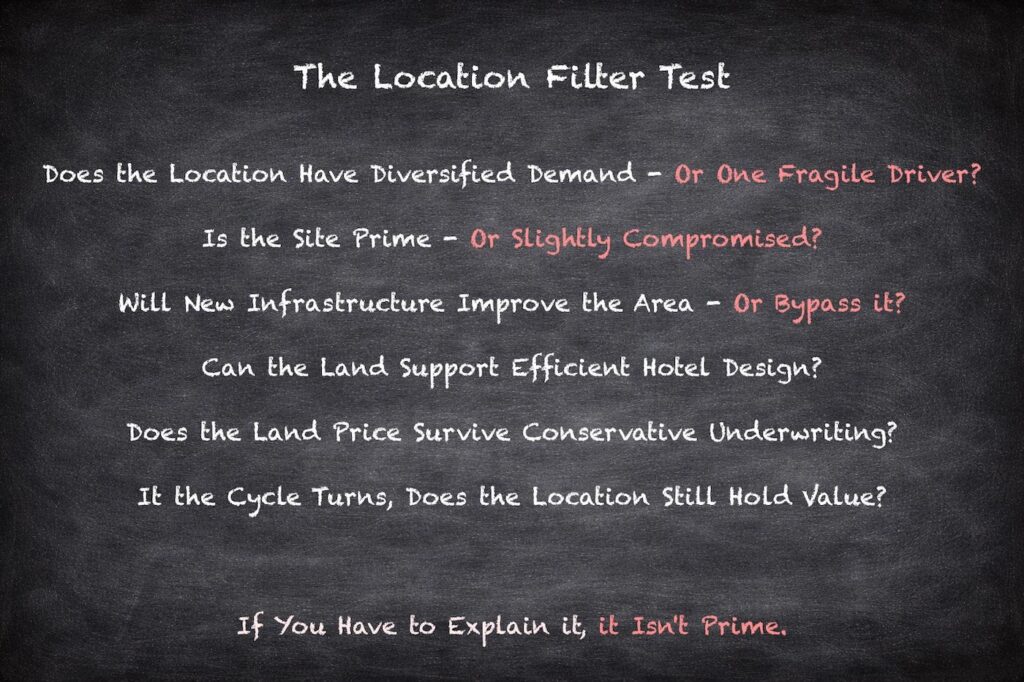
Demand Fundamentals: The Primary Site Location Factors
The most fundamental of all site location factors is demand. A hotel must exist within a reliable and sustainable demand ecosystem. Without sufficient demand drivers, even the most architecturally impressive property will struggle to achieve commercial viability.
Macro-level Site Location Factors
Macro-level site location factors include tourism flows, corporate activity, transport infrastructure, visa accessibility, geopolitical stability, and seasonality patterns. These structural drivers determine the size, stability, and depth of the demand pool long before individual site characteristics come into play. A location supported by an international airport with multiple carriers, diversified source markets, and year-round connectivity is fundamentally different from a destination reliant on a single charter route or seasonal airline capacity. Likewise, strong domestic travel demand can provide resilience when international flows weaken, while a robust corporate base can stabilise occupancy outside peak leisure periods.
Diversification of demand segments is one of the most powerful macro site location factors. Markets supported by a mix of international leisure, domestic leisure, corporate travel, group business, and events are inherently more resilient than those dependent on a single segment. Seasonality must also be analysed carefully. A destination operating at high occupancy for four months but with weak performance for eight months requires a very different development strategy, cost structure, and financing approach compared to a stable year-round urban market. Understanding these macro site location factors allows investors to calibrate risk, positioning, and capital exposure before moving to micro-level analysis.
Future Urban Trajectory & Infrastructure Pipeline
Site location factors must be assessed not only in their current condition but in their likely future trajectory. A location that appears secondary today may become prime if supported by confirmed infrastructure investment, transport expansion, or large-scale regeneration. Conversely, an area that appears stable may face long-term stagnation if demand drivers shift or infrastructure capacity becomes constrained.
Investors should analyse planned metro lines, airport expansions, convention centre developments, mixed-use schemes, waterfront regeneration projects, and government masterplans. Confirmed public investment often precedes private capital inflows, and hotel development positioned ahead of infrastructure completion can benefit from yield compression over time. However, speculative assumptions based on unapproved projects introduce risk. A robust site-location factors analysis distinguishes between committed infrastructure and aspirational announcements.
A well-located hotel building is often a 50-year-plus real estate asset, and in prime markets may operate across multiple ownership and brand cycles over several decades. Its performance will be shaped by how the surrounding urban environment evolves over the long term, not merely by current demand conditions.
Micro-level Site Location Factors
Micro-level site location factors are equally critical. Proximity to business districts, convention centres, hospitals, universities, cultural attractions, beach access, ski lifts, retail clusters, and transport hubs materially influences hotel performance. A difference of just a few hundred metres in an urban setting can shift a site from prime to secondary positioning. Investors must clearly distinguish between primary demand zones and peripheral spillover areas, as this distinction directly affects achievable ADR and long-term competitiveness.
The same principle applies in resort markets. A summer property set behind a coastal road, even if technically “near the beach,” performs very differently from a hotel with direct beachfront access. A seamless connection between rooms and the shoreline supports higher ADR and stronger positioning. Once guests must cross a road or walk several minutes, the asset shifts from prime beachfront to secondary status, with clear pricing implications.
Airport markets show a similar dynamic. A hotel that is genuinely walkable from the terminal has a distinct competitive advantage over one that requires a taxi or shuttle, even if the journey is only a few minutes. The moment transport is required, the property begins competing not just with airport hotels but also with city hotels farther away. Walkability, in this segment, is not a detail; it defines the category.

Accessibility and Connectivity as Site Location Factors
Among the most visible site location factors is accessibility. Hotel guests value ease of access above almost all other physical considerations. A site may appear centrally located on a map but perform poorly if road access is congested, confusing, or poorly integrated with transport networks.
Time-based accessibility is more important than distance-based accessibility. A hotel located twenty minutes from an airport via a reliable highway may outperform one located ten kilometres away, but subject to unpredictable traffic congestion. Public transport connectivity also plays an increasingly important role, particularly in European and urban markets. Direct metro access, walkability, and seamless transfers enhance a hotel’s appeal to both corporate and leisure travellers.
Drop-off design, parking capacity, coach access, and traffic flow patterns also fall within key site location factors. If arrival is stressful or inefficient, the guest experience is negatively impacted from the outset. Over time, friction at arrival translates into reputational and commercial cost.
Visibility further strengthens site location factors. Strong frontage, corner positioning, waterfront presence, skyline exposure, or landmark adjacency improve brand recognition and impulse booking behaviour. A hidden or poorly visible hotel may require significantly higher marketing spend to compensate for its physical disadvantages.
Operational Environment & Labour Market Considerations
Site location factors extend beyond guest demand and physical positioning to include the operational ecosystem that supports the hotel on a daily basis. Labour availability, wage levels, commuting times, and local employment conditions directly affect operating margins and service quality. A resort in a remote coastal area may achieve strong ADR but face chronic staffing shortages, high employee housing costs, or elevated turnover. Urban sites with strong public transport connectivity may benefit from broader labour pools and more stable workforce access.
Back-of-house logistics also influence operational efficiency. Proximity to suppliers, waste management infrastructure, service entrances, and delivery access are often overlooked during acquisition. In high-density urban environments, restricted service access can create ongoing operational friction. Sustainable site location factors analysis considers not only where guests arrive, but also how staff and suppliers sustain the operation long term.
A location that appears commercially attractive but operationally constrained may experience persistent margin pressure despite strong top-line performance.
Competitive Landscape and Market Positioning
Site location factors must always be evaluated in the context of existing and future competition. A strong location in isolation does not guarantee success if competitive supply is excessive or poorly aligned with demand trends.
A thorough analysis should assess the size of the competitive set, classification mix, international versus domestic brand presence, and pipeline supply. Markets experiencing rapid new supply growth may face ADR compression even when demand remains stable. Conversely, markets with constrained supply often support pricing power and brand entry opportunities.
Understanding white space within the competitive environment is an essential component of site location factors. Is there an underserved segment? Is upper-upscale demand unmet, or is the market oversaturated with midscale inventory? A site may be physically attractive yet commercially unviable if it forces entry into an oversupplied category.
In hotel development, entering a stable growth market differs fundamentally from entering a “knife fight” market. Site location factors must therefore incorporate forward-looking competitive risk, not merely current performance snapshots.
Physical Characteristics of the Plot or Building
Physical site location factors determine development efficiency and cost structure. Even in strong demand environments, an inefficient site can undermine project economics.
Plot geometry directly influences the feasibility of hotel design. Regular-shaped plots allow efficient floorplates and double-loaded corridors, optimising room count and operating efficiency. Irregular sites often result in compromised layouts, reduced keys, and higher cost per key. Density allowances, height restrictions, setback requirements, and floor area ratios must be analysed early to confirm whether the site supports optimal scale.
Topography also plays a decisive role in site location factors. Sloped land increases excavation cost, complicates basement construction, and may require structural reinforcement. Ground conditions influence foundation expense, particularly in seismic zones where engineering requirements are stringent.
For existing buildings considered for conversion, structural grid compatibility, ceiling heights, façade restrictions, and window spacing are essential physical site location factors. A building that “resists” a hotel configuration typically results in inflated capital expenditures and long-term operational inefficiencies.
Views and orientation contribute both upside and downside potential. Sea views, skyline exposure, or landmark adjacency may justify premium positioning. Conversely, noise exposure, overshadowing from future development, or unattractive surroundings may constrain achievable ADR.
Environmental & Climate Exposure
Environmental risk is an increasingly material component of site location factors. Coastal flood exposure, erosion risk, wildfire zones, seismic intensity, extreme heat patterns, water scarcity, and storm frequency can significantly influence both development cost and long-term insurance premiums. In certain markets, climate exposure may materially affect lender appetite and exit liquidity.
Hotels located in beachfront environments may benefit from premium ADR positioning, yet face rising insurance costs and regulatory constraints over time. Urban sites may experience heat stress and infrastructure strain as cities densify. Water-intensive resort operations in drought-prone regions may encounter supply restrictions or rising utility costs.
Comprehensive site location factors analysis, therefore, incorporates environmental resilience alongside physical feasibility. A location that performs strongly in the short term but carries escalating climate risk may see long-term value erosion.
Regulatory and Planning Certainty
Legal and regulatory considerations are among the most critical factors in hotel site location. Zoning classification must explicitly permit hotel use, ideally without discretionary approvals that introduce uncertainty or delay.
Developers must confirm tourism designation status where applicable, heritage overlays, environmental restrictions, and building code compliance requirements. In seismic regions, structural regulations can significantly increase cost and influence structural design choices. Fire and life safety compliance must also be assessed thoroughly at the feasibility stage.
Title clarity is fundamental. Ownership disputes, encumbrances, easements, or registry complications introduce risk that can derail financing and delay development timelines. Robust site location factors analysis includes legal due diligence as an integral component rather than an afterthought.
Development Economics and Cost Sensitivity
Site location factors ultimately converge in financial feasibility. A site may score highly on demand, accessibility, and visibility yet fail if acquisition cost exceeds economic capacity.
Residual land value logic provides a disciplined filter. Stabilised net operating income must be projected conservatively, using realistic occupancy and ADR assumptions derived from market evidence. Applying a market-appropriate capitalisation rate produces an implied stabilised value. From this value, the total development cost is deducted to determine the land value that the project can economically support.
If the asking price materially exceeds this residual value, the site is not viable regardless of emotional appeal or architectural ambition. One of the most common errors in hotel development is acquiring land based on comparable residential or commercial values rather than hotel-specific economics.
Sensitivity testing further strengthens the site location factors analysis. If a modest occupancy decline or ADR adjustment renders the project unviable, the margin for error is insufficient. Conservative underwriting protects long-term asset stability.
Brand Alignment and Strategic Fit
Site location factors must align with the brand and positioning strategy. Not every location supports luxury development. Not every transport-oriented location supports full-service operation.
Luxury hotels require strong international demand, prestigious addresses, and meaningful ADR ceilings. Midscale and limited-service formats perform better in transport hubs or suburban commercial corridors. Extended-stay concepts depend for example on durable corporate or medical demand.
Misalignment between site characteristics and brand ambition frequently destroys feasibility. Over-positioning increases cost without commensurate revenue. Under-positioning leaves value unrealised. Site location factors must therefore integrate with the positioning strategy from the earliest feasibility stage.
Alternative Use Flexibility & Downside Optionality
Sophisticated investors evaluate site location factors not only on projected hotel performance but also on the flexibility of alternative uses. If market conditions shift or hotel operations underperform, can the asset be repurposed into residential, serviced apartments, office, mixed-use, or branded residences? Sites located within mixed-use zones or strong residential corridors often provide greater downside protection than single-use hospitality enclaves.
Land that supports multiple development pathways typically carries lower structural risk. Conversely, highly specialised resort sites or remote hospitality-only zones may offer limited fallback options. In such cases, investor exposure becomes concentrated solely on hotel performance.
Alternative use flexibility does not replace feasibility discipline, but it enhances resilience. In cyclical industries such as hospitality, downside optionality is itself a critical site location factor.
Risk Concentration and Exit Liquidity
A comprehensive assessment of site location factors includes risk concentration and exit considerations. Development risk is cumulative. A site with moderate demand volatility may still be viable if regulatory certainty and competitive positioning are strong. However, multiple high-risk factors compound and increase exposure.
Exit liquidity is particularly important for institutional investors. Prime urban markets generally offer broader buyer pools and stronger liquidity. Secondary or tertiary markets may restrict resale options to domestic buyers, limiting exit flexibility.
If a location lacks long-term investor appeal, this should influence acquisition decisions. Site location factors are not only about operational success but also about future acceptance in the capital market.
Conclusion: Site Location Factors Define Long-Term Value
In hotel development, site location factors are not a preliminary checklist; they are the strategic foundation of the entire investment. Every subsequent decision, design, brand affiliation, operator selection, financing structure, asset management, and exit timing flows from the initial site choice.
Disciplined analysis of site location factors integrates demand fundamentals, accessibility, competition, physical feasibility, regulatory certainty, development economics, brand alignment, and exit liquidity. When these elements align, the probability of sustainable performance and long-term value creation increases significantly. When they do not, no operator, brand, or financial engineering can permanently compensate.
For serious hotel investors, the correct site is not merely where a hotel can be built. It is where a hotel should be built.
Further resources:
See HDG – Hotel Asset Management
Choice Hotels Australia & New Zealand – “Choosing a Location, What You Need to Know”