
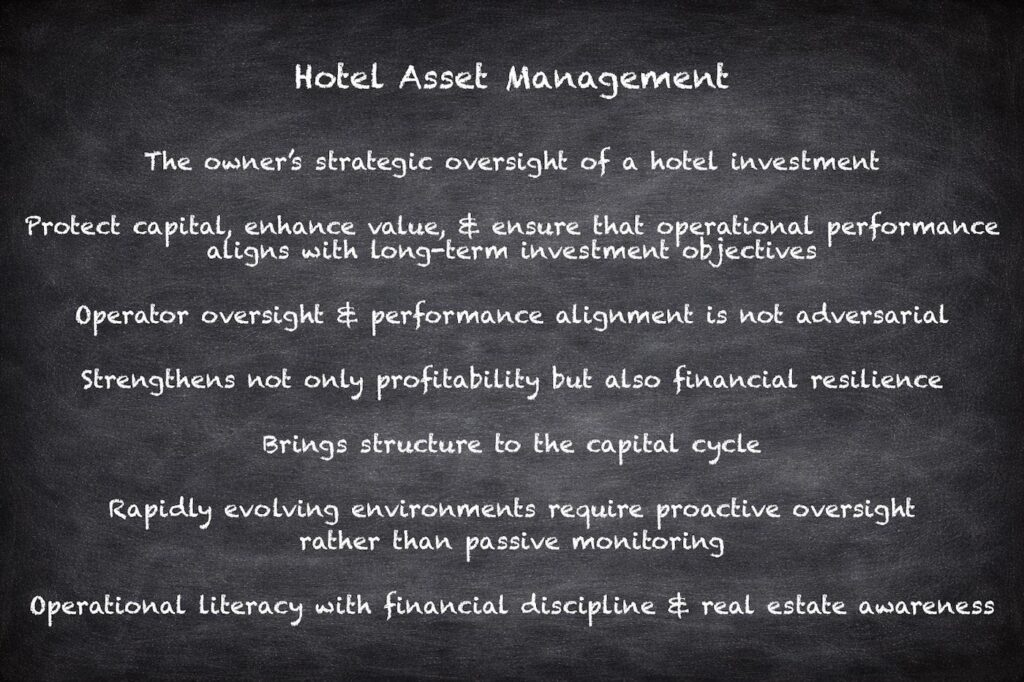
Hotel asset management represents the owner’s strategic oversight of a hotel investment. While operators are responsible for running the hotel on a day-to-day basis, and brands focus on standards and distribution systems, the asset manager’s role is fundamentally different. Asset management exists to protect capital, enhance value, and ensure that operational performance aligns with long-term investment objectives.
- What Is Hotel Asset Management?
- Operator Oversight and Performance Alignment
- Financial Discipline and Capital Performance
- Capital Expenditure and Lifecycle Planning
- Contract Strategy and Structural Review
- Asset Management Across Ownership Models
- Asset Management vs Operational Management
- Value Creation Through Strategic Oversight
- Asset Management in Volatile or Emerging Markets
- A Capital Stewardship Approach
- Hotel Asset Management Summary
A hotel is both an operating business and a real estate asset. Without disciplined oversight, the priorities of management, brand, lender and owner can gradually diverge. Hotel asset management provides the framework through which ownership maintains strategic control. It translates operational results into investment decisions, ensuring the property performs not only as a hotel but also as a capital asset.
In a sector where contracts frequently run for 15–25++ years, and capital cycles are measured in decades, asset management is not an administrative function. It is central to value creation.
What Is Hotel Asset Management?
Hotel asset management is the ongoing strategic supervision of a hotel on behalf of the owner. It does not involve managing staff, setting daily room rates, or operating the front office. Instead, it focuses on evaluating performance, challenging assumptions, reviewing contractual compliance, and guiding long-term direction.
The distinction is important. A hotel general manager concentrates on trading results: occupancy, ADR, RevPAR, and cost control. An asset manager concentrates on returns: net operating income, capital efficiency, risk exposure, and exit value.
This oversight function becomes particularly significant in structures where the owner is separated from the operator, such as management agreements or franchise models. In those cases, the operator controls the business, but the owner retains the financial risk. Asset management ensures that control and risk remain aligned. At its core, hotel asset management is about protecting the owner’s investment and adapting it to evolving market conditions.
Operator Oversight and Performance Alignment
In managed or franchised hotels, the relationship between owner and operator is governed by contract. These contracts define fee structures, performance tests, reporting obligations and capital responsibilities. However, contractual protection alone is rarely sufficient. Active oversight is required to ensure the spirit of the agreement is upheld.
Asset management involves a detailed review of annual budgets and business plans, not simply approving them. It requires assessing whether revenue projections are realistic, staffing assumptions are appropriate, and expense ratios align with market benchmarks. When performance deviates from expectations, the asset manager investigates the underlying causes and works with the operator to implement corrective strategies.
This process is not adversarial. The objective is alignment. Operators seek operational success; owners seek financial return. Asset management ensures that both objectives move in the same direction.
Explore Hotel Operator Oversight →
Financial Discipline and Capital Performance
Because a hotel is an income-producing real estate asset, financial discipline is central to asset management. Monthly performance reports must be analysed not only for trading results, but for implications on cash flow, debt service, and valuation.
A modest decline in operating margin can materially affect asset value when capitalised at market yields. Conversely, incremental improvements in efficiency can significantly enhance investment returns over time. Asset management, therefore, focuses on variance analysis, forward cash flow forecasting, and scenario planning.
In leveraged structures, oversight also includes monitoring compliance with loan covenants and preparing the asset for refinancing. Clear reporting, credible forecasting, and performance stability improve lender confidence and reduce financing risk. In this sense, asset management strengthens not only profitability but also financial resilience.
Capital Expenditure and Lifecycle Planning
Hotels require continual reinvestment. Guestrooms age, public areas lose competitiveness, and building systems reach the end of their lifecycle. Brands may impose a property improvement plan (PIP), and regulatory environments may evolve.
Asset management brings structure to this capital cycle. Rather than reacting to deterioration or brand mandates, the asset manager develops forward-looking capital plans that balance competitiveness with return on investment. Timing becomes critical. Premature renovation erodes returns; delayed renovation damages positioning and pricing power.
Strategic capital planning also extends beyond aesthetic upgrades. Structural compliance, sustainability improvements, and mechanical system renewals must be considered within a broader lifecycle framework. The objective is to preserve asset integrity while optimising capital deployment.
Contract Strategy and Structural Review
Over time, ownership objectives may change. Markets evolve, financing structures shift, and brand landscapes develop. An agreement signed at development stage may no longer represent the optimal structure five or ten years later.
Hotel asset management, therefore, includes periodic evaluation of the contractual framework. This may involve assessing fee levels, reviewing performance test thresholds, examining incentive fee structures, or analysing the potential benefits of rebranding or conversion.
In some cases, renegotiation can materially improve owner returns. In other cases, preparing the asset for an eventual exit may require adjusting the operating model to enhance buyer appeal. Asset management ensures that contractual arrangements remain aligned with investment strategy rather than becoming static constraints.
Asset Management Across Ownership Models
The importance of asset management varies according to the ownership structure, but it is rarely absent.
- In owner-operated hotels, the function may be internalised, yet strategic oversight remains essential to avoid operational bias influencing capital decisions.
- In managed hotels, asset management plays a more formalised role, ensuring that the operator’s performance meets contractual and financial expectations.
- In franchise structures, where the owner assumes operational risk while paying brand fees, asset management focuses on profitability, brand compliance, and cost efficiency.
- In lease models, the emphasis shifts toward tenant covenant strength, lease terms, and long-term asset positioning.
Regardless of structure, the unifying principle remains the same: the asset must serve the owner’s capital objectives.
Asset Management vs Operational Management
Confusion often arises between operational management and asset management. The distinction lies not in competence, but in perspective.
Operational management focuses on running the hotel effectively, delivering service, managing teams, and achieving revenue targets. Asset management, by contrast, focuses on capital performance and strategic direction. It interprets results, questions assumptions, and evaluates long-term implications.
Both functions are essential. However, their incentives and time horizons differ. Operational managers are judged on annual results. Asset managers evaluate decisions within a multi-year investment framework.
Value Creation Through Strategic Oversight
Hotel asset management creates value through incremental, disciplined decision-making rather than dramatic interventions. Improvements in margin, optimisation of fee structures, and disciplined capital timing compound over time.
Value is also created through risk mitigation. Identifying emerging regulatory requirements, anticipating market shifts, or preparing for refinancing reduces volatility and enhances investor confidence. In competitive markets, stability and predictability are often rewarded with stronger valuations.
Perhaps most importantly, asset management prepares the asset for liquidity. Whether through sale, refinancing, or restructuring, an asset that demonstrates consistent oversight and transparent reporting commands greater market confidence.
Asset Management in Volatile or Emerging Markets
In markets characterised by regulatory change, financing constraints, or structural risk, asset management becomes even more critical. Rapidly evolving environments require proactive oversight rather than passive monitoring.
Strategic capital planning, contractual flexibility, and risk assessment are particularly important where market conditions can shift quickly. Asset management ensures that ownership remains responsive, rather than reactive, to external pressures.
A Capital Stewardship Approach
Effective hotel asset management combines operational literacy with financial discipline and real estate awareness. It requires understanding how a hotel functions operationally, while never losing sight of its role as an investment vehicle.
The objective is not to micromanage operators or interfere with daily decisions. It is to provide structured, informed oversight that aligns performance with ownership strategy. Hotels trade daily, but they are owned for years. Asset management ensures that daily trading decisions enhance long-term value.
Hotel Asset Management Summary
Hotel asset management sits at the intersection of operations and investment. It protects capital, strengthens performance, and enhances strategic flexibility.
In an industry defined by long-term contracts, capital intensity, and operational complexity, disciplined oversight is fundamental. Owners who actively manage their assets are better positioned to navigate volatility, optimise returns, and realise value at exit.
Ultimately, hotel asset management ensures the asset serves the owner’s objectives, not merely drives operational momentum.
Further resources:
See Hotels Magazine (February 2026) – “Why and when hotels should consider third-party asset management“