
Architectural planning is not a design exercise. It is a capital discipline. For hotel investors and developers, architectural planning determines whether an asset compounds value or quietly erodes it over decades. Every structural span, every circulation corridor, every service shaft, and every core position influences operational efficiency, payroll intensity, maintenance costs, flexibility, and, ultimately, exit yield. Hotels are long-duration assets. Architectural mistakes are therefore long-term liabilities.
This guide explains architectural planning from an investor’s perspective. It is not about decorative expression, interior styling, or brand storytelling. Those disciplines matter and will be addressed separately. Architectural planning, in the development sense, is about economic performance in built form. It is about protecting net operating income, preserving optionality, and engineering resilience into the physical asset.
If commercial intent is unclear, architecture becomes expensive guesswork. If architectural planning is disciplined, the asset becomes structurally aligned with long-term value.
- Architecture Follows Commercial Strategy
- The Architectural Planning Timeline in Hotel Development
- Stage 1 – Pre-Feasibility and Capacity Testing
- Stage 2 – Concept Design and Commercial Geometry Lock
- Stage 3 – Planning Submission and Envelope Commitment
- Stage 4 – Detailed Design and Multidisciplinary Coordination
- Stage 5 – Tender and Controlled Value Engineering
- Stage 6 – Construction and Site Reality
- Stage 7 – Handover, Stabilisation, and Operational Proof
- The Compression of Flexibility and Decision Gates
- Who Controls Architectural Planning?
- The Developer: Commercial Authority and Final Accountability
- The Architect: Spatial Translator of Commercial Intent
- The Operator: Operational Advisor, Not Structural Author
- The Engineers: Technical Integrity and System Viability
- The Cost Consultant: Capital Discipline Without Structural Compromise
- The Project Manager: Sequencing and Decision Gate Control
- Collaboration in Execution, Singularity in Accountability
- Site Constraints Define the Development Envelope
- Gross-to-Net Efficiency and Revenue Logic
- Structural Grid and Long-Term Flexibility
- Vertical Circulation and Core Discipline
- Back-of-House as Operational Infrastructure
- Public Space Strategy and Commercial Alignment
- Integration of Building Systems
- Code Compliance and Regulatory Risk
- Conversion Versus Ground-Up Architectural Planning
- Constructability and Programme Discipline
- Value Engineering Without Value Destruction
- Architecture and Exit Valuation
- What Architectural Planning Is Not
- The Core Principle
Architecture Follows Commercial Strategy
Architectural planning must begin with development strategy, not sketching.
Before any line is drawn, the investor must define positioning, target demand segmentation, brand or independent strategy, hold-period assumptions, and the exit profile. An urban transient hotel, a lifestyle conversion, a resort, and an extended-stay asset each require different structural logic. Ceiling heights, public space ratios, service cores, and room modules shift depending on commercial intent.
Architecture should never lead strategy. Strategy defines the economic framework. Architectural planning translates that framework into spatial reality.
For example, if the development thesis assumes repositioning potential within ten years, the structural grid and vertical systems must allow reconfiguration. If the strategy anticipates sale to an institutional buyer, functional efficiency and compliance discipline will directly influence cap rate perception. Architectural planning is therefore inseparable from valuation logic.
When developers allow aesthetic ambition to outrun feasibility discipline, they introduce structural inefficiency that compounds for decades. Architecture must respond to the business model, not compete with it.
The Architectural Planning Timeline in Hotel Development
Architectural planning in hotel development is not a single decision. It is a sequence of irreversible commitments.
At each stage of development, flexibility narrows. Risk shifts. Costs solidify. What appears adjustable at the concept stage becomes structurally fixed by detailed design. What is ignored during feasibility becomes expensive during construction.
Understanding the architectural planning timeline allows investors and developers to intervene at the right moment, not after options have disappeared.
Below is the structured progression of architectural planning in hotel development, from early feasibility through post-opening operational reality.
Stage 1 – Pre-Feasibility and Capacity Testing
Architectural planning begins before design.
At the pre-feasibility stage, the objective is not beauty. It is capacity testing. The developer must determine whether the site can physically support the commercial thesis.
This stage typically involves high-level massing studies, indicative stacking diagrams, and regulatory envelope analysis. The key questions are fundamental: How many keys are realistically achievable? What is the approximate gross floor area? Are there fatal planning constraints? Does the buildable footprint support efficient double-loaded corridors? Can vertical circulation be accommodated without distorting the floorplate?
Errors at this stage are rarely visible immediately. They emerge later as reduced key count, compromised room layouts, or structural inefficiency. A five percent miscalculation in buildable efficiency at this stage can permanently distort return on cost.
By the end of pre-feasibility architectural planning, three elements should be understood with clarity: the probable key count range, the likely efficiency ratio, and the structural density limits. If these are unclear, development risk is already embedded.
Stage 2 – Concept Design and Commercial Geometry Lock
Concept design is where architectural planning becomes structurally consequential.
At this stage, the structural grid is established. Core positions are defined. Vertical circulation logic is determined. Typical room modules are tested and refined. Floor-to-floor heights are proposed. Back-of-house ratios are approximately allocated. Public space proportions are outlined.
This is the most dangerous stage in the architectural planning timeline because decisions made here are extremely difficult to reverse later without substantial cost. Once the structural grid is coordinated with the core layout, flexibility narrows dramatically. Changing elevator positions or corridor logic after concept sign-off often requires redesign of the entire structural system.
Investors should be deeply engaged during this phase. It is not sufficient to rely solely on aesthetic presentations. The commercial geometry must be interrogated. Does the grid support room flexibility? Are core locations minimising housekeeping walking distances? Are public areas appropriately scaled to revenue assumptions? Are structural spans rational for cost control?
When concept design is signed off, the economic skeleton of the building is largely established. Detailed design may refine it, but it cannot fundamentally transform it without a severe capital impact.
Stage 3 – Planning Submission and Envelope Commitment
During planning submission, architectural planning shifts from internal efficiency to external compliance.
The building mass, envelope articulation, height, and relationship to the public realm become central. Regulatory approval processes often focus on façade treatments, height impacts, parking ratios, environmental compliance, and the urban interface. By this stage, the building’s macro form is largely set.
This stage introduces a new category of risk: regulatory delay and planning compromise. If height reductions are imposed, key count may be affected. If façade articulation requires structural adjustment, cost may increase. If parking ratios exceed initial assumptions, the basement design may become more complex.
Investors must understand that, once planning approval is granted, changes to the envelope or massing are rarely straightforward. The architectural planning decisions made at this stage influence both programme certainty and capital exposure.
By the end of planning submission, the building’s external form and structural ambition are substantially committed.
Stage 4 – Detailed Design and Multidisciplinary Coordination
Detailed design is where architectural planning integrates fully with engineering and operational realities.
Structural systems are finalised. Mechanical, electrical, and plumbing coordination is resolved. Riser positions are fixed. Ceiling void depths are confirmed. Fire strategy is embedded into final layouts. Back-of-house spaces are refined. If an operator is appointed, brand standards are incorporated.
However, detailed design is not the stage to rethink structural fundamentals. If core positioning is flawed or room modules inefficient, detailed design cannot correct them without significant redesign and cost escalation.
This stage determines buildability. It is also where latent design conflicts surface. Inadequate coordination between architecture and engineering often manifests here as reduced ceiling heights, awkward bulkheads, or compromised room proportions.
At the end of detailed design, flexibility is minimal. Structural geometry, riser locations, and plant allocations are effectively locked. Architectural planning has transitioned from a conceptual framework to executable documentation.
Stage 5 – Tender and Controlled Value Engineering
The tender stage introduces cost pressure. Market pricing reveals whether architectural ambition aligns with capital reality.
Value engineering discussions inevitably arise. Façade materials may be simplified. Structural systems may be rationalised. Specification levels may be adjusted. However, disciplined architectural planning protects structural fundamentals.
This stage requires strong developer leadership. Savings should be achieved through standardisation, simplification, and optimisation of specifications, not by compromising ceiling heights, room dimensions, or service capacity.
When value engineering attacks structural geometry, the long-term consequences often outweigh short-term savings. A marginal reduction in floor-to-floor height may permanently restrict future repositioning. Eliminating service flexibility may increase operational inefficiency for decades.
The architectural planning discipline at the tender stage distinguishes between cost optimisation and value destruction.
Stage 6 – Construction and Site Reality
Construction tests architectural planning under real conditions.
Coordination errors become visible. Site constraints introduce practical challenges. Material lead times and contractor interpretation affect execution quality. Changes at this stage are expensive and disruptive.
Strong architectural planning reduces site variations. Clear documentation, rational geometry, and integrated coordination minimise change orders. Weak architectural planning manifests in delayed decisions, design clarifications, and reactive problem-solving.
During construction, the architect’s role shifts from design author to quality guardian. However, by this stage, the opportunity to influence economic fundamentals has largely passed.
The building being constructed is the consequence of earlier architectural planning discipline, or lack of it.
Stage 7 – Handover, Stabilisation, and Operational Proof
Architectural planning is ultimately validated during operations.
After opening, the building’s efficiency becomes measurable. Housekeeping walking distances reveal circulation logic quality. Guest elevator wait times reveal core adequacy. Energy consumption reveals envelope and system integration quality. Maintenance accessibility reveals service planning foresight.
Operational teams quickly identify architectural strengths and weaknesses. Narrow service corridors, poorly positioned linen rooms, insufficient storage, or under-sized plant areas become daily friction points.
Hotels operate for decades. Architectural planning decisions embedded years earlier continue to influence payroll intensity, maintenance cost, guest satisfaction, and repositioning potential.
The Compression of Flexibility and Decision Gates
Across this timeline, one pattern is constant: flexibility compresses. During pre-feasibility, almost everything is adjustable. During concept design, major geometry is set. During planning submission, the envelope and height solidify. During detailed design, systems are embedded. By construction, change becomes punitive.
Investors who understand this compression curve intervene early. Those who engage too late discover that architectural planning decisions have already hardened into concrete and steel.
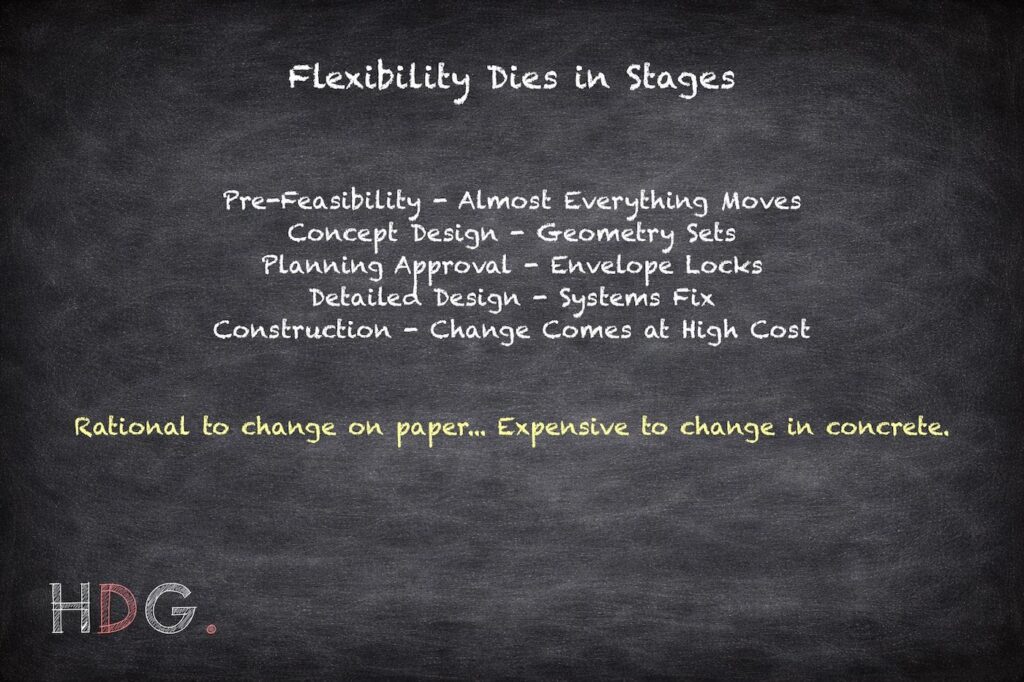
Architectural planning in hotel development should be understood as a series of decision gates: The first gate confirms density viability. The second lock’s structural geometry. The third commits envelope and height. The fourth embeds systems and coordination. The fifth tests cost reality. After that, execution begins. Each gate carries an increasing capital consequence. The discipline of hotel development lies in recognising which decisions are still flexible and which are already permanent.
Architectural planning is not a one moment in development. It is a structured progression from possibility to permanence. For hotel investors and developers, the timeline matters as much as the design itself. Understanding when geometry locks, when risk shifts, and when flexibility narrows is fundamental to protecting yield and valuation.
Architecture does not become risky when construction begins. It becomes risky when early planning decisions are made without commercial clarity. Control the timeline, and architectural planning becomes a tool for value creation. Ignore it, and the building controls you for the next fifty years.
Who Controls Architectural Planning?
Architectural planning in hotel development is collaborative in execution but singular in accountability. Many parties influence the building. The developer, architect, operator, engineers, cost consultant, and project manager all contribute to shaping the asset. However, influence is not the same as control. When control is unclear, architectural planning drifts. When accountability is diffused, structural inefficiency is embedded into the building for decades.
Hotel assets are long-duration investments. Once structural geometry is poured in concrete and steel, it cannot be argued away. For that reason, clarity of responsibility in architectural planning is not procedural; it is financial. Below is how control should be understood in disciplined hotel development.
The Developer: Commercial Authority and Final Accountability
The developer controls architectural planning because they bear capital risk.
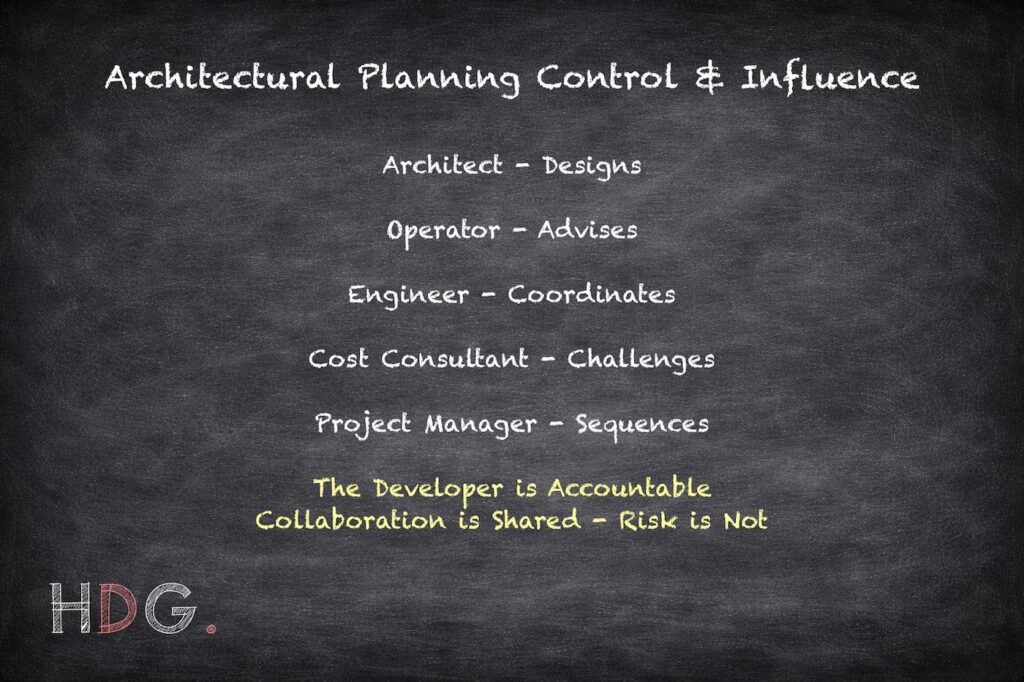
Architects design. Engineers coordinate. Operators advise. Cost consultants challenge. But only the developer bears the consequences of structural misalignment. If the grid is inefficient, if the cores are misplaced, if the building cannot adapt to future repositioning, it is the developer’s equity that absorbs the impact.
For that reason, the developer must define the commercial framework before architectural planning begins. Target key count, efficiency expectations, capital envelope, positioning, hold strategy, and exit thesis must be clear. Without this clarity, architectural planning becomes interpretative rather than disciplined.
The developer does not need to dictate design solutions. However, the developer must interrogate them. Questions about gross-to-net ratios, circulation logic, structural flexibility, and long-term adaptability are not architectural intrusions. They are capital protections.
Architectural planning succeeds when the developer leads alignment, not aesthetics.
The Architect: Spatial Translator of Commercial Intent
The architect translates commercial strategy into physical form.
Their responsibility is to convert positioning, density targets, and operational logic into a coherent structural framework. This includes establishing the structural grid, rationalising circulation, coordinating vertical cores, allocating back-of-house zones, and ensuring regulatory and life-safety requirements are integrated into the building’s geometry.
Architects do not determine the business model. They respond to it. When the commercial brief is unclear, architectural planning becomes exploratory rather than disciplined. When the commercial brief is precise, architectural planning becomes focused and efficient.
An architect’s strength lies in spatial synthesis. They balance proportion, compliance, and coordination. However, without commercial clarity, spatial elegance may conflict with economic efficiency. Architectural planning is strongest when the architect understands yield logic, efficiency ratios, and long-term asset flexibility as clearly as design composition.
The architect controls the integrity of the building’s spatial logic. The developer controls whether that logic aligns with the capital strategy.
The Operator: Operational Advisor, Not Structural Author
Hotel operators bring operational expertise. They understand housekeeping flows, service sequencing, brand standards, front-of-house expectations, and guest movement patterns. Their input is essential in refining operational efficiency.
However, operators should not control structural fundamentals unless they are embedded from the earliest concept stage. When operators are introduced late, they often request modifications that conflict with the established structural grid or core placement. By that stage, flexibility is limited. What appears to be a minor operational adjustment may require structural redesign.
The correct sequence is disciplined: commercial thesis first, structural framework second, operational refinement third. Operators advise on how the building will function day to day. They should not redefine the economic skeleton once it is set in stone. Architectural planning becomes unstable when operational preference overrides structural logic, without regard for capital consequences.
The Engineers: Technical Integrity and System Viability
Structural and MEP engineers embed safety, resilience, and systems performance into the building. The structural engineer ensures load paths, seismic performance, foundation logic, and structural economy. The mechanical and electrical engineers ensure that plant sizing, riser distribution, ventilation, energy systems, and fire strategies are technically sound and compliant.
However, engineers optimise within the architectural framework established during concept planning. If the grid is inefficient or the floor-to-floor heights are constrained, engineering complexity increases. Overly ambitious architectural gestures often translate into mechanical inefficiency or structural cost escalation.
The engineering discipline protects safety and operational viability. It does not replace commercial alignment. Architectural planning succeeds when engineering is integrated early, not layered in reactively.
The Cost Consultant: Capital Discipline Without Structural Compromise
The cost consultant introduces financial realism into architectural planning.
They test whether structural ambition aligns with budget parameters. They identify over-specification, inefficient spans, façade complexity, and unnecessary structural elaboration. In disciplined development, the cost consultant is not a late-stage critic but an early-stage calibrator.
However, cost control must be aligned with lifecycle value. Reducing ceiling heights, compressing room modules, or eliminating service redundancy may reduce capital expenditure in the short term but damage long-term adaptability and valuation.
The role of the cost consultant is not to minimise cost at any price. It is to optimise capital deployment relative to long-term asset performance. Architectural planning should reflect economic discipline, not austerity.
The Project Manager: Sequencing and Decision Gate Control
The project manager governs process integrity.
Architectural planning unfolds through stages, and each stage contains decision gates that reduce flexibility. The project manager ensures that decisions are resolved at the appropriate time and that design freezes occur before procurement and construction advance too far.
Without disciplined sequencing, architectural planning becomes reactive. Late decisions generate redesign. Redesign generates a delay. Delay generates financing pressure. Financing pressure triggers reactive value engineering.
Strong project management preserves clarity between phases and ensures that architectural planning decisions are deliberate rather than accidental.
Collaboration in Execution, Singularity in Accountability
Architectural planning involves many voices. But accountability must not be diffused. If inefficiency is blamed on the architect, the operator, the engineer, and the cost consultant simultaneously, the real issue is a lack of development leadership. Architectural planning does not fail because one consultant erred. It fails because alignment was not enforced.
The developer must ensure that:
- Commercial intent is defined before design begins.
- Structural geometry reflects density targets.
- Operator input is integrated at the correct stage.
- Engineering is coordinated early.
- Cost discipline protects value rather than undermines it.
- Architectural planning is collaborative in execution.
With accountability clarified and the decision gates understood, architectural planning returns to its technical execution. The following sections examine the structural components that define performance: density, grid logic, circulation, service infrastructure, systems integration, and regulatory discipline. Each of these elements sits within the timeline described above and under the responsibility structure defined here.
Site Constraints Define the Development Envelope
Architectural planning begins with the site. Land area does not equal buildable area. Zoning constraints, height limits, setbacks, red lines, daylight planes, and floor area ratios define the true development envelope. Investors must understand that early misinterpretation of planning constraints can permanently distort key counts and yield.
Architectural planning in this phase is analytical. The goal is to test massing, density, and circulation efficiency within the legal framework. Access points, loading positions, and utility capacities must be integrated early. A site that appears commercially attractive can become economically compromised if vertical circulation cores consume excessive footprint or if planning setbacks eliminate efficient room stacking.
Topography and geotechnical conditions also influence structural cost. Sloped sites increase foundation complexity. Seismic considerations materially affect structural design and capex allocation. Architectural planning must integrate engineering realities from day one.
Small inefficiencies in the buildable footprint multiply across floors. A minor reduction in floorplate efficiency can permanently reduce the total number of keys or distort room layouts. Architectural planning is, therefore, a density optimisation exercise grounded in regulatory compliance.
Gross-to-Net Efficiency and Revenue Logic
Architectural planning is fundamentally about efficiency. Hotels generate revenue primarily from keys and strategically programmed public areas. Corridors, oversized lobbies, and excessive back-of-house do not generate income.
The relationship between gross floor area and net revenue-producing area is one of the most critical metrics in hotel development. An inefficient building with excessive circulation may appear generous in spatial quality but will underperform financially. Over a 40–50 year lifecycle, marginal inefficiency compounds into substantial EBITDA drag.
Architectural planning must balance code compliance, guest comfort, and operational practicality while protecting net efficiency. Corridor widths, stair placement, and room stacking patterns must be optimized without compromising safety. In disciplined architectural planning, circulation is minimized but never compromised.
Developers who ignore gross-to-net ratios during early planning often attempt to correct inefficiencies later through value engineering. By then, structural decisions are already fixed. The time to protect revenue density is during architectural planning, not post-tender.
Structural Grid and Long-Term Flexibility
The structural grid is one of the most underestimated aspects of architectural planning. It determines room module flexibility, bathroom stacking logic, façade rhythm, and long-term conversion potential.
A rigid or poorly proportioned grid limits repositioning options. If two standard rooms cannot easily merge into a suite, future ADR growth potential is constrained. If the floor-to-floor height is insufficient for mechanical retrofitting, future brand upgrades become capital-intensive.
Architectural planning should therefore consider not only initial brand compliance but future adaptability. Hotels evolve. Brands change. Market segments shift. An asset that cannot adapt structurally will eventually suffer value compression.
Flexibility does not mean overbuilding. It means disciplined foresight. Structural spans should align with efficient room modules. Mechanical risers should be positioned to allow reconfiguration. Vertical load paths should anticipate future rooftop or amenity expansion where feasible.
Investors who treat structural planning as a purely engineering matter risk limiting their own strategic optionality.
Vertical Circulation and Core Discipline
Core placement is operational architecture. Elevators, stairs, and service shafts determine guest flow, housekeeping efficiency, and fire compliance.
Poorly located cores increase walking distances for staff, inflate housekeeping payroll, and complicate guest orientation. Architectural planning must separate guest circulation from service circulation wherever possible. Loading docks, service elevators, and waste management routes must function without interrupting the guest journey.
Elevator quantity and positioning should reflect peak occupancy modeling, not aesthetic symmetry. Insufficient lift capacity leads to service bottlenecks. Excess capacity increases capital cost without revenue benefit.
In architectural planning, vertical circulation is not a design flourish. It is a yield-sensitive operational mechanism embedded in the building’s DNA.
Back-of-House as Operational Infrastructure
Back-of-house space is frequently misunderstood as secondary architecture. In reality, it is operational infrastructure.
Architectural planning must allocate appropriate areas for staff facilities, storage, laundry interfaces, waste handling, and engineering rooms. Undersized back-of-house creates long-term operational strain. Oversized back-of-house inflates capital cost and reduces net efficiency.
The correct balance requires coordination between developer, operator (if appointed), and technical advisors. While interior design and specialist planning will refine these areas later, architectural planning establishes the physical envelope within which those disciplines operate.
Back-of-house inefficiency increases payroll intensity. The architectural discipline protects NOI.
Public Space Strategy and Commercial Alignment
Public space in hotel architectural planning must be commercially justified. Lobbies, restaurants, bars, meeting rooms, and wellness areas consume valuable square meters. The question is not whether they are attractive, but whether they are economically aligned.
An oversized lobby in a limited-service urban transient hotel may reduce key count and dilute returns. Conversely, an undersized arrival experience in an upper-upscale property may constrain ADR potential.
Architectural planning should reflect revenue modeling. If food and beverage is an amenity rather than a profit center, its footprint must reflect that. If meeting space demand is uncertain, flexibility and subdivision capability should be integrated.
Public space is strategic infrastructure, not decorative volume.
Integration of Building Systems
Although specialist engineers design mechanical, electrical, and plumbing systems, architectural planning must anticipate spatial requirements for these systems.
Plant rooms, risers, ceiling voids, and distribution zones must be allocated early. Insufficient coordination between structure and MEP systems often results in compromised ceiling heights, awkward bulkheads, and expensive redesign.
Hotels are energy-intensive assets. Architectural planning that ignores system integration may increase long-term energy consumption and maintenance cost. Sustainable envelope performance, façade shading, and thermal mass should be considered at the architectural level.
Operational savings over decades frequently outweigh marginal upfront savings. Architectural planning should therefore integrate lifecycle thinking rather than short-term capex minimisation.
Code Compliance and Regulatory Risk
Life-safety and accessibility compliance are non-negotiable. Architectural planning must embed regulatory discipline from inception.
Fire escape distances, compartmentation, smoke extraction strategies, and accessibility standards must be integrated structurally. Late-stage compliance adjustments often reduce key count or distort layouts.
In seismic regions, structural resilience becomes both a safety requirement and a valuation consideration. Institutional buyers increasingly scrutinize building resilience and compliance history. Architectural planning that neglects regulatory rigor introduces future liquidity risk.
Regulatory discipline is not bureaucratic overhead. It is asset protection.
Conversion Versus Ground-Up Architectural Planning
Conversion projects require a different architectural mindset. Floor-to-floor heights, column spacing, window positioning, and core alignment in existing buildings may restrict efficient hotel layouts.
Architectural planning in conversion scenarios must begin with feasibility modeling. Can bathrooms stack? Can escape routes meet code? Can vertical circulation be upgraded without destroying net efficiency? Can façade constraints limit room module optimization?
Not every building converts economically, even if acquisition cost appears attractive. Architectural planning reveals whether structural compromise will permanently dilute performance.
Ground-up projects offer greater flexibility but carry higher capital risk. In both cases, architectural planning must reconcile commercial ambition with structural reality.
Constructability and Programme Discipline
Architecture that cannot be built efficiently undermines financial feasibility.
Complex geometries, irregular façades, and non-standard structural systems increase contractor pricing and programme risk. Architectural planning must consider local contractor capability, material availability, and construction sequencing.
Phasing is particularly relevant in urban infill sites where logistics constraints affect crane positioning and material storage. Delays increase financing cost and erode projected returns.
Disciplined architectural planning balances ambition with constructability. Elegance in hotel development is often simplicity executed with precision.
Value Engineering Without Value Destruction
Value engineering is inevitable in development. However, architectural planning should protect core economic drivers.
Reducing ceiling heights, compressing room dimensions below market expectations, or eliminating service flexibility may reduce capex but damage long-term revenue potential. Architectural planning must distinguish between rational simplification and strategic compromise.
Standardisation of room modules, structural rationalisation, and façade efficiency can generate savings without eroding asset value. However, decisions that undermine functional quality or flexibility often result in valuation penalties at exit.
Architectural planning is the stage at which intelligent value engineering is embedded structurally, rather than imposed reactively.
Architecture and Exit Valuation
Institutional buyers evaluate hotels based on functional efficiency, compliance, flexibility, and lifecycle durability. Architectural planning directly influences these perceptions.
Assets with rational circulation, disciplined gross-to-net ratios, adaptable room modules, and well-integrated systems command stronger buyer confidence. Conversely, architecturally compromised hotels trade at wider cap rates due to perceived operational and capital risk.
Architecture influences liquidity. Investors should view architectural planning not as design expenditure but as valuation engineering. A disciplined building attracts disciplined capital.
What Architectural Planning Is Not
Architectural planning should not be confused with interior styling, brand concept development, or decorative execution. Those disciplines shape guest experience and brand identity. Architectural planning defines the structural and spatial framework within which those disciplines operate.
It is the asset’s economic skeleton.
The Core Principle
Architectural planning translates capital strategy into physical form. Every square metre is either revenue-generating or efficiency-diluting. Every structural choice affects flexibility. Every circulation decision influences payroll. Every compliance oversight introduces risk.
Hotel assets may operate for half a century or more. Architectural mistakes endure just as long. Disciplined architectural planning protects yield, preserves optionality, supports operational efficiency, and strengthens exit liquidity.
- Design for density.
- Design for flexibility.
- Design for durability.
- Design for value.
Further resources:
See HDG – Hotel Architectural & Design Team
See HDG – Hotel Asset Management
See LEED – “Building Design and Construction: Hospitality“